Department of Orthopedics, Section of Physical Therapy, Erasmus MC-Sophia Children's Hospital, Rotterdam, The Netherlands.
Department of Neurology, Erasmus MC-Sophia Children's Hospital, Rotterdam, The Netherlands.
Mult Scler. 2018 Jun;24(7):982-990. doi: 10.1177/1352458517706038. Epub 2017 Apr 26.
Fatigue and physical impairments are a major concern in children with multiple sclerosis (MS) and after acute disseminated encephalomyelitis (post-ADEM). We here aimed to evaluate the interaction between fatigue, exercise capacity, motor performance, neurological status, and quality of life (HRQoL).
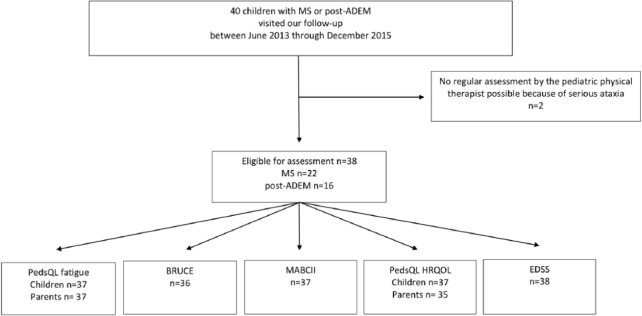
In this cross-sectional study, data of 38 children (MS n = 22, post-ADEM n = 16), aged 4-17 years attending our national pediatric MS center, were studied. Fatigue was measured with the Pediatric Quality of Life Multidimensional Fatigue Scale, exercise capacity with the Bruce Protocol, motor performance with the Movement Assessment Battery for Children second edition, HRQoL with the Pediatric Quality of Life Questionnaire, and extent of disability with the Expanded Disability Status Scale (EDSS).
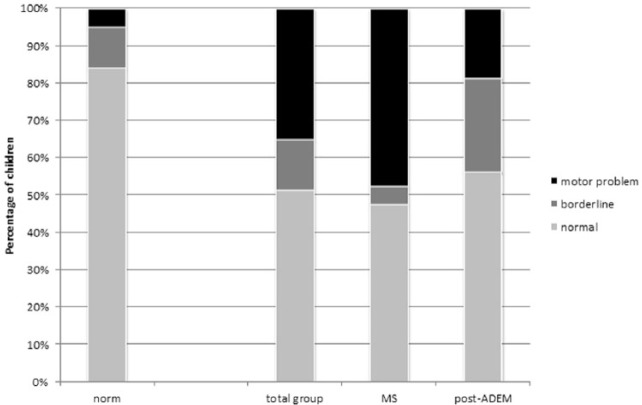
Children with MS and post-ADEM experienced more fatigue ( p < 0.001), reduced exercise capacity ( p < 0.001), and impaired motor performance ( p < 0.001), despite low scores on the EDSS. Fatigue, but not the other parameters, was significantly correlated with HRQoL. Fatigue was not correlated with exercise capacity.
We confirm the major impact of fatigue on quality of life in children with MS and post-ADEM. Fatigue was not explained by reduced exercise capacity or impaired motor performance. An important finding for clinical practice is that the low EDSS score did not reflect the poor physical functioning.
疲劳和身体损伤是多发性硬化症(MS)和急性播散性脑脊髓炎(ADEM)后儿童的主要关注点。我们旨在评估疲劳、运动能力、运动表现、神经状态和生活质量(HRQoL)之间的相互作用。
在这项横断面研究中,研究了 38 名年龄在 4-17 岁的儿童的数据,他们都在我们国家儿科 MS 中心就诊,包括 22 名 MS 患儿和 16 名 ADEM 后患儿。疲劳用儿童生活质量多维疲劳量表进行评估,运动能力用 Bruce 方案进行评估,运动表现用儿童运动评估电池第二版进行评估,HRQoL 用儿童生活质量问卷进行评估,残疾程度用扩展残疾状况量表(EDSS)进行评估。
MS 患儿和 ADEM 后患儿经历了更多的疲劳(p < 0.001)、运动能力降低(p < 0.001)和运动表现受损(p < 0.001),尽管 EDSS 得分较低。疲劳,但不是其他参数,与 HRQoL 显著相关。疲劳与运动能力无关。
我们证实了疲劳对 MS 和 ADEM 后儿童生活质量的重大影响。疲劳不能用运动能力降低或运动表现受损来解释。对临床实践的一个重要发现是,低 EDSS 评分并不能反映身体功能不佳。