Prunier Chloé, Prudent Renaud, Kapur Reuben, Sadoul Karin, Lafanechère Laurence
Institute for Advanced Biosciences, INSERM, CNRS UMR, Université Grenoble Alpes, Grenoble, France.
Department of Molecular Cell Biology, Leiden University Medical Center, Leiden, The Netherlands.
Oncotarget. 2017 Jun 20;8(25):41749-41763. doi: 10.18632/oncotarget.16978.
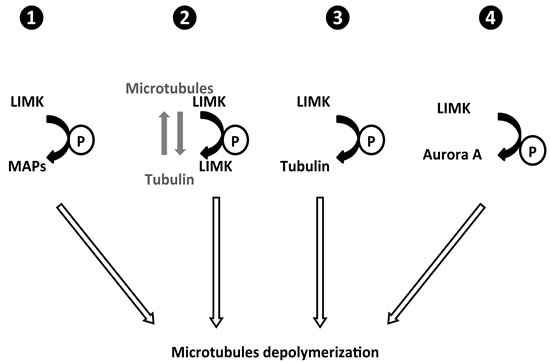
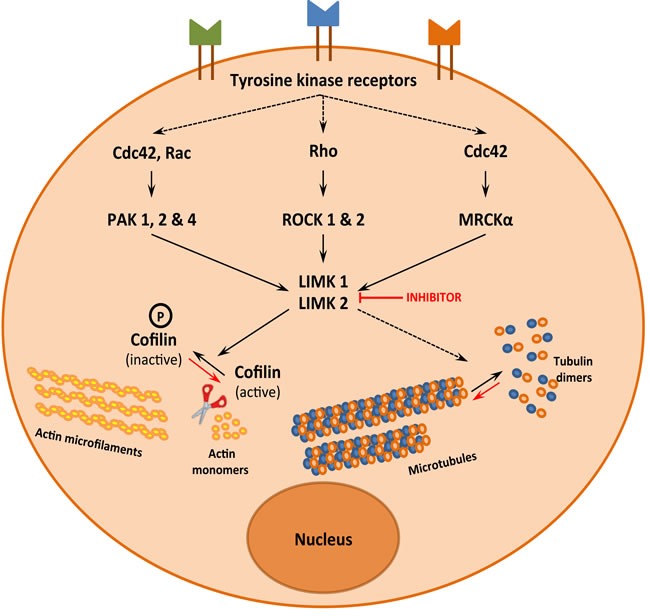
LIM kinases are common downstream effectors of several signalization pathways and function as a signaling node that controls cytoskeleton dynamics through the phosphorylation of the cofilin family proteins. These last 10 years, several reports indicate that the functions of LIM kinases are more extended than initially described and, specifically, that LIM kinases also control microtubule dynamics, independently of their regulation of actin microfilament. In this review we analyze the data supporting these conclusions and the possible mechanisms that could be involved in the control of microtubules by LIM kinases. The demonstration that LIM kinases also control microtubule dynamics has pointed to new therapeutic opportunities. Consistently, several new LIM kinase inhibitors have been recently developed. We provide a comprehensive comparison of these inhibitors, of their chemical structure, their specificity, their cellular effects as well as their effects in animal models of various diseases including cancer.
LIM激酶是几种信号通路常见的下游效应器,作为一个信号节点,通过对丝切蛋白家族蛋白的磷酸化作用来控制细胞骨架动力学。在过去十年中,多项报告表明,LIM激酶的功能比最初描述的更为广泛,具体而言,LIM激酶还能独立于其对肌动蛋白微丝的调节来控制微管动力学。在这篇综述中,我们分析了支持这些结论的数据以及LIM激酶控制微管可能涉及的机制。LIM激酶也能控制微管动力学这一发现带来了新的治疗机会。相应地,最近已开发出几种新型LIM激酶抑制剂。我们全面比较了这些抑制剂,包括它们的化学结构、特异性、细胞效应以及在包括癌症在内的各种疾病动物模型中的效应。