Miller Benjamin, Hamilton Karyn, Boushel Robert, Williamson Katherine, Laner Verena, Gnaiger Erich, Davis Michael
Department of Health and Exercise Science, Colorado State University, Fort Collins, CO, United States of America.
School of Kinesiology, University of British Columbia, Vancouver, British Columbia, Canada.
PLoS One. 2017 Apr 26;12(4):e0174874. doi: 10.1371/journal.pone.0174874. eCollection 2017.
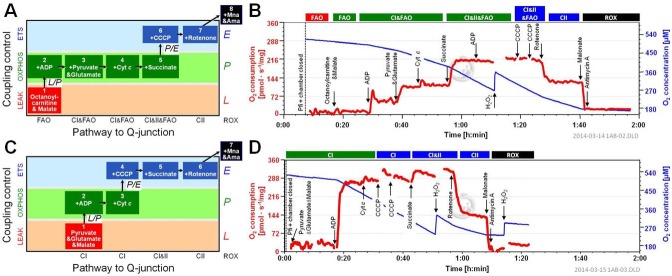
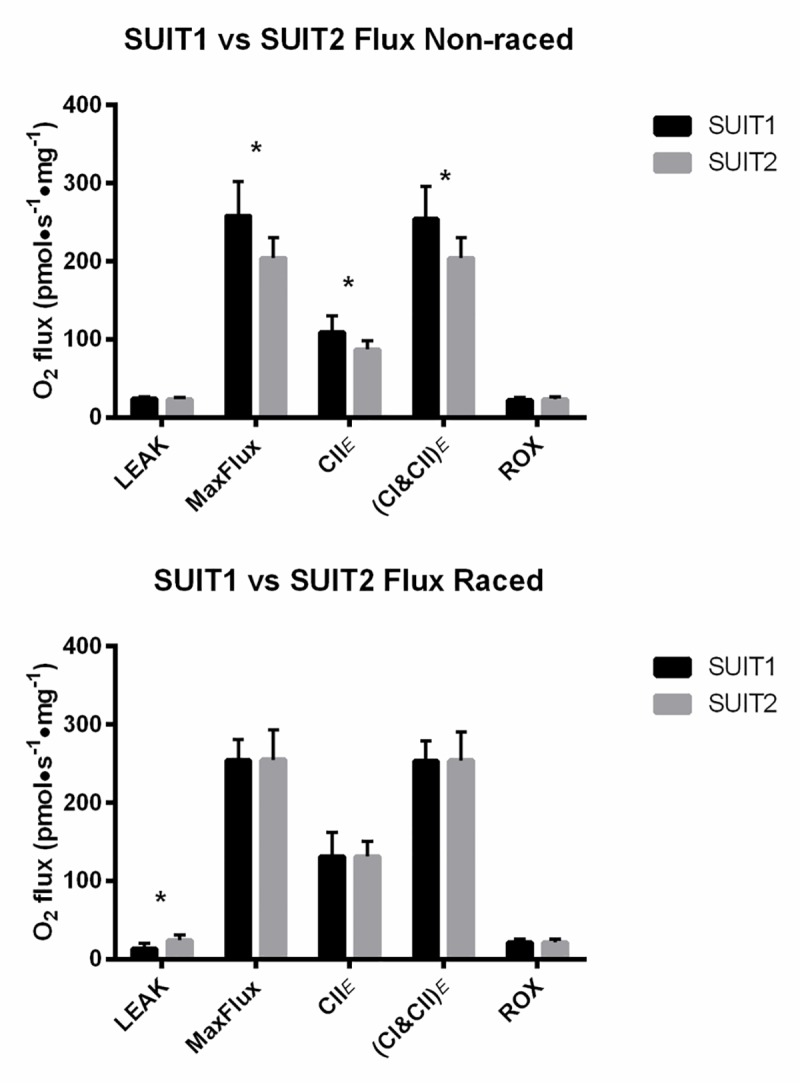
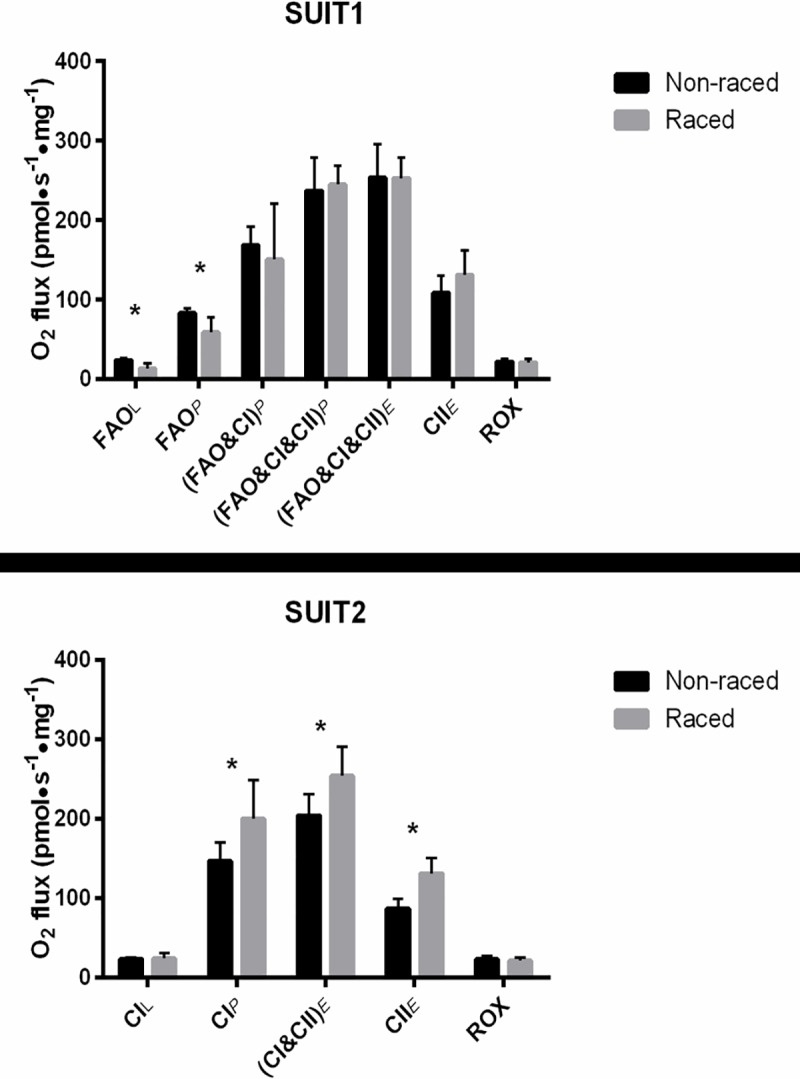
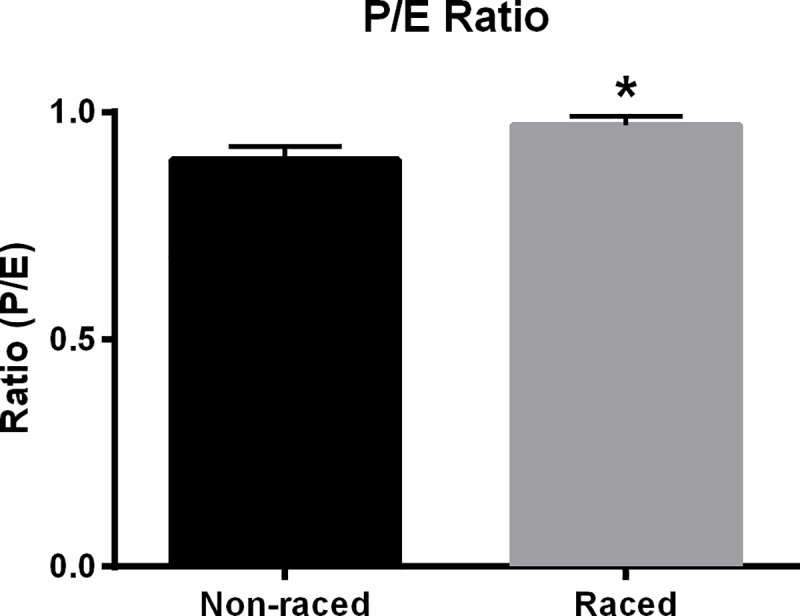
At the annual Iditarod Race, Alaskan Huskies repeatedly run for up to 8 hours at 16 km/h to complete 1600 km. We previously demonstrated high rates of mitochondrial protein synthesis in Alaskan Huskies, which we suspected allowed rapid remodeling of mitochondrial proteins in response to energetic stress. The purpose of this study was to examine mitochondrial respiration in permeabilized skeletal muscle fibers of Alaskan Huskies in the offseason (Non-raced) and following the 1600 km Iditarod Sled Dog Race (Raced). We hypothesized that compared to Non-raced Huskies, raced Huskies that completed a 1600 km race would have greater mitochondrial respiratory capacities, and improvements in capacities of oxidative phosphorylation (OXPHOS) based on NADH-generating substrates as compared to fatty acids. Using high-resolution respirometry (HRR) we investigated the respiration of permeabilized muscle fibers from Alaskan Huskies. Maximum capacities were 254±26 pmol.s-1.mg-1 for OXPHOS (coupled, P) and 254±37 pmol.s-1.mg-1 for the electron transfer system (ETS; non-coupled, E). After racing respiratory capacities from NADH-linked substrates, but not fat-derived substrates increased. Finally, the OXPHOS to ETS capacity ratio (P/E) increased after racing from 0.90±0.03 to 0.97±0.02. From our previous studies and the current study, we conclude that Alaskan Huskies maintain high mitochondrial protein turnover to facilitate rapid adaptation to environmental extremes and energetic challenges.
在每年的艾迪塔罗德狗拉雪橇比赛中,阿拉斯加哈士奇犬要以每小时16公里的速度反复奔跑长达8小时,以完成1600公里的赛程。我们之前证明了阿拉斯加哈士奇犬的线粒体蛋白质合成速率很高,我们怀疑这使得线粒体蛋白质能够快速重塑以应对能量应激。本研究的目的是检测阿拉斯加哈士奇犬在非比赛季(未参赛)以及完成1600公里艾迪塔罗德雪橇犬比赛后(参赛),其透化骨骼肌纤维中的线粒体呼吸情况。我们假设,与未参赛的哈士奇犬相比,完成1600公里比赛的参赛哈士奇犬将具有更大的线粒体呼吸能力,并且与脂肪酸相比,基于生成NADH的底物,其氧化磷酸化(OXPHOS)能力会有所提高。我们使用高分辨率呼吸测定法(HRR)研究了阿拉斯加哈士奇犬透化肌纤维的呼吸情况。OXPHOS(偶联,P)的最大能力为254±26 pmol·s⁻¹·mg⁻¹,电子传递系统(ETS;非偶联,E)的最大能力为254±37 pmol·s⁻¹·mg⁻¹。比赛后,来自与NADH相关底物的呼吸能力增加,但来自脂肪衍生底物的呼吸能力未增加。最后,比赛后OXPHOS与ETS能力比(P/E)从0.90±0.03增加到0.97±0.02。根据我们之前的研究和当前的研究,我们得出结论,阿拉斯加哈士奇犬保持高线粒体蛋白质周转率,以促进对极端环境和能量挑战的快速适应。