Jentho Elisa, Bodden Malena, Schulz Christine, Jung Anna-Lena, Seidel Kerstin, Schmeck Bernd, Bertrams Wilhelm
Institute for Lung Research/iLung, German Center for Lung Research, Universities of Giessen and Marburg Lung Center, Philipps-University Marburg, Marburg, Germany.
Department of Medicine, Pulmonary and Critical Care Medicine, University Medical Center Marburg, Philipps-University Marburg, Marburg, Germany.
PLoS One. 2017 Apr 26;12(4):e0176204. doi: 10.1371/journal.pone.0176204. eCollection 2017.
Legionella pneumophila (L. pneumophila) is a causative agent of severe pneumonia. It is highly adapted to intracellular replication and manipulates host cell functions like vesicle trafficking and mRNA translation to its own advantage. However, it is still unknown to what extent microRNAs (miRNAs) are involved in the Legionella-host cell interaction.
WT and MyD88-/- murine bone marrow-derived macrophages (BMM) were infected with L. pneumophila, the transcriptome was analyzed by high throughput qPCR array (microRNAs) and conventional qPCR (mRNAs), and mRNA-miRNA interaction was validated by luciferase assays with 3´-UTR mutations and western blot.
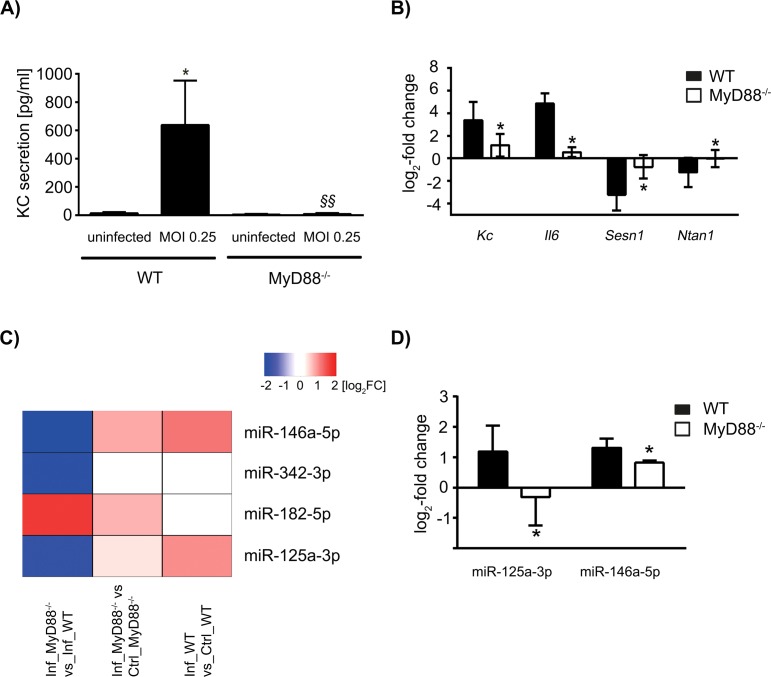
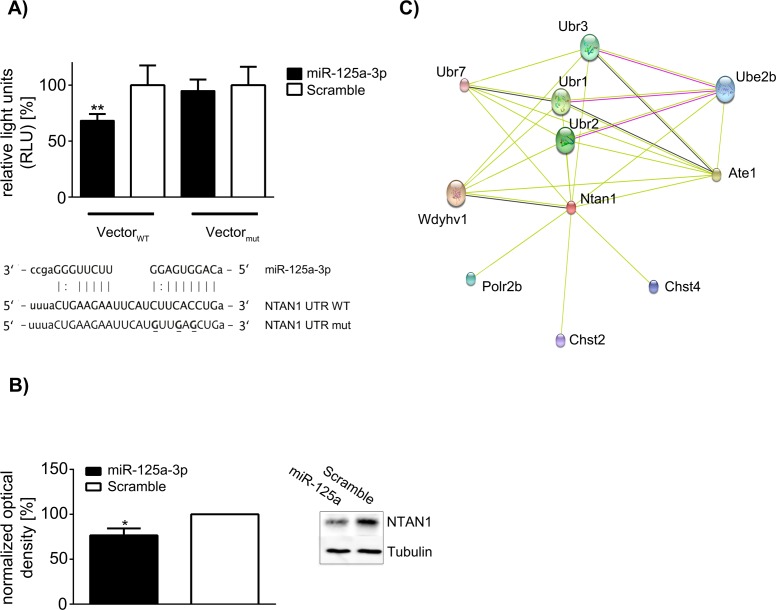
L. pneumophila infection caused a pro-inflammatory reaction and significant miRNA changes in murine macrophages. In MyD88-/- cells, induction of inflammatory markers, such as Ccxl1/Kc, Il6 and miR-146a-5p was reduced. Induction of miR-125a-3p was completely abrogated in MyD88-/- cells. Target prediction analyses revealed N-terminal asparagine amidase 1 (NTAN1), a factor from the n-end rule pathway, to be a putative target of miR-125a-3p. This interaction could be confirmed by luciferase assay and western blot.
Taken together, we characterized the miRNA regulation in L. pneumophila infection with regard to MyD88 signaling and identified NTAN1 as a target of miR-125a-3p. This finding unravels a yet unknown feature of Legionella-host cell interaction, potentially relevant for new treatment options.
嗜肺军团菌是重症肺炎的病原体。它高度适应细胞内复制,并操纵宿主细胞功能,如囊泡运输和mRNA翻译,以利于自身。然而,尚不清楚微小RNA(miRNA)在多大程度上参与军团菌与宿主细胞的相互作用。
用嗜肺军团菌感染野生型和MyD88基因敲除的小鼠骨髓来源巨噬细胞(BMM),通过高通量qPCR芯片(miRNA)和传统qPCR(mRNA)分析转录组,并通过3'-UTR突变的荧光素酶测定和蛋白质印迹验证mRNA-miRNA相互作用。
嗜肺军团菌感染在小鼠巨噬细胞中引起促炎反应和显著的miRNA变化。在MyD88基因敲除的细胞中,炎症标志物如Ccxl1/Kc、Il6和miR-146a-5p的诱导减少。MyD88基因敲除的细胞中miR-125a-3p的诱导完全消除。靶标预测分析显示,N端规则途径中的一个因子N端天冬酰胺酶1(NTAN1)是miR-125a-3p的一个假定靶标。这种相互作用可以通过荧光素酶测定和蛋白质印迹得到证实。
综上所述,我们表征了嗜肺军团菌感染中与MyD88信号传导相关的miRNA调控,并确定NTAN1是miR-125a-3p的靶标。这一发现揭示了军团菌与宿主细胞相互作用中一个未知的特征,可能与新的治疗选择相关。