Choy Cecilia, Ansari Khairul I, Neman Josh, Hsu Sarah, Duenas Matthew J, Li Hubert, Vaidehi Nagarajan, Jandial Rahul
Division of Neurosurgery, Beckman Research Institute, City of Hope, 1500 E. Duarte Rd, Duarte, CA, 91010, USA.
Irell & Manella Graduate School of Biological Sciences, City of Hope, Duarte, CA, 91010, USA.
Breast Cancer Res. 2017 Apr 26;19(1):51. doi: 10.1186/s13058-017-0844-3.
Patients with primary breast cancer that is positive for human epidermal growth factor receptor 2 (Her2+) have a high risk of developing metastases in the brain. Despite gains with systemic control of Her2+ disease using molecular therapies, brain metastases remain recalcitrant to therapeutic discovery. The clinical predilection of Her2+ breast cancer cells to colonize the brain likely relies on paracrine mechanisms. The neural niche poses unique selection pressures, and neoplastic cells that utilize the brain microenvironment may have a survival advantage.
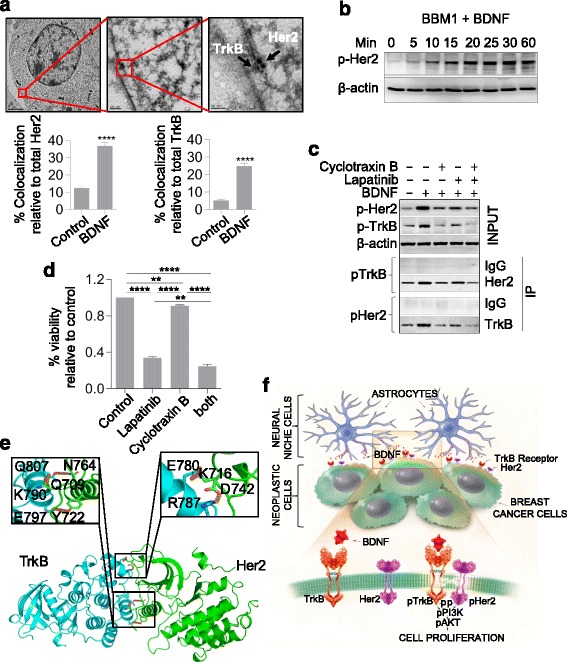
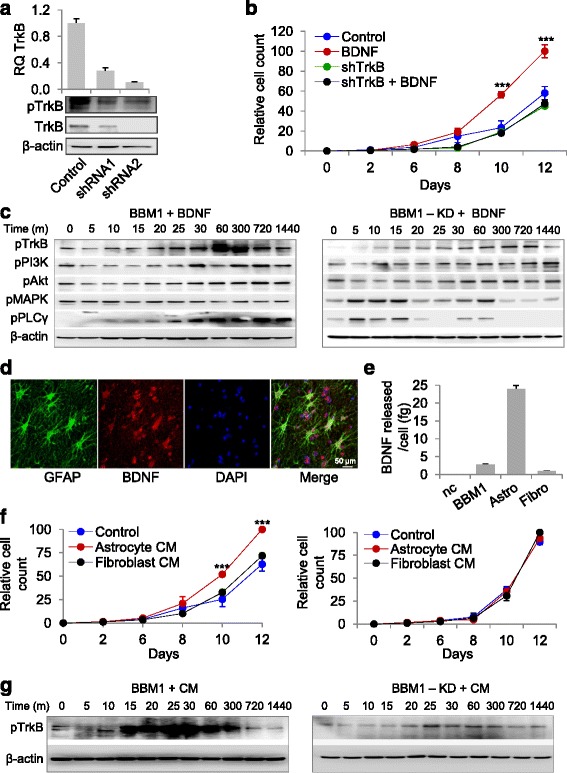
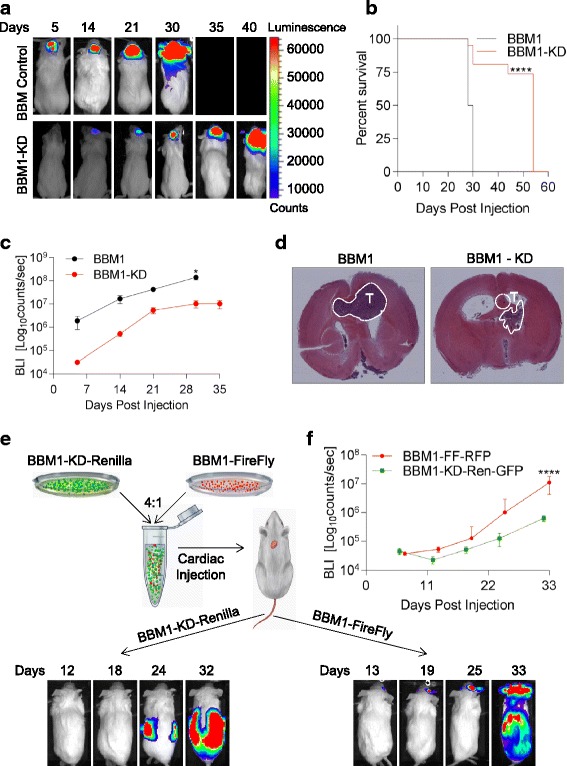
Tropomyosin-related kinase B (TrkB), Her2, and downstream targets were analyzed in primary breast cancer, breast-to-brain metastasis (BBM) tissues, and tumor-derived cell lines using quantitative real-time PCR, western blot, and immunohistochemical assessment. TrkB function on BBM was confirmed with intracranial, intracardiac, or mammary fat pad xenografts in non-obese diabetic/severe combined immunodeficiency mice. The function of brain-derived neurotrophic factor (BDNF) on cell proliferation and TrkB/Her2 signaling and interactions were confirmed using selective shRNA knockdown and selective inhibitors. The physical interaction of Her2-TrkB was analyzed using electron microscopy, co-immunoprecipitation, and in silico analysis. Dual targeting of Her2 and TrkB was analyzed using clinically utilized treatments.
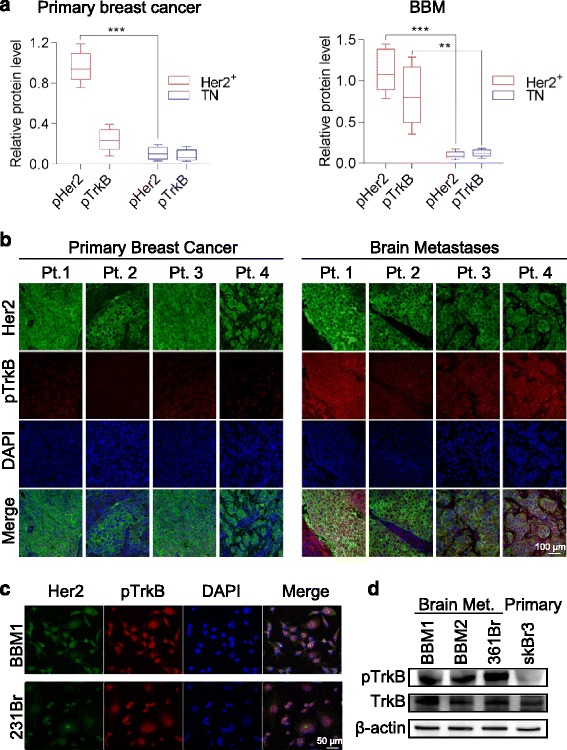
We observed that patient tissues and cell lines derived from Her2+ human BBM displayed increased activation of TrkB, a neurotrophin receptor. BDNF, an extracellular neurotrophin, with roles in neuronal maturation and homeostasis, specifically binds to TrkB. TrkB knockdown in breast cancer cells led to decreased frequency and growth of brain metastasis in animal models, suggesting that circulating breast cancer cells entering the brain may take advantage of paracrine BDNF-TrkB signaling for colonization. In addition, we investigated a possible interaction between TrkB and Her2 receptors on brain metastatic breast cancer cells, and found that BDNF phosphorylated both its cognate TrkB receptor and the Her2 receptor in brain metastatic breast cancer cells.
Collectively, our findings suggest that heterodimerization of Her2 and TrkB receptors gives breast cancer cells a survival advantage in the brain and that dual inhibition of these receptors may hold therapeutic potential.
人表皮生长因子受体2呈阳性(Her2+)的原发性乳腺癌患者发生脑转移的风险很高。尽管使用分子疗法在系统性控制Her2+疾病方面取得了进展,但脑转移对治疗发现仍然具有抗性。Her2+乳腺癌细胞在脑内定植的临床倾向可能依赖于旁分泌机制。神经微环境施加独特的选择压力,利用脑微环境的肿瘤细胞可能具有生存优势。
使用定量实时PCR、蛋白质免疫印迹和免疫组织化学评估,对原发性乳腺癌、乳腺至脑转移(BBM)组织和肿瘤衍生细胞系中的原肌球蛋白相关激酶B(TrkB)、Her2及其下游靶点进行分析。通过在非肥胖糖尿病/严重联合免疫缺陷小鼠中进行颅内、心内或乳腺脂肪垫异种移植,证实了TrkB在BBM中的功能。使用选择性短发夹RNA敲低和选择性抑制剂,证实了脑源性神经营养因子(BDNF)对细胞增殖以及TrkB/Her2信号传导和相互作用的功能。使用电子显微镜、免疫共沉淀和计算机分析,分析了Her2-TrkB的物理相互作用。使用临床应用的治疗方法,分析了Her2和TrkB的双重靶向作用。
我们观察到,源自Her2+人类BBM的患者组织和细胞系显示出神经生长因子受体TrkB的激活增加。BDNF是一种细胞外神经营养因子,在神经元成熟和体内平衡中起作用,特异性结合TrkB。乳腺癌细胞中的TrkB敲低导致动物模型中脑转移的频率和生长降低,这表明进入脑内的循环乳腺癌细胞可能利用旁分泌BDNF-TrkB信号进行定植。此外,我们研究了脑转移性乳腺癌细胞上TrkB和Her2受体之间可能的相互作用,发现BDNF使脑转移性乳腺癌细胞中的同源TrkB受体和Her2受体均磷酸化。
总体而言,我们的研究结果表明,Her2和TrkB受体的异二聚化赋予乳腺癌细胞在脑内的生存优势,对这些受体的双重抑制可能具有治疗潜力。