García-Patiño María Guadalupe, García-Contreras Rodolfo, Licona-Limón Paula
Departamento de Biología Celular y del Desarrollo, Instituto de Fisiología Celular, Universidad Nacional Autónoma de México, Ciudad de México, Mexico.
Facultad de Medicina, Departamento de Microbiología y Parasitología, Universidad Nacional Autónoma de México, Ciudad de México, Mexico.
Front Immunol. 2017 Apr 12;8:441. doi: 10.3389/fimmu.2017.00441. eCollection 2017.
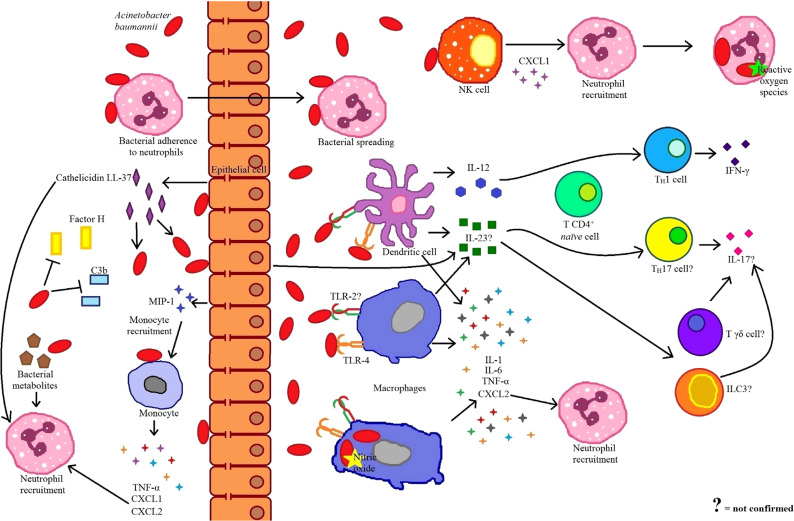
is the etiologic agent of a wide range of nosocomial infections, including pneumonia, bacteremia, and skin infections. Over the last 45 years, an alarming increase in the antibiotic resistance of this opportunistic microorganism has been reported, a situation that hinders effective treatments. In order to develop effective therapies against it is crucial to understand the basis of host-bacterium interactions, especially those concerning the immune response of the host. Different innate immune cells such as monocytes, macrophages, dendritic cells, and natural killer cells have been identified as important effectors in the defense against ; among them, neutrophils represent a key immune cell indispensable for the control of the infection. Several immune strategies to combat have been identified such as recognition of the bacteria by immune cells through pattern recognition receptors, specifically toll-like receptors, which trigger bactericidal mechanisms including oxidative burst and cytokine and chemokine production to amplify the immune response against the pathogen. However, a complete picture of the protective immune strategies activated by this bacteria and its potential therapeutic use remains to be determined and explored.
是多种医院感染的病原体,包括肺炎、菌血症和皮肤感染。在过去45年里,有报道称这种机会性微生物的抗生素耐药性惊人地增加,这种情况阻碍了有效治疗。为了开发针对它的有效疗法,了解宿主与细菌相互作用的基础至关重要,尤其是那些与宿主免疫反应有关的相互作用。不同的固有免疫细胞,如单核细胞、巨噬细胞、树突状细胞和自然杀伤细胞,已被确定为抵御的重要效应细胞;其中,中性粒细胞是控制感染不可或缺的关键免疫细胞。已经确定了几种对抗的免疫策略,例如免疫细胞通过模式识别受体,特别是Toll样受体识别细菌,这些受体触发杀菌机制,包括氧化爆发以及细胞因子和趋化因子的产生,以放大针对病原体的免疫反应。然而,这种细菌激活的保护性免疫策略及其潜在治疗用途的全貌仍有待确定和探索。