Yi Qin, Xu Hao, Yang Ke, Wang Yue, Tan Bin, Tian Jie, Zhu Jing
Department of Pediatric Research Institute, Children's Hospital of Chongqing Medical University, Chongqing 400014, P.R. China.
Cardiovascular Department (Internal Medicine), Children's Hospital of Chongqing Medical University, Chongqing 400014, P.R. China.
Mol Med Rep. 2017 May;15(5):2511-2520. doi: 10.3892/mmr.2017.6343. Epub 2017 Mar 16.
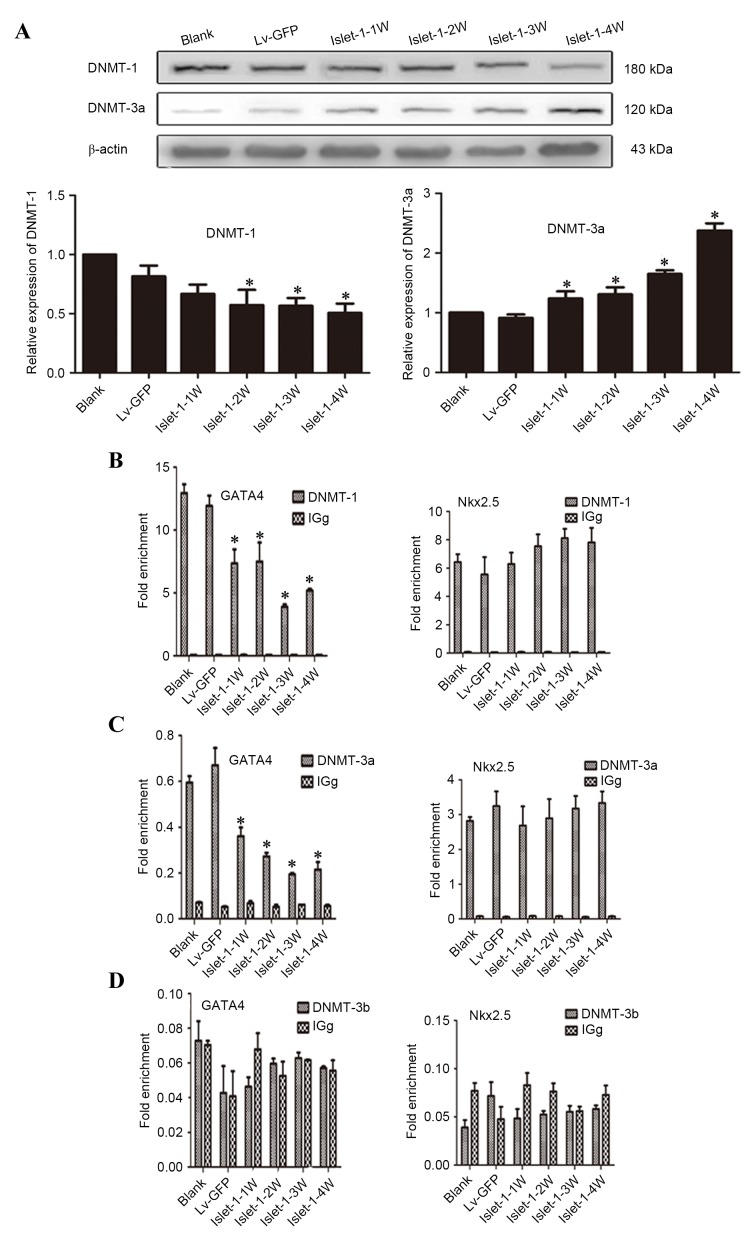
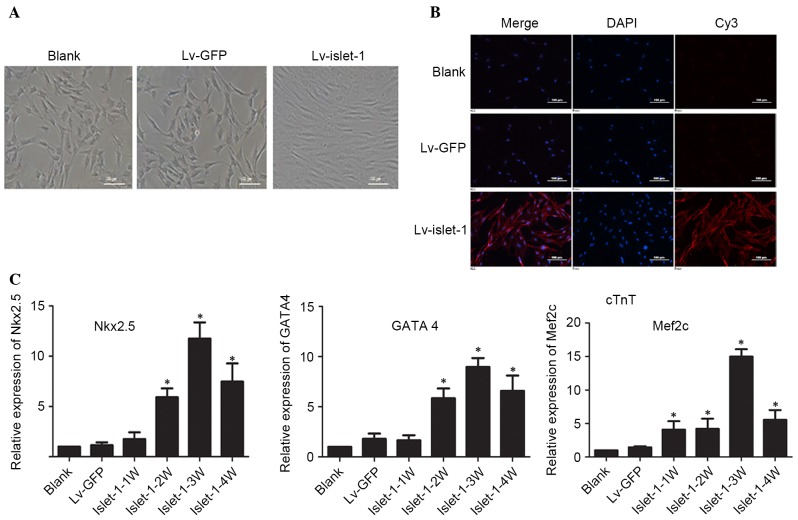
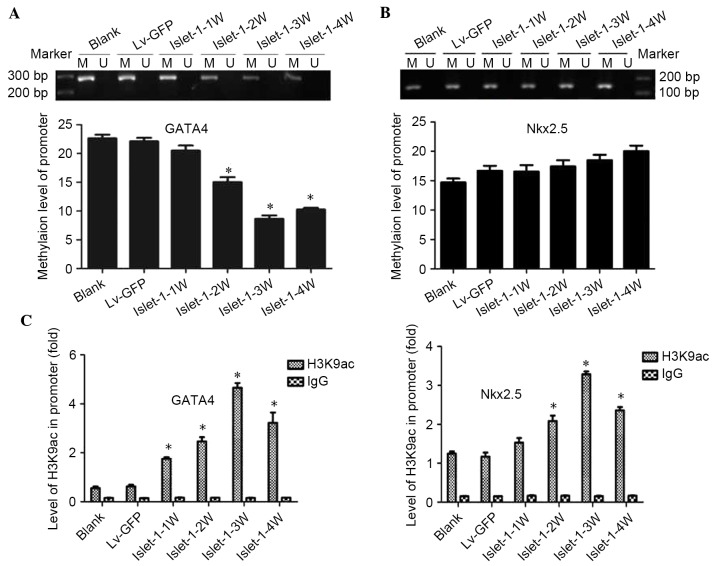
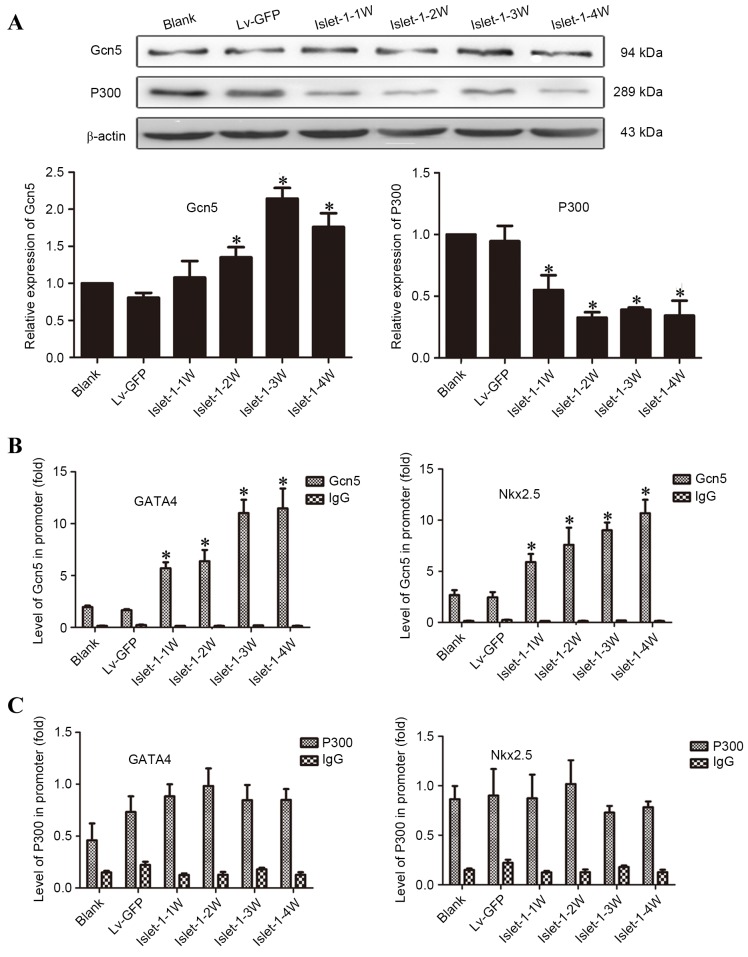
Previous studies from this group demonstrated that insulin gene enhancer binding protein ISL-1 (Islet-1) specifically induces the differentiation of mesenchymal stem cells (MSCs) into cardiomyocyte‑like cells through histone acetylation. However, the underlying mechanisms remain unclear. In the present study, the role of the histone acetylation and DNA methylation on the regulatory mechanism of the Islet‑1 was further investigated by methylation‑specific polymerase chain reaction (PCR), chromatin immunoprecipitation quantitative PCR and western blot analysis. The results demonstrated that Islet‑1 upregulated expression of general control of amino acid biosynthesis protein 5 (Gcn5) and enhanced the binding of Gcn5 to the promoters of GATA binding protein 4 (GATA4) and NK2 homeobox 5 (Nkx2.5). In addition, Islet-1 downregulated DNA methyltransferase (DNMT)‑1 expression and reduced its binding to the GATA4 promoter. In contrast, the amount of DNMT-1 binding on Nkx2.5 did not match the expression trend. Therefore, it was concluded that Islet‑1 may influence the histone acetylation and DNA methylation of GATA4 promoter region via Gcn5 and DNMT‑1 during the MSC differentiation into cardiomyocyte-like cells, thus prompting the expression of GATA4. The Nkx2.5 was likely only affected by histone acetylation instead of DNA methylation. The present study demonstrated that Islet‑1 induces the differentiation of mesenchymal stem cells into cardiomyocyte‑like cells through a specific interaction between histone acetylation and DNA methylation on regulating GATA4.
该研究团队之前的研究表明,胰岛素基因增强子结合蛋白ISL-1(胰岛-1)通过组蛋白乙酰化特异性诱导间充质干细胞(MSC)分化为心肌样细胞。然而,其潜在机制仍不清楚。在本研究中,通过甲基化特异性聚合酶链反应(PCR)、染色质免疫沉淀定量PCR和蛋白质印迹分析,进一步研究了组蛋白乙酰化和DNA甲基化在胰岛-1调控机制中的作用。结果表明,胰岛-1上调了氨基酸生物合成蛋白5(Gcn5)的表达,并增强了Gcn5与GATA结合蛋白4(GATA4)和NK2同源盒5(Nkx2.5)启动子的结合。此外,胰岛-1下调了DNA甲基转移酶(DNMT)-1的表达,并减少了其与GATA4启动子的结合。相反,DNMT-1与Nkx2.5的结合量与表达趋势不匹配。因此,得出结论,在MSC分化为心肌样细胞的过程中,胰岛-1可能通过Gcn5和DNMT-1影响GATA4启动子区域的组蛋白乙酰化和DNA甲基化,从而促进GATA4的表达。Nkx2.5可能仅受组蛋白乙酰化影响,而非DNA甲基化。本研究表明,胰岛-1通过组蛋白乙酰化和DNA甲基化在调节GATA4上的特异性相互作用,诱导间充质干细胞分化为心肌样细胞。