Lu Zhiyan, Xiao Youzhang, Liu Xing, Zhang Zaipeng, Xiao Feng, Bi Yongyi
Department of Radiology, Zhongnan Hospital of Wuhan University, Wuhan, Hubei 430071, P.R. China.
Key Laboratory of Pharmaceutical Biotechnology, School of Medicine, Jinggangshan University, Ji'an, Jiangxi 343000, P.R. China.
Mol Med Rep. 2017 May;15(5):2415-2422. doi: 10.3892/mmr.2017.6331. Epub 2017 Mar 16.
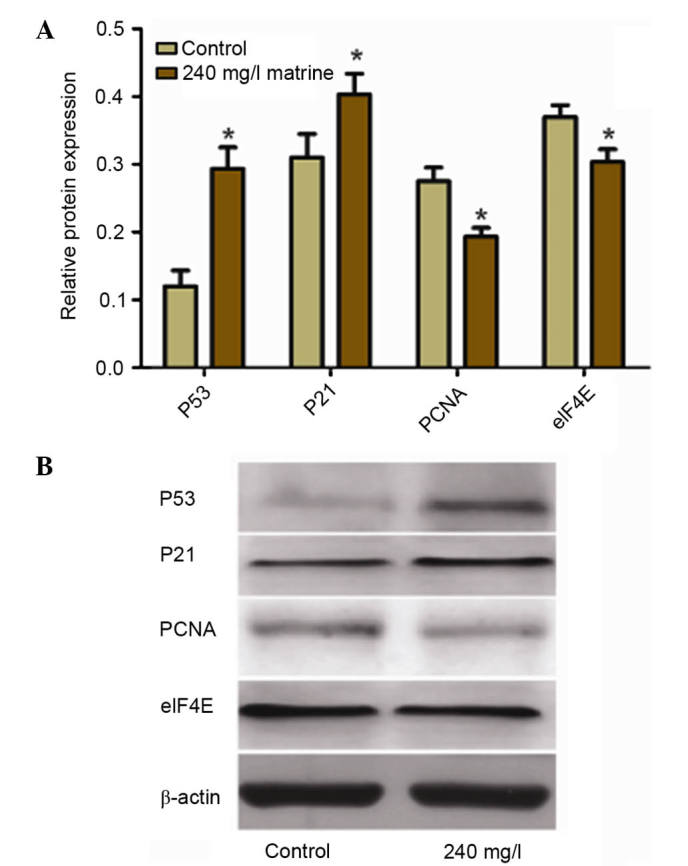
The aim of the present study was to investigate how matrine affects the proliferation of A549 human lung adenocarcinoma cells via the p53/p21/proliferating cell nuclear antigen (PCNA)/eukaryotic translation initiation factor 4E (eIF4E) signaling pathway. The effect of different concentrations of matrine on the proliferation of A549 cells was investigated using a 3‑(4,5‑dimethylthiazol‑2‑yl)‑2,5‑diphenyltetrazolium bromide (MTT) assay. The migration of A549 cells following exposure to varied concentrations of matrine was detected using a Transwell cell migration assay. The effect of 240 mg/l matrine on the apoptotic rate of A549 cells was determined using flow cytometry. The change in the mRNA and protein expression levels of p53, p21, PCNA and eIF4E following exposure to matrine were detected using reverse transcription‑quantitative polymerase chain reaction and western blotting, respectively. The increase of matrine from 60‑240 mg/l led to reduced cell migration and inhibition of A549 cell proliferation. The apoptotic rate of A549 cells when treated with 240 mg/l matrine was significantly different when compared with the untreated control. The mRNA expression levels of p53 and p21 in the group treated with 240 mg/l matrine were significantly higher compared with the control group. The mRNA expression levels of PCNA and eIF4E were significantly lower in the 240 mg/l matrine‑treated group compared with the control. The protein expression levels of p53 and p21 were significantly higher in the 240 mg/l matrine group compared with the control group. Treatment with 240 mg/l matrine reduced the protein expression levels of PCNA and eIF4E. Matrine also reduced the migration ability of A549 cells and inhibited their proliferation, which may be associated with the overexpression of p53 and p21, and the reduction of PCNA and eIF4E expression levels.
本研究的目的是探讨苦参碱如何通过p53/p21/增殖细胞核抗原(PCNA)/真核生物翻译起始因子4E(eIF4E)信号通路影响A549人肺腺癌细胞的增殖。使用3-(4,5-二甲基噻唑-2-基)-2,5-二苯基四氮唑溴盐(MTT)法研究不同浓度苦参碱对A549细胞增殖的影响。使用Transwell细胞迁移试验检测暴露于不同浓度苦参碱后A549细胞的迁移情况。使用流式细胞术测定240mg/l苦参碱对A549细胞凋亡率的影响。分别使用逆转录-定量聚合酶链反应和蛋白质免疫印迹法检测暴露于苦参碱后p53、p21、PCNA和eIF4E的mRNA和蛋白质表达水平的变化。苦参碱浓度从60-240mg/l增加导致细胞迁移减少和A549细胞增殖受到抑制。与未处理的对照组相比,用240mg/l苦参碱处理时A549细胞的凋亡率有显著差异。与对照组相比,用240mg/l苦参碱处理组中p53和p21的mRNA表达水平显著更高。与对照组相比,240mg/l苦参碱处理组中PCNA和eIF4E的mRNA表达水平显著更低。与对照组相比,240mg/l苦参碱组中p53和p21的蛋白质表达水平显著更高。用240mg/l苦参碱处理降低了PCNA和eIF4E的蛋白质表达水平。苦参碱还降低了A549细胞的迁移能力并抑制其增殖,这可能与p53和p21的过表达以及PCNA和eIF4E表达水平的降低有关。