Danuser Brigitta, Simcox Amira, Studer Regina, Koller Michael, Wild Pascal
Institut Universitaire Romand de Santé au Travail (Institute for Work and Health), University of Lausanne and University of Geneva, Epalinges - Lausanne, Switzerland.
Basel Institute for Clinical Epidemiology and Biostatistics, University Hospital Basel, Basel, Switzerland.
PLoS One. 2017 Apr 27;12(4):e0175161. doi: 10.1371/journal.pone.0175161. eCollection 2017.
Return to work with or after a chronic disease is a dynamic process influenced by a variety of interactions between personal, work, societal and medical resources or constraints. The aim of this study was to identify predictors for employment 12 months after transplantation in kidney patients, applying a bio-psycho-social model.
All kidney patients followed in the Swiss Transplant Cohort between May 2008 and December 2012, aged 18 to 65 were assessed before, 6 and 12 months after transplantation.
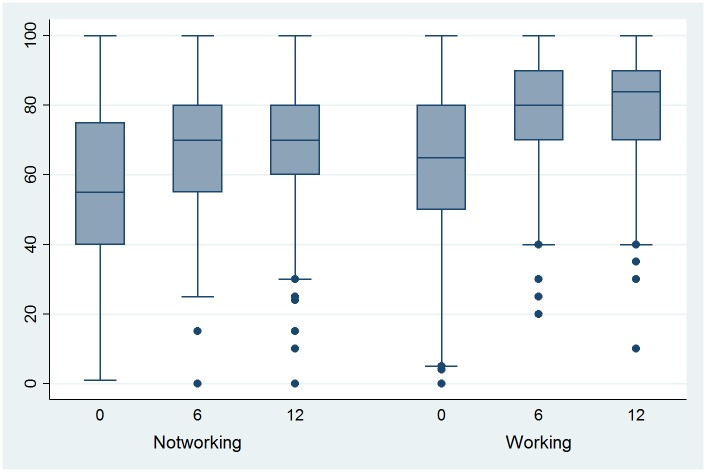
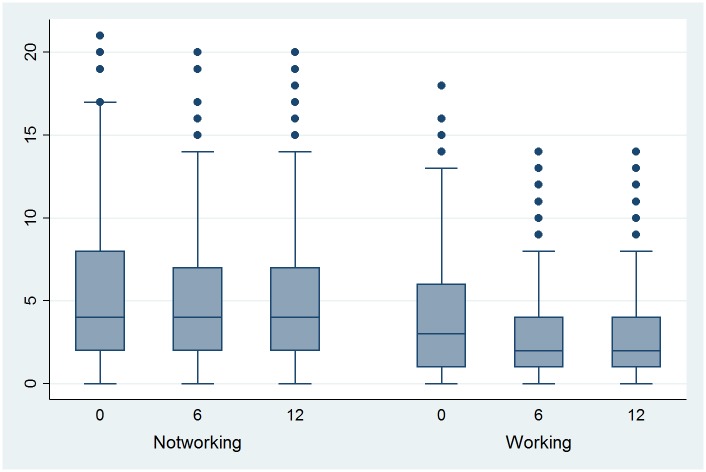
Of the 689 included patients, 56.2% worked 12 months post- transplantation compared to 58.9% pre-transplantation. Age, education, self-perceived health (6 months post- transplantation), pre- transplantation employment and receiving an organ from a living donor are significant predictors of employment post- transplantation. Moreover, while self-perceived health increased post- transplantation, depression score decreased only among those employed 12 months post- transplantation. Pre- transplantation employment status was the main predictor for post- transplantation employment (OR = 18.6) and was associated with sex, age, education, depression and duration of dialysis. An organ from a living donor (42.1%) was more frequent in younger patients, with higher education, no diabetes and shorter waiting time to surgery.
Transplantation did not increase employment in end-stage kidney disease patients but helped maintaining employment. Pre-transplantation employment has been confirmed to be the most important predictor of post-transplantation employment. Furthermore, socio-demographic and individual factors predicted directly and indirectly the post-transplantation employment status. With living donor, an additional predictor linked to social factors and the medical procedure has been identified.
患有慢性病或病愈后重返工作岗位是一个动态过程,受到个人、工作、社会和医疗资源或限制因素之间各种相互作用的影响。本研究旨在应用生物心理社会模型,确定肾移植患者移植后12个月就业情况的预测因素。
对2008年5月至2012年12月在瑞士移植队列中随访的所有18至65岁的肾移植患者,在移植前、移植后6个月和12个月进行评估。
在纳入研究的689名患者中,移植后12个月有56.2%的患者工作,移植前这一比例为58.9%。年龄、教育程度、自我感知健康状况(移植后6个月)、移植前就业情况以及接受活体供体器官移植是移植后就业情况的显著预测因素。此外,虽然自我感知健康状况在移植后有所改善,但仅在移植后12个月就业的患者中抑郁评分有所下降。移植前就业状况是移植后就业的主要预测因素(比值比=18.6),并与性别、年龄、教育程度、抑郁和透析时间有关。活体供体器官移植(42.1%)在年轻患者、受教育程度较高、无糖尿病且手术等待时间较短的患者中更为常见。
移植并未增加终末期肾病患者的就业率,但有助于维持就业。移植前就业已被证实是移植后就业最重要的预测因素。此外,社会人口统计学和个体因素直接或间接预测了移植后的就业状况。对于活体供体移植,已确定了一个与社会因素和医疗程序相关的额外预测因素。