Caja Sergio, Enríquez Jose Antonio
Centro Nacional de Investigaciones Cardiovasculares Carlos III (CNIC), Melchor Fernández Almagro 3, 28029 Madrid, Spain.
Centro Nacional de Investigaciones Cardiovasculares Carlos III (CNIC), Melchor Fernández Almagro 3, 28029 Madrid, Spain; Centro de Investigaciones en RED (CIBERFES), Melchor Fernández Almagro, 28029 Madrid, Spain.
Redox Biol. 2017 Aug;12:821-827. doi: 10.1016/j.redox.2017.04.021. Epub 2017 Apr 18.
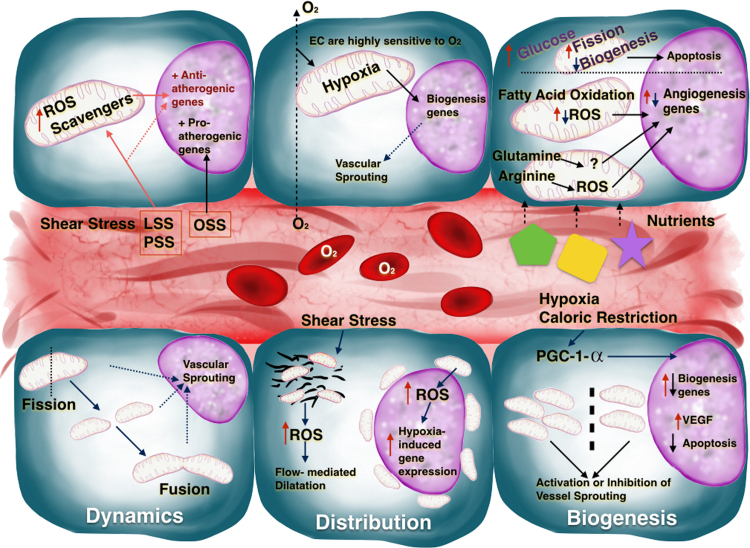
The involvement of angiogenesis in disease and its potential as a therapeutic target have been firmly established over recent decades. Endothelial cells (ECs) are central elements in vessel homeostasis and regulate the passage of material and cells into and out of the bloodstream. EC proliferation and migration are modified by alterations to mitochondrial biogenesis and dynamics resulting from several signals and environmental cues, such as oxygen, hemodynamics, and nutrients. As intermediary signals, mitochondrial ROS are released as important downstream modulators of the expression of angiogenesis-related genes. In this review, we discuss the physiological actions of these signals and aberrant responses during vascular disorders.
近几十年来,血管生成在疾病中的作用及其作为治疗靶点的潜力已得到明确证实。内皮细胞(ECs)是血管稳态的核心要素,调节物质和细胞进出血液的过程。内皮细胞的增殖和迁移会因多种信号和环境线索(如氧气、血流动力学和营养物质)导致的线粒体生物发生和动力学改变而发生变化。作为中间信号,线粒体活性氧作为血管生成相关基因表达的重要下游调节剂而释放。在本综述中,我们讨论了这些信号的生理作用以及血管疾病期间的异常反应。