Wilhelm Kerstin, Happel Katharina, Eelen Guy, Schoors Sandra, Oellerich Mark F, Lim Radiance, Zimmermann Barbara, Aspalter Irene M, Franco Claudio A, Boettger Thomas, Braun Thomas, Fruttiger Marcus, Rajewsky Klaus, Keller Charles, Brüning Jens C, Gerhardt Holger, Carmeliet Peter, Potente Michael
Angiogenesis &Metabolism Laboratory, Max Planck Institute for Heart and Lung Research, D-61231 Bad Nauheim, Germany.
Laboratory of Angiogenesis and Neurovascular Link, Vesalius Research Center, Department of Oncology, University of Leuven, Leuven 3000, Belgium.
Nature. 2016 Jan 14;529(7585):216-20. doi: 10.1038/nature16498. Epub 2016 Jan 6.
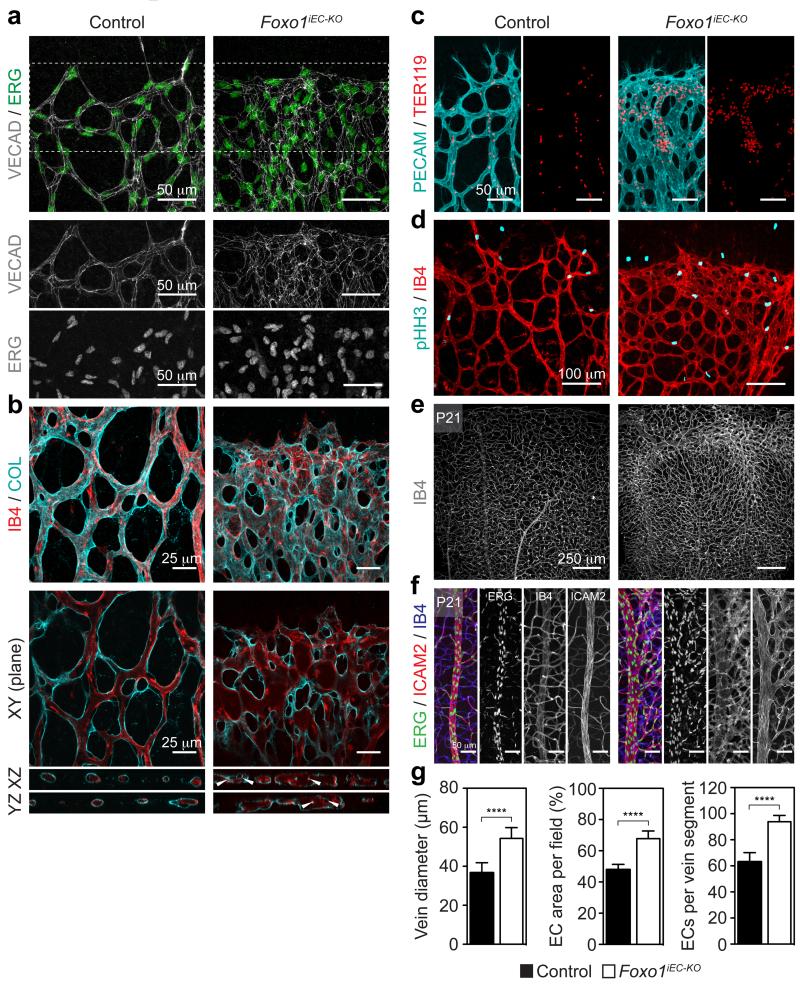
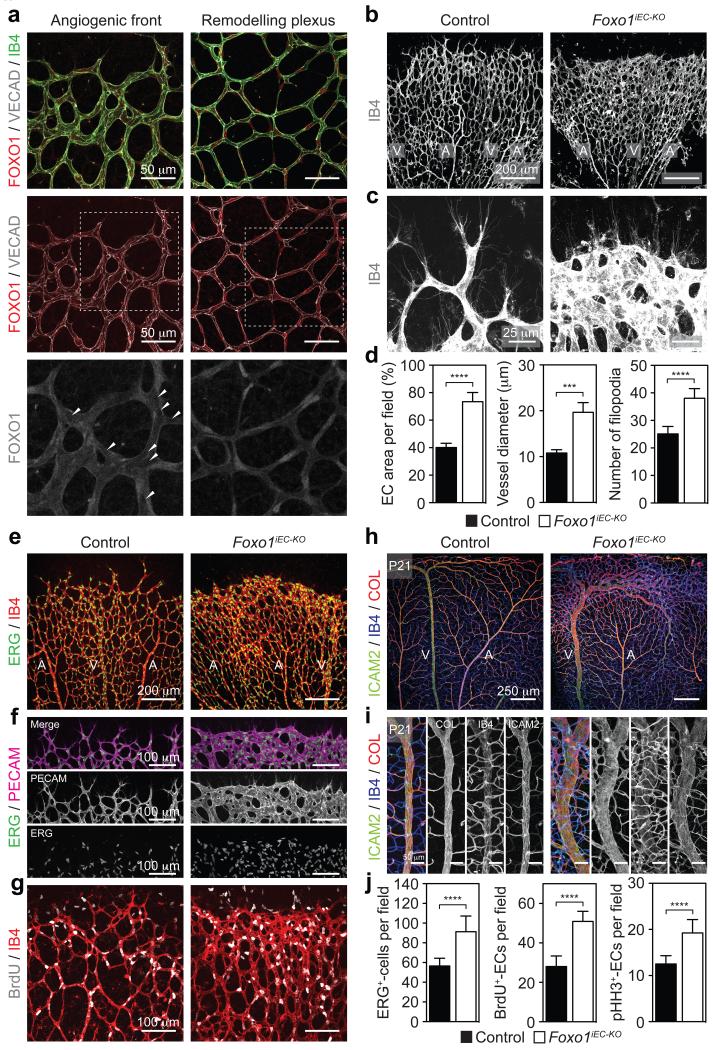
Endothelial cells (ECs) are plastic cells that can switch between growth states with different bioenergetic and biosynthetic requirements. Although quiescent in most healthy tissues, ECs divide and migrate rapidly upon proangiogenic stimulation. Adjusting endothelial metabolism to the growth state is central to normal vessel growth and function, yet it is poorly understood at the molecular level. Here we report that the forkhead box O (FOXO) transcription factor FOXO1 is an essential regulator of vascular growth that couples metabolic and proliferative activities in ECs. Endothelial-restricted deletion of FOXO1 in mice induces a profound increase in EC proliferation that interferes with coordinated sprouting, thereby causing hyperplasia and vessel enlargement. Conversely, forced expression of FOXO1 restricts vascular expansion and leads to vessel thinning and hypobranching. We find that FOXO1 acts as a gatekeeper of endothelial quiescence, which decelerates metabolic activity by reducing glycolysis and mitochondrial respiration. Mechanistically, FOXO1 suppresses signalling by MYC (also known as c-MYC), a powerful driver of anabolic metabolism and growth. MYC ablation impairs glycolysis, mitochondrial function and proliferation of ECs while its EC-specific overexpression fuels these processes. Moreover, restoration of MYC signalling in FOXO1-overexpressing endothelium normalizes metabolic activity and branching behaviour. Our findings identify FOXO1 as a critical rheostat of vascular expansion and define the FOXO1-MYC transcriptional network as a novel metabolic checkpoint during endothelial growth and proliferation.
内皮细胞(ECs)是可塑性细胞,能够在具有不同生物能量和生物合成需求的生长状态之间转换。尽管在大多数健康组织中处于静止状态,但内皮细胞在促血管生成刺激下会迅速分裂和迁移。将内皮细胞代谢调整到生长状态对于正常血管生长和功能至关重要,但在分子水平上对此了解甚少。在这里,我们报告叉头框O(FOXO)转录因子FOXO1是血管生长的关键调节因子,它将内皮细胞中的代谢和增殖活动联系起来。在小鼠中内皮细胞特异性缺失FOXO1会导致内皮细胞增殖显著增加,这会干扰协调的芽生,从而导致增生和血管扩张。相反,强制表达FOXO1会限制血管扩张,并导致血管变细和分支减少。我们发现FOXO1作为内皮细胞静止的守门人,通过减少糖酵解和线粒体呼吸来减缓代谢活动。从机制上讲,FOXO1抑制MYC(也称为c-MYC)的信号传导,MYC是合成代谢和生长的强大驱动因子。MYC缺失会损害内皮细胞的糖酵解、线粒体功能和增殖,而其在内皮细胞中的特异性过表达则会促进这些过程。此外,在过表达FOXO1的内皮细胞中恢复MYC信号传导可使代谢活动和分支行为正常化。我们的研究结果确定FOXO1是血管扩张的关键调节器,并将FOXO1-MYC转录网络定义为内皮细胞生长和增殖过程中的一个新的代谢检查点。