Department of Cancer Immunology and Virology, Dana-Farber Cancer Institute.
Department of Neurology, Massachusetts General Hospital.
Clin Infect Dis. 2017 Aug 15;65(4):626-635. doi: 10.1093/cid/cix391.
Marijuana use is prevalent among persons infected with human immunodeficiency virus (HIV), but its long-term effects on HIV disease progression and comorbidities are unknown.
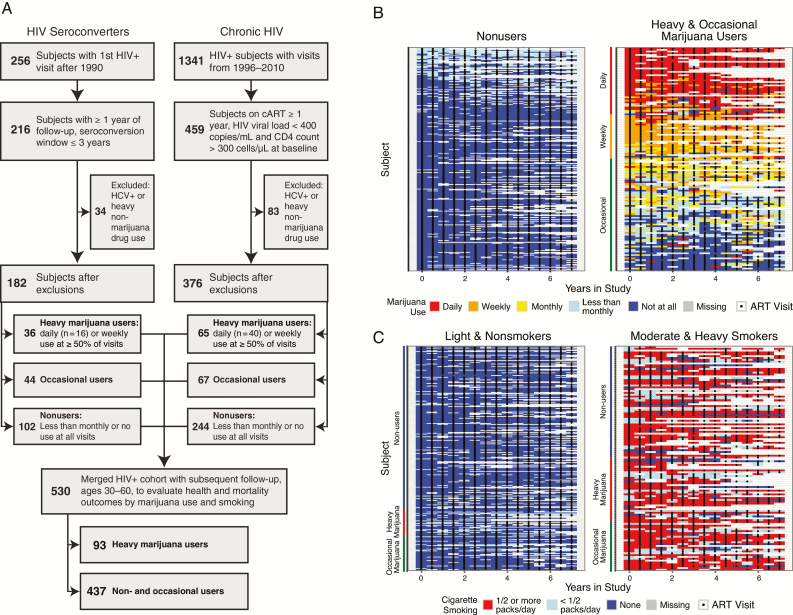
In this prospective study of 558 HIV-infected men enrolled in the Multicenter AIDS Cohort Study between 1990 and 2010, there were 182 HIV seroconverters and 376 with viral suppression on combination antiretroviral therapy (ART). Associations between heavy marijuana use and HIV disease markers or white blood cell (WBC) count were examined using mixed-effects and linear regression models. Effects of marijuana use on cardiovascular (CV) events and other endpoints were estimated using Kaplan-Meier and logistic regression analyses.
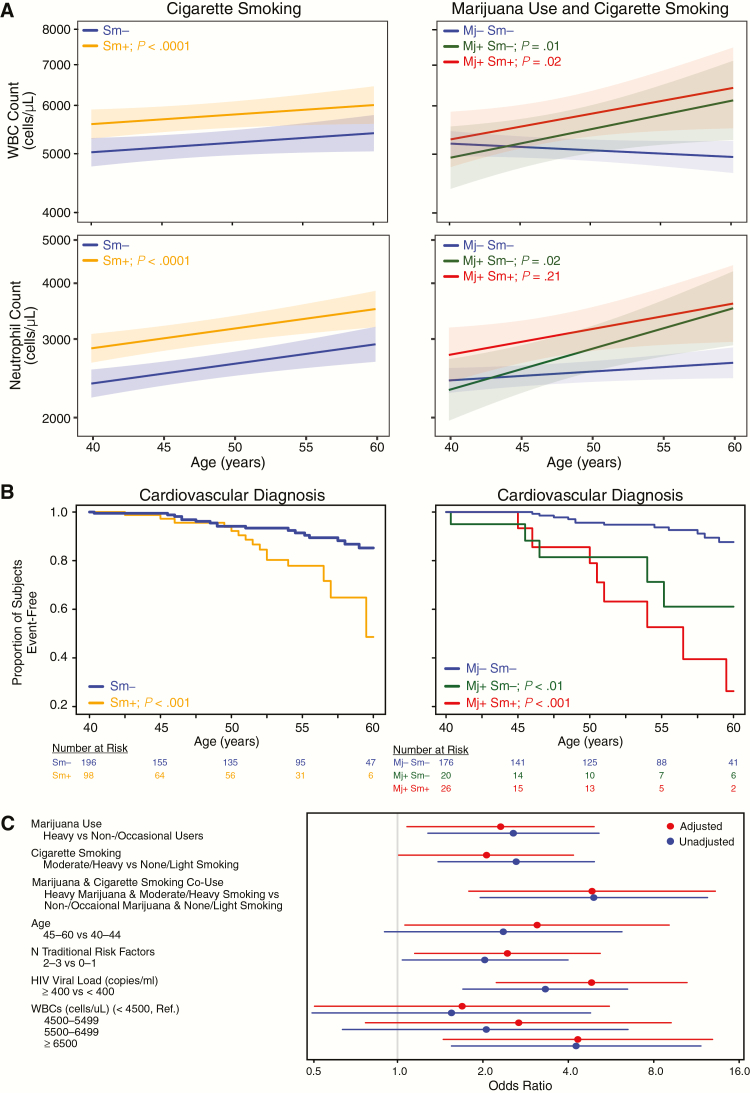
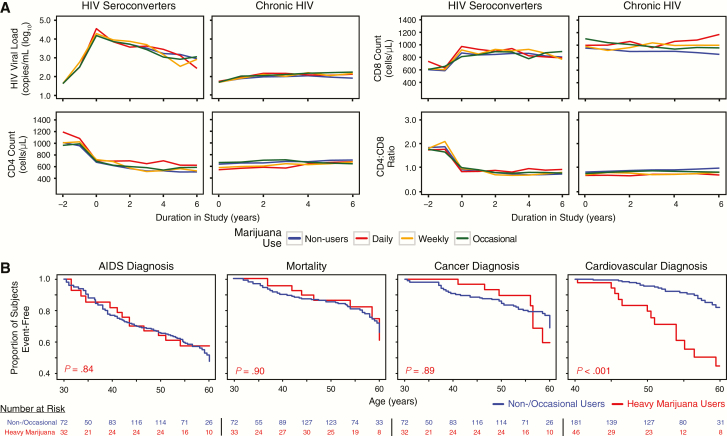
The median baseline age of participants was 41, 66% were white, 79% had education >12 years, and 20% reported heavy marijuana use at ≥50% of biannual visits during follow-up. Long-term heavy marijuana use showed no significant associations with viral load, CD4 counts, AIDS, cancer, or mortality in both cohorts but was independently associated with increased CV events between ages 40-60 after adjusting for age, tobacco smoking, viral load, and traditional risk factors (odds ratio [OR], 2.5; 95% confidence interval [CI] 1.3, 5.1). Marijuana and tobacco use were each independently associated with higher WBC counts in adjusted models (P < .01); the highest quartile of WBC counts (≥6500 cells/µL) was associated with increased CV events (OR 4.3; 95% CI, 1.5, 12.9).
Heavy marijuana use is a risk factor for CV disease in HIV-infected men ages 40-60, independent of tobacco smoking and traditional risk factors.
在感染人类免疫缺陷病毒 (HIV) 的人群中,大麻的使用很普遍,但它对 HIV 疾病进展和合并症的长期影响尚不清楚。
在这项对 1990 年至 2010 年间参加多中心艾滋病队列研究的 558 名 HIV 感染男性的前瞻性研究中,有 182 名 HIV 血清转换者和 376 名接受联合抗逆转录病毒治疗 (ART) 的病毒抑制者。使用混合效应和线性回归模型研究了重度大麻使用与 HIV 疾病标志物或白细胞 (WBC) 计数之间的关系。使用 Kaplan-Meier 和逻辑回归分析估计了大麻使用对心血管 (CV) 事件和其他终点的影响。
参与者的中位基线年龄为 41 岁,66%为白人,79%接受过 >12 年的教育,20%在随访期间每两年报告一次重度大麻使用≥50%。在两个队列中,长期重度大麻使用与病毒载量、CD4 计数、艾滋病、癌症或死亡率均无显著关联,但在调整年龄、吸烟、病毒载量和传统危险因素后,与 40-60 岁之间 CV 事件的增加独立相关(比值比 [OR],2.5;95%置信区间 [CI],1.3,5.1)。大麻和烟草使用在调整模型中均与较高的 WBC 计数独立相关(P <.01);WBC 计数最高四分位数(≥6500 个细胞/µL)与 CV 事件增加相关(OR 4.3;95% CI,1.5,12.9)。
在 40-60 岁的 HIV 感染男性中,重度大麻使用是 CV 疾病的一个危险因素,独立于吸烟和传统危险因素。