Llorca-Bofí Vicent, Mur Maria, Font Maria, Palacios-Garrán Roberto, Sellart Maite, Del Agua-Martínez Enrique, Bioque Miquel, Arteaga-Henríquez Gara
Department of Psychiatry, Hospital Universitari Santa Maria, Lleida, Spain.
Department of Medicine, University of Barcelona, Barcelona Clínic Schizophrenia Unit (BCSU), Neuroscience Institute, Hospital Clínic de Barcelona, Barcelona, Spain.
Brain Behav Immun Health. 2024 Nov 6;42:100898. doi: 10.1016/j.bbih.2024.100898. eCollection 2024 Dec.
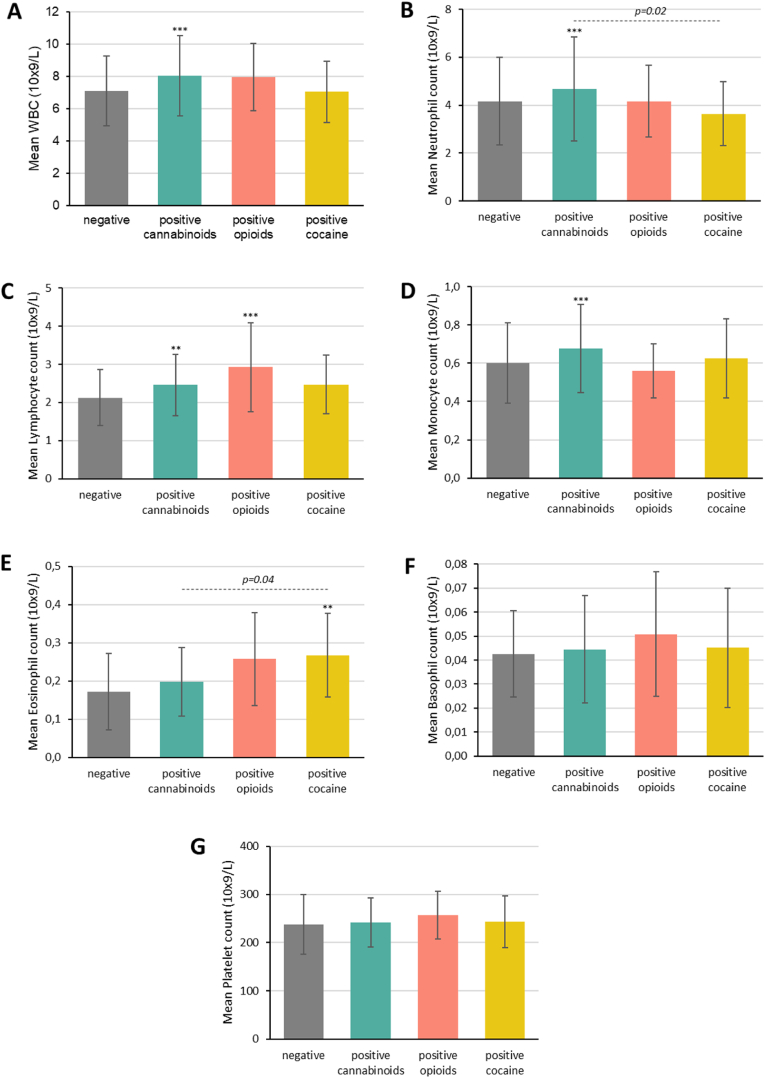
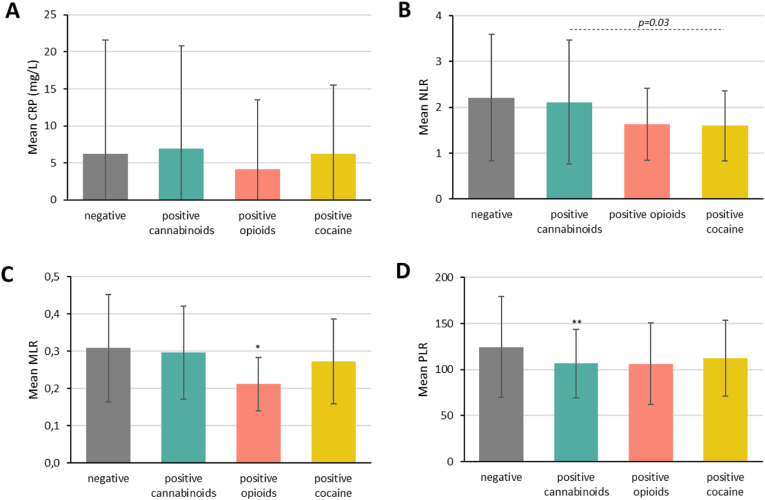
Several drugs of abuse may exert their action by modulating the immune system. Despite this, individuals using substances of abuse are often excluded from immunopsychiatry studies. We conducted a retrospective, single-center study to examine differences in circulating immune/inflammatory parameters (i.e., total and differential white blood cell (WBC) counts, neutrophil-to-lymphocyte ratio, monocyte-to-lymphocyte (MLR) ratio, platelet-to-lymphocyte ratio, and C-reactive protein) between psychiatric inpatients with a positive urine test to cannabinoids, opioids, or cocaine, and those with negative toxicology. A total of 927 inpatients were included. Patients with positive toxicology (n = 208) had significantly higher WBC counts ( < 0.001, p = 0.02), as well as increased neutrophils ( = 0.002, p = 0.01), monocytes ( < 0.001, p = 0.02), lymphocytes ( < 0.001, p = 0.02), and eosinophils ( = 0.01, p = 0.01) compared to those with negative toxicology (n = 719). The increase in neutrophil counts was particularly evident in patients who tested positive for cannabinoids (n = 168; < 0.001, p = 0.02). In contrast, eosinophil counts were particularly increased in the cocaine-positive subgroup (n = 27; = 0.004, p = 0.01). Patients with a positive urine test to opioids (n = 13) were characterized by a significantly lower MLR ( = 0.03, p = 0.005). The type of psychiatric diagnosis moderated the differences in neutrophil counts between patients with a positive and negative toxicology to cannabinoids. Notably, significantly higher neutrophil counts were found only in patients diagnosed with a psychotic disorder ( < 0.001, p = 0.03). Taken together, our findings suggest that drugs of abuse may differently impact the immune/inflammatory response system in individuals diagnosed with psychiatric conditions. Specifically, recent cannabinoids use may be associated with an acute activation of the inflammatory response system, particularly in individuals with a psychotic disorder, while cocaine and opioid use may be associated with eosinophilia and a decrease in the MLR, respectively, regardless of the primary psychiatric diagnosis.
几种滥用药物可能通过调节免疫系统来发挥作用。尽管如此,滥用药物的个体通常被排除在免疫精神病学研究之外。我们进行了一项回顾性单中心研究,以检查尿液检测大麻素、阿片类药物或可卡因呈阳性的精神科住院患者与毒理学检测呈阴性的患者之间循环免疫/炎症参数(即白细胞总数及分类计数、中性粒细胞与淋巴细胞比值、单核细胞与淋巴细胞比值、血小板与淋巴细胞比值以及C反应蛋白)的差异。总共纳入了927名住院患者。毒理学检测呈阳性的患者(n = 208)白细胞计数显著更高(< 0.001,p = 0.02),中性粒细胞(= 0.002,p = 0.01)、单核细胞(< 0.001,p = 0.02)、淋巴细胞(< 0.001,p = 0.02)和嗜酸性粒细胞(= 0.01,p = 0.01)也有所增加,相比之下毒理学检测呈阴性的患者(n = 719)则不然。中性粒细胞计数的增加在大麻素检测呈阳性的患者中尤为明显(n = 168;< 0.001,p = 0.02)。相反,嗜酸性粒细胞计数在可卡因阳性亚组中尤其增加(n = 27;= 0.004,p = 0.01)。尿液检测阿片类药物呈阳性的患者(n = 13)的特征是单核细胞与淋巴细胞比值显著降低(= 0.03,p = 0.005)。精神科诊断类型调节了大麻素毒理学检测呈阳性和阴性的患者之间中性粒细胞计数的差异。值得注意的是,仅在被诊断为精神障碍的患者中发现中性粒细胞计数显著更高(< 0.001,p = 0.03)。综上所述,我们的研究结果表明,滥用药物可能对被诊断患有精神疾病的个体的免疫/炎症反应系统产生不同影响。具体而言,近期使用大麻素可能与炎症反应系统的急性激活有关,特别是在患有精神障碍的个体中,而使用可卡因和阿片类药物可能分别与嗜酸性粒细胞增多和单核细胞与淋巴细胞比值降低有关,无论主要的精神科诊断如何。