Huber Florence, Merceron Alice, Madec Yoann, Gadio Gueda, About Vincent, Pastre Agathe, Coupez Isabelle, Adenis Antoine, Adriouch Leila, Nacher Mathieu
COREVIH, Cayenne General Hospital, Cayenne, French Guiana, France.
Day Hospital, Cayenne General Hospital, Cayenne, French Guiana, France.
PLoS One. 2017 Apr 28;12(4):e0175740. doi: 10.1371/journal.pone.0175740. eCollection 2017.
French Guiana is a South American French territory, where HIV prevalence consistently exceeds 1% in the adult population. In the only correctional facility, HIV prevalence fluctuates at around 4%.
After describing the population of HIV-positive inmates, we aimed to evaluate mortality after release from the correctional facility, and to identify its predictive factors.
Outside North American settings, data on treatment outcome and vital status of HIV-positive former inmates are scarce. There were no data in French Guiana. Filling this gap represents a basis for potential improvements.
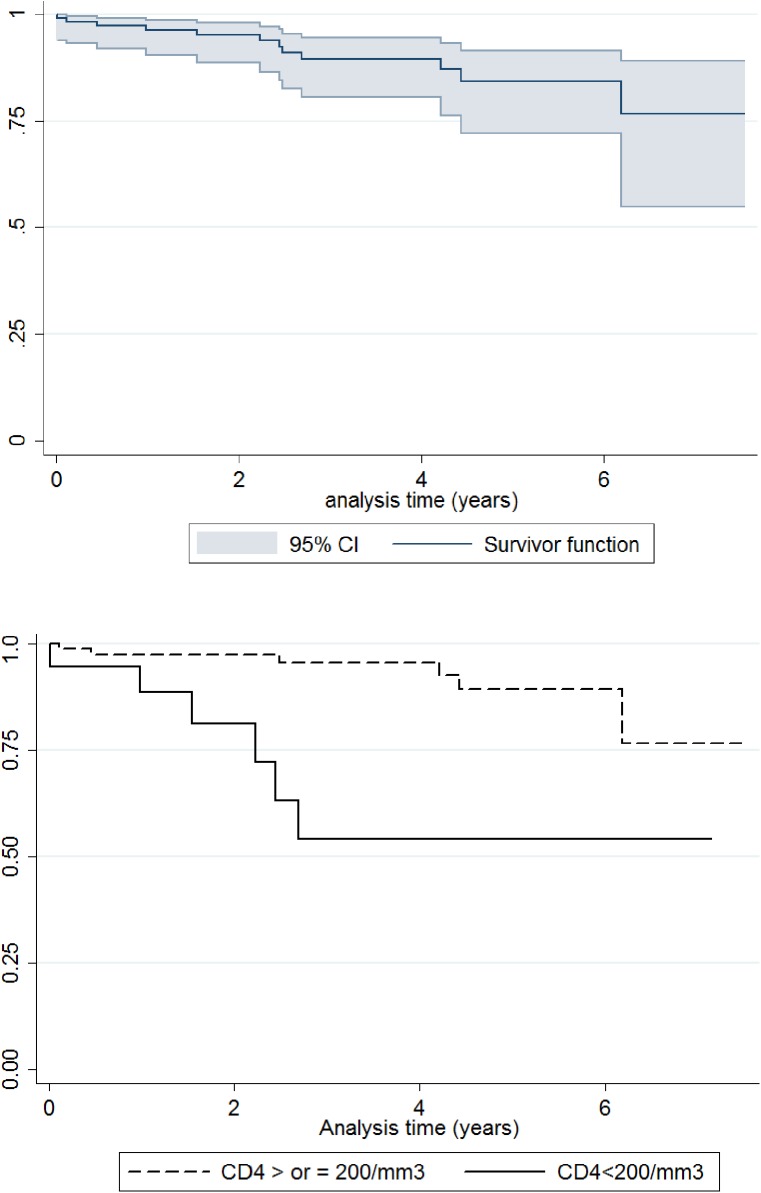
All HIV-infected adults released from an incarceration of 30 days or more, between 2007 and 2013, were enrolled in a retrospective cohort study. Mortality was described over time, one to seven years following release, using Kaplan-Meier estimates. Factors associated with mortality were identified through a non-parametric survival regression model.
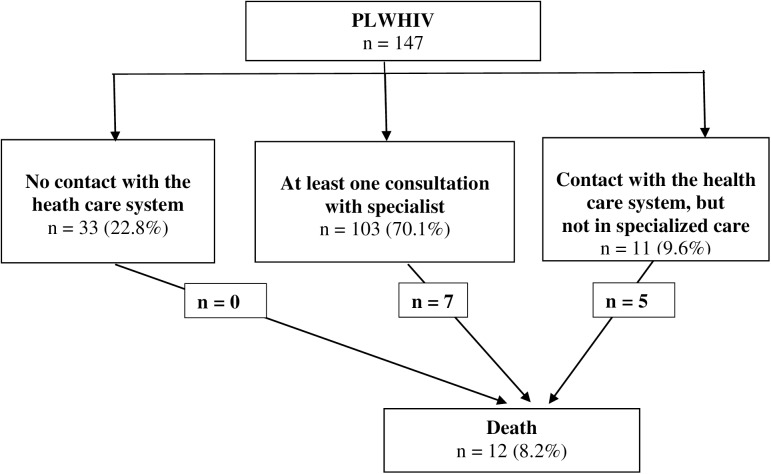
147 former inmates were included. The male to female ratio was 4.4. The median age was 37.3 years. The majority were migrants, 25.8% were homeless, 70.1% suffered from substance abuse, with 34.0% of crack-cocaine users. On admission, 78.1% had an early HIV-stage infection (CDC-stage A), with a median CD4 count of 397.5/mm3, 34.0% had one comorbidity, mainly hypertension. Upon release, 50.3% were on ART. Reasons for not being treated were not fulfilling the criteria for 74.6%, and refusing for 15.1%. Before release, 84.5% of the patients on ART had a viral load≤200cp/ml. After release, 8.2% of the cohort had died, with a crude incidence of 33.8/1000 person-years. All recorded deaths were males, with an incidence of 42.2/1000 person-years. Comparing with the age-specific mortality rates for males in French Guiana, the standardized mortality ratio was 14.8. In multivariate analysis, factors associated with death were age and CD4 count before release.
Despite access to ART while incarcerated, with good virological outcome, the post-release mortality was very high for males, almost 15 times what is observed in the general male population living in French Guiana, after age standardization. Access to ART in correctional facilities may be a necessary, but not sufficient condition to protect male inmates from death after release.
法属圭亚那是南美洲的法国领土,该国成年人口中的艾滋病毒流行率一直超过1%。在唯一的惩教设施中,艾滋病毒流行率波动在4%左右。
在描述了艾滋病毒阳性囚犯群体后,我们旨在评估从惩教设施获释后的死亡率,并确定其预测因素。
在北美以外的地区,关于艾滋病毒阳性前囚犯的治疗结果和生命状况的数据很少。法属圭亚那没有相关数据。填补这一空白是实现潜在改善的基础。
所有在2007年至2013年期间从30天或更长时间监禁中获释的艾滋病毒感染成年人被纳入一项回顾性队列研究。使用Kaplan-Meier估计法描述了获释后1至7年随时间变化的死亡率。通过非参数生存回归模型确定与死亡率相关的因素。
纳入了147名前囚犯。男女比例为4.4。中位年龄为37.3岁。大多数是移民,25.8%无家可归,70.1%有药物滥用问题,其中34.0%是快克可卡因使用者。入院时,78.1%处于艾滋病毒早期感染阶段(疾病控制中心A期),中位CD4细胞计数为397.5/mm³,34.0%有一种合并症,主要是高血压。获释时,50.3%正在接受抗逆转录病毒治疗。未接受治疗的原因中,74.6%是不符合标准,15.1%是拒绝治疗。在获释前,接受抗逆转录病毒治疗的患者中84.5%的病毒载量≤200拷贝/毫升。获释后,该队列中有8.2%死亡,粗发病率为33.8/1000人年。所有记录在案的死亡均为男性,发病率为42.2/1000人年。与法属圭亚那男性的年龄特异性死亡率相比,标准化死亡率为14.8。在多变量分析中,与死亡相关的因素是年龄和获释前的CD4细胞计数。
尽管在监禁期间能够获得抗逆转录病毒治疗且病毒学结果良好,但男性获释后的死亡率非常高,在年龄标准化后,几乎是法属圭亚那普通男性人口中观察到的死亡率的15倍。惩教设施中获得抗逆转录病毒治疗可能是保护男性囚犯获释后免于死亡的必要条件,但并非充分条件。