Paulo Ana Cristina, Sá-Leão Raquel
Laboratory of Molecular Microbiology of Human Pathogens, Instituto de Tecnologia Quimíca e Biológica António Xavier, Universidade Nova de Lisboa, Oeiras, Portugal.
Departamento de Biologia Vegetal, Faculdade de Ciências, Universidade de Lisboa, Lisboa, Portugal.
PLoS One. 2017 Apr 28;12(4):e0176723. doi: 10.1371/journal.pone.0176723. eCollection 2017.
Periodic cycles in the serotype-specific incidence of invasive pneumococcal disease have been described but less is known in carriage.
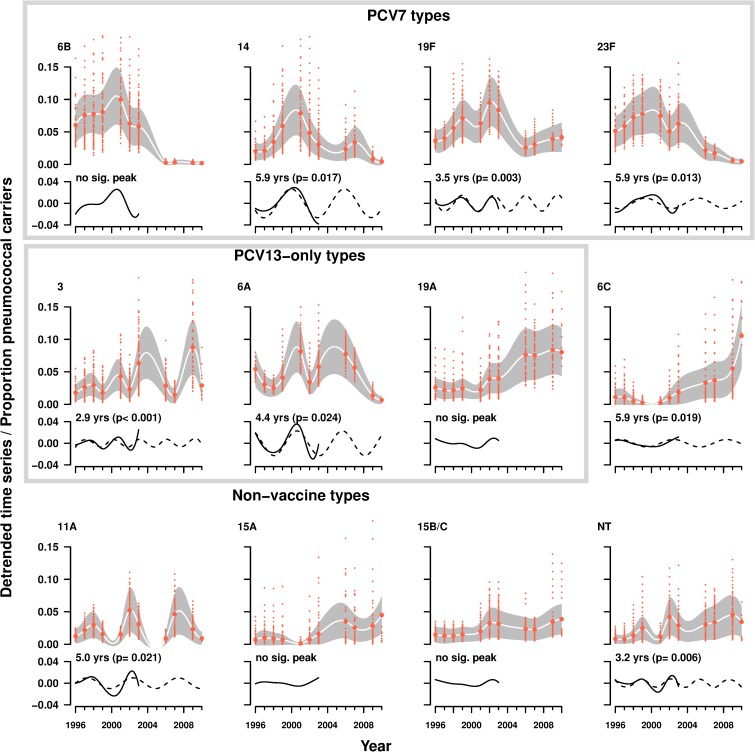
We analyzed serotype carriage prevalence among children 0-6 years old over a 15-year period that included pre-PCV7 data and a decade of PCV7 use. Mixed generalized additive models were used to study periodic cycles and how PCV7 impacted on them.
Pneumococcal carriage data of 7,463 children were analyzed. Periodic cycles ranging from 3 to 6 years were observed for PCV7-serotypes (VT) 14, 19F and 23F and for non-PCV7 types (NVT) 3, 6A, 6C, 11A, and NT. An indirect impact of PCV7 on periodic cycles of NVT was observed and could be translated in three ways: (i) a higher amplitude in the PCV7 period (serotypes 3 and 11A), (ii) sustained increase in the prevalence of carriage (serotypes 6C, 19A and NT) and (iii) an increase in the inter-epidemic period (serotypes 3, 6A and NT). An increase in the child's mean age of carriage of VTs 6B, 19F and 23F was observed. Serotypes 3, 6C, 11A and 15A became more frequent in ages previously associated with carriage of VTs.
Periodic cycles among serotypes frequently carried exist and can be modeled. These cycles can be perturbed upon introduction of PCVs and can lead to shifts in the mean age of carriage. Cyclic re-emergence of VTs can occur in settings with non-universal vaccine use. These results should be taken into account when interpreting surveillance data on pneumococcal carriage.
侵袭性肺炎球菌疾病血清型特异性发病率的周期性循环已有描述,但关于携带情况的了解较少。
我们分析了15年间0至6岁儿童的血清型携带率,其中包括PCV7疫苗接种前的数据以及使用PCV7疫苗的十年数据。采用混合广义相加模型研究周期性循环以及PCV7疫苗对其的影响。
分析了7463名儿童的肺炎球菌携带数据。观察到PCV7血清型(VT)14、19F和23F以及非PCV7血清型(NVT)3、6A、6C、11A和非型别(NT)存在3至6年的周期性循环。观察到PCV7疫苗对NVT周期性循环有间接影响,可通过三种方式体现:(i)在PCV7疫苗接种期间幅度更高(血清型3和11A),(ii)携带率持续上升(血清型6C、19A和NT),(iii)流行间期增加(血清型3、6A和NT)。观察到VT血清型6B、19F和23F儿童的平均携带年龄增加。血清型3、6C、11A和15A在先前与VT携带相关的年龄组中变得更为常见。
常见携带血清型之间存在周期性循环且可进行建模。引入肺炎球菌结合疫苗后这些循环可能受到干扰,并可能导致携带平均年龄的变化。在疫苗未普遍使用的情况下,VT血清型可能会周期性重新出现。在解释肺炎球菌携带监测数据时应考虑这些结果。