Billings Liana K, Jablonski Kathleen A, Warner A Sofia, Cheng Yu-Chien, McAteer Jarred B, Tipton Laura, Shuldiner Alan R, Ehrmann David A, Manning Alisa K, Dabelea Dana, Franks Paul W, Kahn Steven E, Pollin Toni I, Knowler William C, Altshuler David, Florez Jose C
Diabetes Unit, Department of Medicine, Massachusetts General Hospital, Boston, Massachusetts 02114.
Department of Medicine, Harvard Medical School, Boston, Massachusetts 02114.
J Clin Endocrinol Metab. 2017 Aug 1;102(8):2678-2689. doi: 10.1210/jc.2016-3429.
Variation in genes that cause maturity-onset diabetes of the young (MODY) has been associated with diabetes incidence and glycemic traits.
This study aimed to determine whether genetic variation in MODY genes leads to differential responses to insulin-sensitizing interventions.
This was a secondary analysis of a multicenter, randomized clinical trial, the Diabetes Prevention Program (DPP), involving 27 US academic institutions. We genotyped 22 missense and 221 common variants in the MODY-causing genes in the participants in the DPP.
The study included 2806 genotyped DPP participants randomized to receive intensive lifestyle intervention (n = 935), metformin (n = 927), or placebo (n = 944).
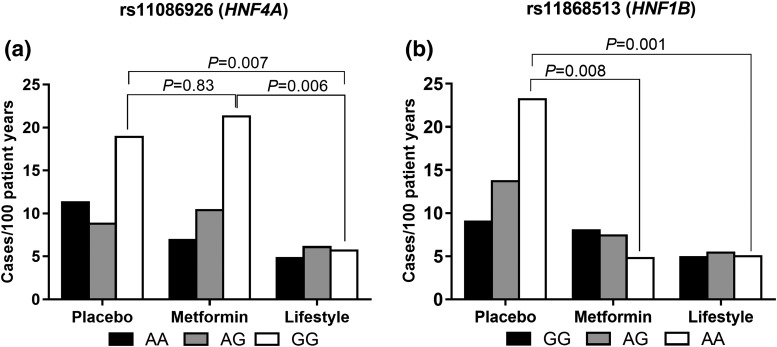
Association of MODY genetic variants with diabetes incidence at a median of 3 years and measures of 1-year β-cell function, insulinogenic index, and oral disposition index. Analyses were stratified by treatment group for significant single-nucleotide polymorphism × treatment interaction (Pint < 0.05). Sequence kernel association tests examined the association between an aggregate of rare missense variants and insulinogenic traits.
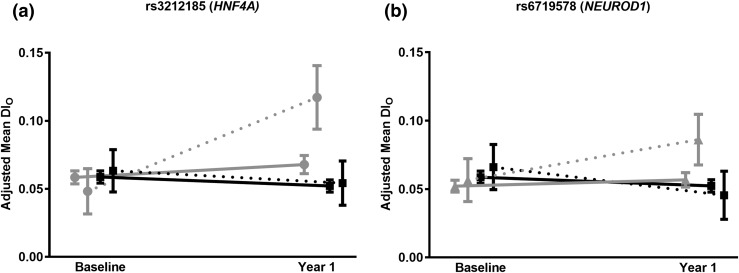
After 1 year, the minor allele of rs3212185 (HNF4A) was associated with improved β-cell function in the metformin and lifestyle groups but not the placebo group; the minor allele of rs6719578 (NEUROD1) was associated with an increase in insulin secretion in the metformin group but not in the placebo and lifestyle groups.
These results provide evidence that genetic variation among MODY genes may influence response to insulin-sensitizing interventions.
导致青年发病的成年型糖尿病(MODY)的基因变异与糖尿病发病率及血糖特征相关。
本研究旨在确定MODY基因的遗传变异是否会导致对胰岛素增敏干预产生不同反应。
这是一项对多中心随机临床试验——糖尿病预防计划(DPP)的二次分析,该试验涉及美国27家学术机构。我们对DPP参与者中导致MODY的基因的22个错义变异和221个常见变异进行了基因分型。
该研究纳入了2806名进行了基因分型的DPP参与者,他们被随机分配接受强化生活方式干预(n = 935)、二甲双胍(n = 927)或安慰剂(n = 944)。
MODY基因变异与中位3年糖尿病发病率以及1年β细胞功能、胰岛素生成指数和口服处置指数测量值之间的关联。分析按治疗组进行分层,以检验显著的单核苷酸多态性×治疗交互作用(Pint < 0.05)。序列核关联检验研究了罕见错义变异集合与胰岛素生成特征之间的关联。
1年后,rs3212185(HNF4A)的次要等位基因与二甲双胍组和生活方式组中β细胞功能改善相关,但与安慰剂组无关;rs6719578(NEUROD1)的次要等位基因与二甲双胍组中胰岛素分泌增加相关,但与安慰剂组和生活方式组无关。
这些结果提供了证据,表明MODY基因之间的遗传变异可能会影响对胰岛素增敏干预的反应。