Leu David, Spasojevic Ivan, Nguyen Huy, Deng Brian, Tovmasyan Artak, Weitner Tin, Sampaio Romulo S, Batinic-Haberle Ines, Huang Ting-Ting
Department of Neurology and Neurological Sciences, Stanford University School of Medicine, Stanford, CA, USA; Palo Alto Veterans Institute for Research, Palo Alto, CA, USA.
Duke Cancer Institute, Pharmaceutical Research Shared Resource, PK/PD Core laboratory, Duke University Medical Center, Durham, NC, USA; Department of Medicine, Duke University Medical Center, Durham, NC, USA.
Redox Biol. 2017 Aug;12:864-871. doi: 10.1016/j.redox.2017.04.027. Epub 2017 Apr 22.
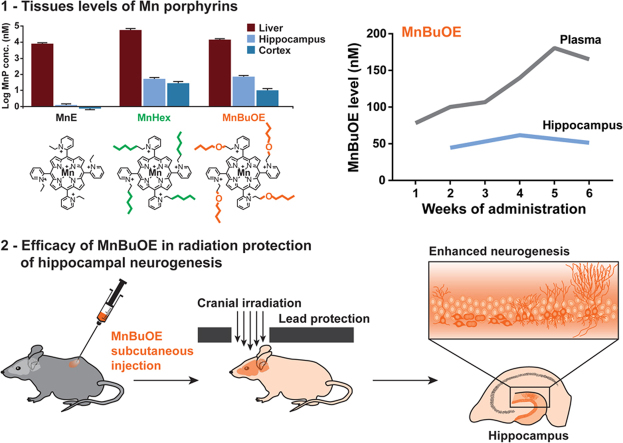
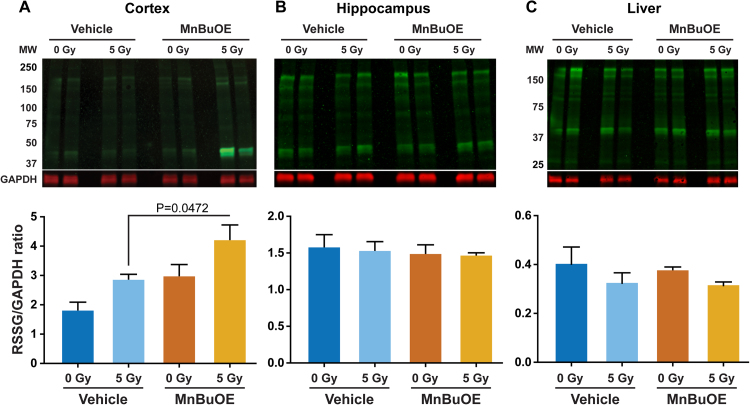
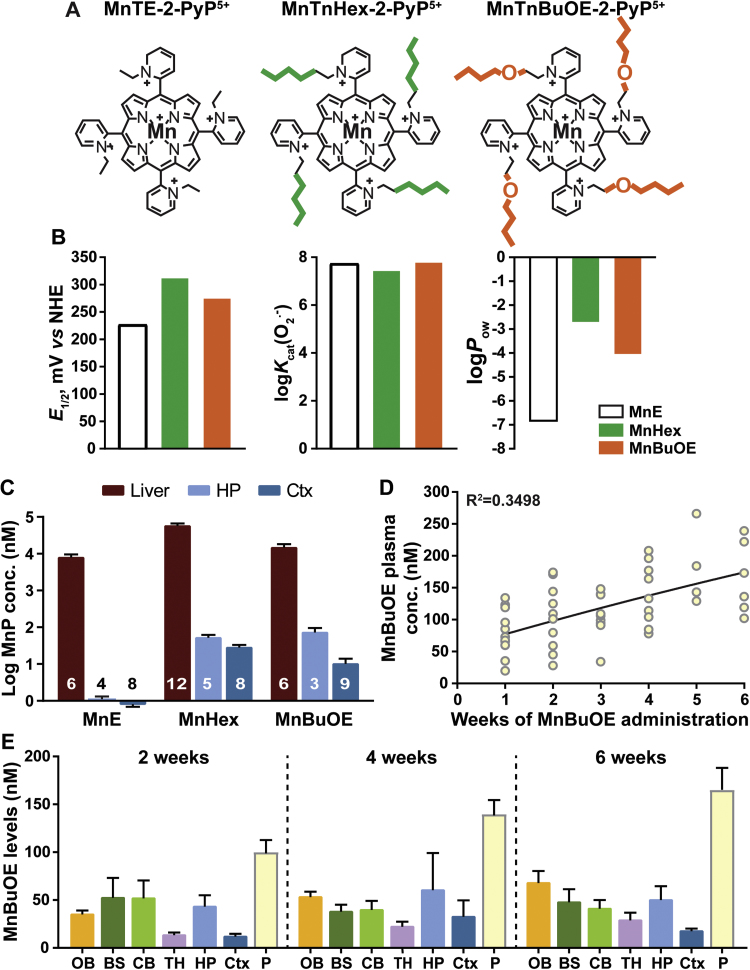
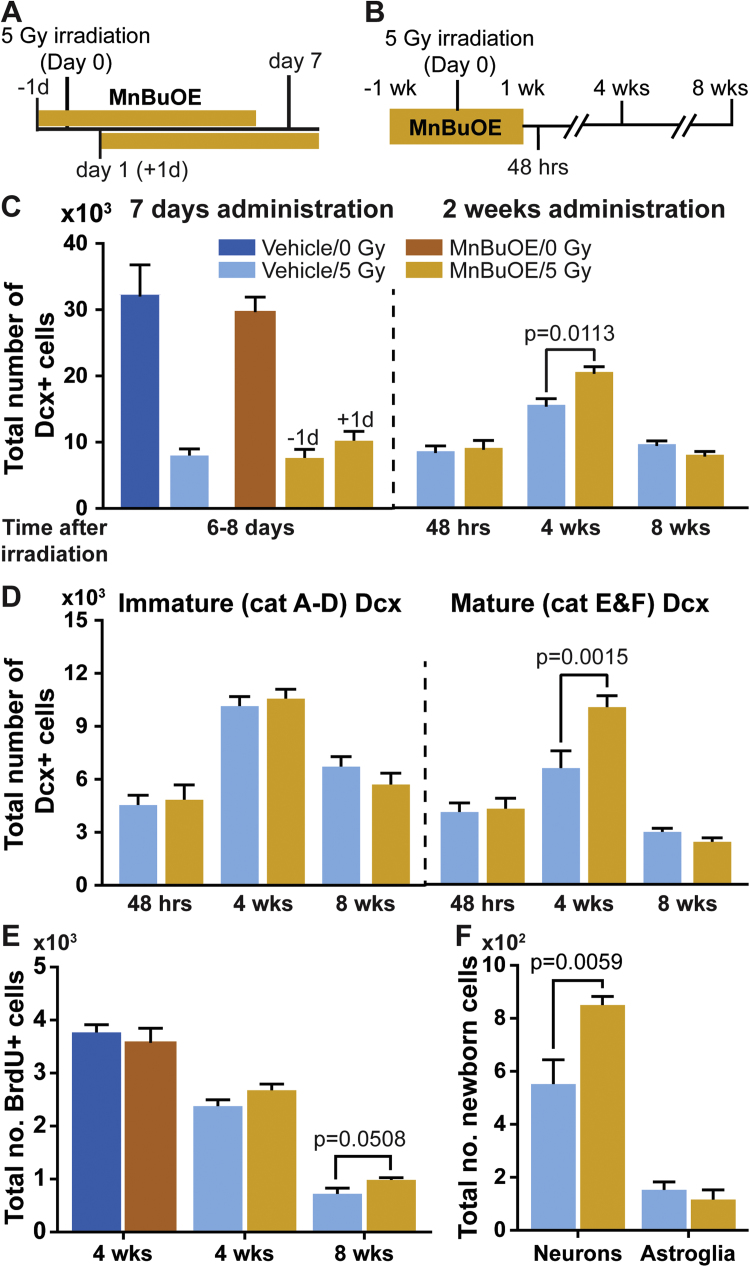
Although radiation therapy can be effective against cancer, potential damage to normal tissues limits the amount that can be safely administered. In central nervous system (CNS), radiation damage to normal tissues is presented, in part, as suppressed hippocampal neurogenesis and impaired cognitive functions. Mn porphyrin (MnP)-based redox active drugs have demonstrated differential effects on cancer and normal tissues in experimental animals that lead to protection of normal tissues and radio- and chemo-sensitization of cancers. To test the efficacy of MnPs in CNS radioprotection, we first examined the tissue levels of three different MnPs - MnTE-2-PyP(MnE), MnTnHex-2-PyP(MnHex), and MnTnBuOE-2-PyP(MnBuOE). Nanomolar concentrations of MnHex and MnBuOE were detected in various brain regions after daily subcutaneous administration, and MnBuOE was well tolerated at a daily dose of 3mg/kg. Administration of MnBuOE for one week before cranial irradiation and continued for one week afterwards supported production and long-term survival of newborn neurons in the hippocampal dentate gyrus. MnP-driven S-glutathionylation in cortex and hippocampus showed differential responses to MnP administration and radiation in these two brain regions. A better understanding of how preserved hippocampal neurogenesis correlates with cognitive functions following cranial irradiation will be helpful in designing better MnP-based radioprotection strategies.
尽管放射治疗对癌症可能有效,但对正常组织的潜在损害限制了能够安全给予的剂量。在中枢神经系统(CNS)中,对正常组织的辐射损伤部分表现为海马神经发生受抑制和认知功能受损。基于锰卟啉(MnP)的氧化还原活性药物在实验动物中对癌症和正常组织表现出不同的作用,从而导致对正常组织的保护以及癌症的放射增敏和化学增敏。为了测试锰卟啉在中枢神经系统放射防护中的功效,我们首先检测了三种不同锰卟啉——MnTE - 2 - PyP(MnE)、MnTnHex - 2 - PyP(MnHex)和MnTnBuOE - 2 - PyP(MnBuOE)的组织水平。每日皮下给药后,在各个脑区检测到纳摩尔浓度的MnHex和MnBuOE,并且MnBuOE在每日剂量为3mg/kg时耐受性良好。在颅脑照射前一周给予MnBuOE并在照射后持续一周,这支持了海马齿状回中新生神经元的产生和长期存活。在皮质和海马中,锰卟啉驱动的S - 谷胱甘肽化对这两种脑区中锰卟啉给药和辐射表现出不同的反应。更好地理解颅脑照射后保留的海马神经发生与认知功能之间的关系将有助于设计更好的基于锰卟啉的放射防护策略。