Rafii Saeed, Gourley Charlie, Kumar Rajiv, Geuna Elena, Ern Ang Joo, Rye Tzyvia, Chen Lee-May, Shapira-Frommer Ronnie, Friedlander Michael, Matulonis Ursula, De Greve Jacques, Oza Amit M, Banerjee Susana, Molife L Rhoda, Gore Martin E, Kaye Stan B, Yap Timothy A
Drug Development Unit, The Institute of Cancer Research and The Royal Marsden NHS Foundation Trust, London, UK.
University of Edinburgh Cancer Research UK Centre, Edinburgh, UK.
Oncotarget. 2017 Jul 18;8(29):47154-47160. doi: 10.18632/oncotarget.17005.
The PARP inhibitor olaparib was recently granted Food and Drug Administration (FDA) accelerated approval in patients with advanced BRCA1/2 mutation ovarian cancer. However, antitumor responses are observed in only approximately 40% of patients and the impact of baseline clinical factors on response to treatment remains unclear. Although platinum sensitivity has been suggested as a marker of response to PARP inhibitors, patients with platinum-resistant disease still respond to olaparib.
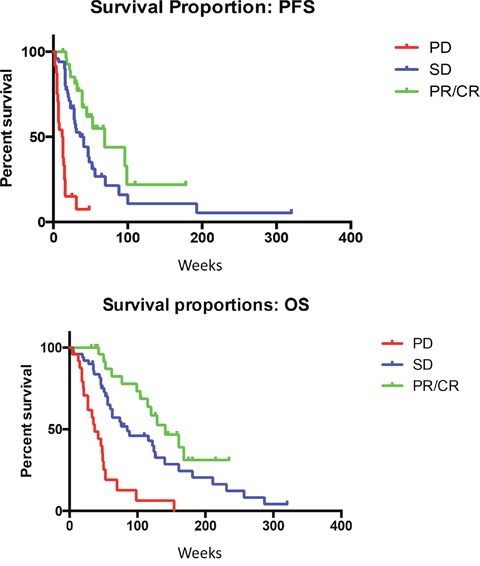
108 patients with advanced BRCA1/2 mutation ovarian cancers were included. The interval between the end of the most recent platinum chemotherapy and PARPi (PTPI) was used to predict response to olaparib independent of conventional definition of platinum sensitivity. RECIST complete response (CR) and partial response (PR) rates were 35% in patients with platinum-sensitive versus 13% in platinum-resistant (p<0.005). Independent of platinum sensitivity status, the RECIST CR/PR rates were 42% in patients with PTPI greater than 52 weeks and 18% in patients with PTPI less than 52 weeks (p=0.016). No association was found between baseline clinical factors such as FIGO staging, debulking surgery, BRCA1 versus BRCA2 mutations, prior history of breast cancer and prior chemotherapy for breast cancer, and the response to olaparib.
We conducted an international multicenter retrospective study to investigate the association between baseline clinical characteristics of patients with advanced BRCA1/2 mutation ovarian cancers from eight different cancer centers and their antitumor response to olaparib.
PTPI may be used to refine the prediction of response to PARP inhibition based on the conventional categorization of platinum sensitivity.
聚(ADP - 核糖)聚合酶(PARP)抑制剂奥拉帕尼最近获得美国食品药品监督管理局(FDA)加速批准,用于治疗晚期BRCA1/2基因突变的卵巢癌患者。然而,仅约40%的患者观察到抗肿瘤反应,基线临床因素对治疗反应的影响仍不清楚。尽管铂敏感性已被认为是PARP抑制剂反应的一个标志物,但铂耐药性疾病患者仍对奥拉帕尼有反应。
纳入108例晚期BRCA1/2基因突变的卵巢癌患者。最近一次铂类化疗结束至PARP抑制剂(PTPI)的间隔时间用于预测对奥拉帕尼的反应,而不依赖于铂敏感性的传统定义。铂敏感患者的实体瘤疗效评价标准(RECIST)完全缓解(CR)和部分缓解(PR)率为35%,铂耐药患者为13%(p<0.005)。不考虑铂敏感性状态,PTPI大于52周的患者RECIST CR/PR率为42%,PTPI小于52周的患者为18%(p = 0.016)。未发现基线临床因素如国际妇产科联盟(FIGO)分期、肿瘤减灭术、BRCA1与BRCA2突变、既往乳腺癌病史及乳腺癌既往化疗与奥拉帕尼反应之间存在关联。
我们进行了一项国际多中心回顾性研究,以调查来自八个不同癌症中心的晚期BRCA1/2基因突变卵巢癌患者的基线临床特征与其对奥拉帕尼的抗肿瘤反应之间的关联。
PTPI可用于在基于铂敏感性的传统分类基础上优化对PARP抑制反应的预测。