Liu Ziqin, Wang Tianyou, Zhang Zhaoxia, Tang Suoqin, Feng Shunqiao, Yue Mei, Hu Mengze, Xuan Litian, Chen Yanfei
Department of Pediatrics, Capital Institute of Pediatrics, Chaoyang, Beijing 100020, P.R. China.
Department of Hematology and Oncology, Beijing Children's Hospital, Capital Medical University, Xicheng, Beijing 100045, P.R. China.
Oncol Lett. 2017 Apr;13(4):2723-2730. doi: 10.3892/ol.2017.5754. Epub 2017 Feb 21.
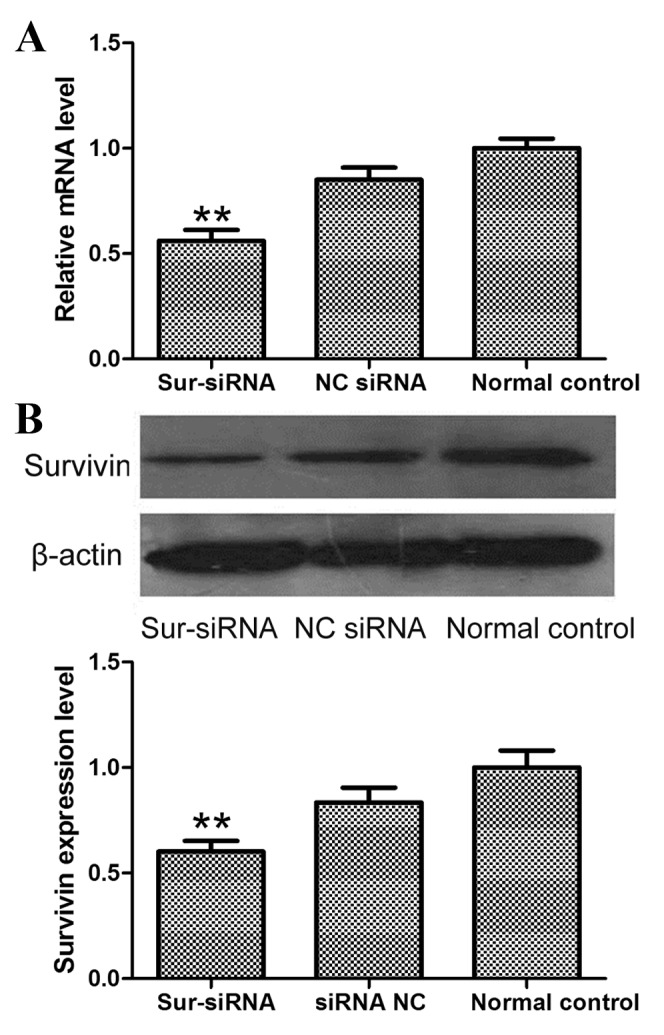
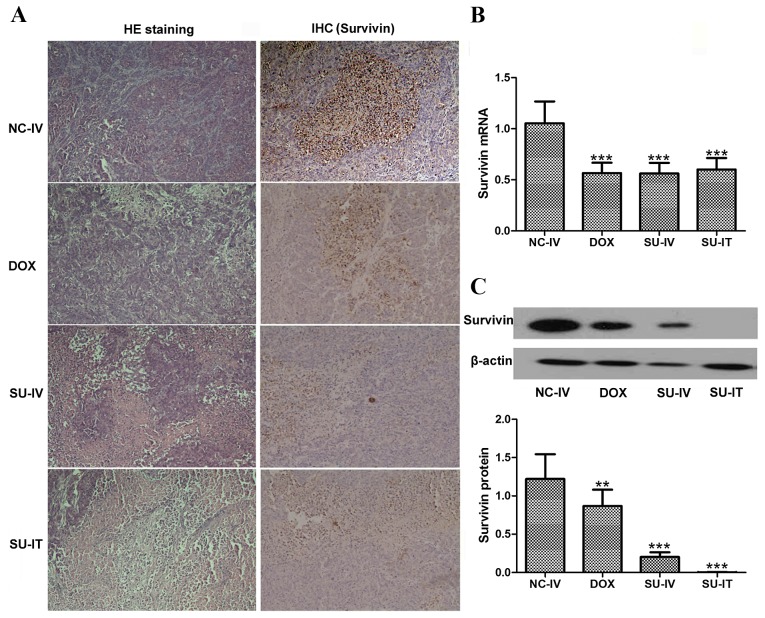
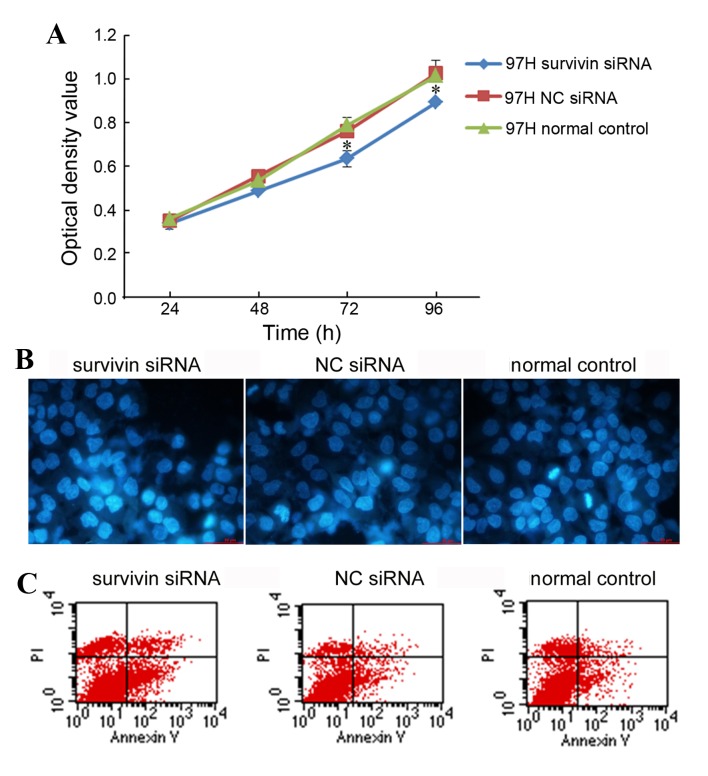
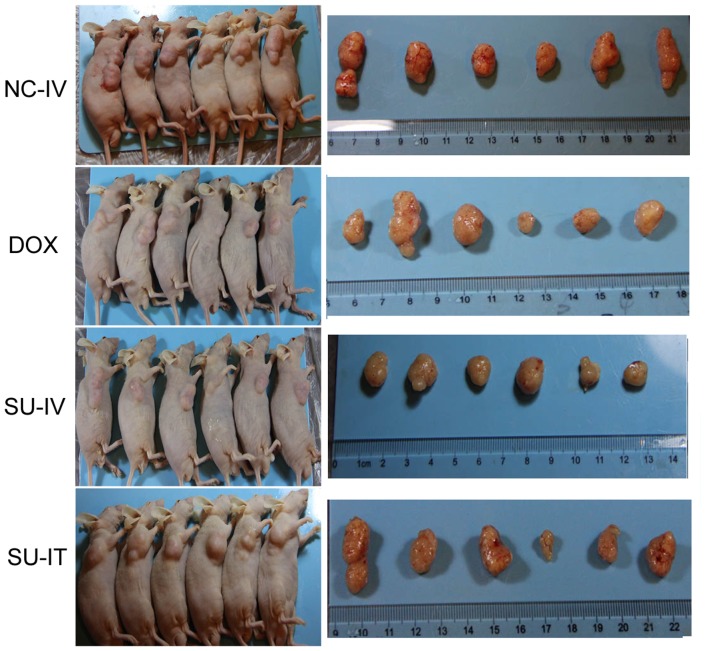
At present, survivin is one of the most cancer-specific proteins that has been identified. The present study aimed to investigate the antitumor effects of novel survivin small interfering RNA (siRNA) nanoliposomes targeting survivin in human hepatocellular carcinoma MHCC-97H cells and xenograft mouse models. Survivin-targeted siRNA nanoliposomes were prepared and transfected into MHCC-97H cells and MHCC-97H-bearing nude mice. Survivin expression was analyzed using reverse transcription-quantitative polymerase chain reaction (RT-qPCR) and western blotting. Cell viability was analyzed using an MTT assay and apoptosis was evaluated using Hoechst and Annexin V-fluorescein isothiocyanate/propidium iodide staining. Tumor growth in MHCC-97H-bearing mice was monitored following treatment and tumor samples were obtained for survivin expression analysis using RT-qPCR, western blotting and immunohistochemistry staining. Survivin expression levels were significantly downregulated by nanoliposome-mediated survivin siRNA delivery and this was associated with a significant inhibition of cell growth and an increase in the apoptosis of MHCC-97H cells. Downregulation of survivin expression using survivin siRNA nanoliposomes inhibited tumor growth in the MHCC-97H xenograft models without significant treatment-associated toxicity. Therefore, a cationic nanoliposome-based survivin siRNA delivery system was constructed and demonstrated to be efficient for survivin siRNA delivery in and studies. These results demonstrate that survivin downregulation was able to significantly attenuate cell proliferation and induce the apoptosis of MHCC-97H cells, as well as inhibit tumor cell growth in MHCC-97H xenograft models, indicating that survivin suppression using siRNA may contribute to the inhibition of tumor development by suppressing cell proliferation and promoting apoptosis.
目前,生存素是已被鉴定出的最具癌症特异性的蛋白质之一。本研究旨在探讨新型靶向生存素的小干扰RNA(siRNA)纳米脂质体对人肝癌MHCC-97H细胞和异种移植小鼠模型的抗肿瘤作用。制备了靶向生存素的siRNA纳米脂质体,并将其转染至MHCC-97H细胞和荷MHCC-97H的裸鼠体内。使用逆转录-定量聚合酶链反应(RT-qPCR)和蛋白质免疫印迹法分析生存素的表达。使用MTT法分析细胞活力,并使用Hoechst染色和膜联蛋白V-异硫氰酸荧光素/碘化丙啶染色评估细胞凋亡。在治疗后监测荷MHCC-97H小鼠的肿瘤生长情况,并获取肿瘤样本,使用RT-qPCR、蛋白质免疫印迹法和免疫组织化学染色分析生存素的表达。纳米脂质体介导的生存素siRNA递送可显著下调生存素的表达水平,这与显著抑制MHCC-97H细胞的生长及细胞凋亡增加相关。使用生存素siRNA纳米脂质体下调生存素表达可抑制MHCC-97H异种移植模型中的肿瘤生长,且无明显的治疗相关毒性。因此,构建了基于阳离子纳米脂质体的生存素siRNA递送系统,并在体外和体内研究中证明其对生存素siRNA递送有效。这些结果表明,下调生存素能够显著减弱MHCC-97H细胞的增殖并诱导其凋亡,以及抑制MHCC-97H异种移植模型中的肿瘤细胞生长,这表明使用siRNA抑制生存素可能通过抑制细胞增殖和促进凋亡来抑制肿瘤发展。