Becker Alena, Ehret Anna M, Kirsch Peter
Department of Clinical Psychology, Central Institute of Mental Health, Medical Faculty Mannheim/Heidelberg University, Mannheim, Germany.
BMC Psychiatry. 2017 Apr 28;17(1):153. doi: 10.1186/s12888-017-1324-0.
Alcohol use disorder and depression occur commonly in the community. Even though this high-prevalence comorbidity is associated with poorer posttreatment outcomes and greater utilization of costly treatment services, existing treatment trials often exclude patients with comorbid depressive and alcohol use disorders. Past research suggests that symptoms such as craving and anhedonia might be associated with alterations within the reward circuit, while emotion regulation deficits are related to disruptions within the default mode network. The aim of this clinical neuroimaging study is to transfer previous research about the reward circuit and default mode network underlying alcohol use disorder and depression to achieve a better understanding of neural signatures characterizing their comorbidity. In addition, the neurobiological results will be used to test whether two psychotherapeutic intervention programs, mindfulness-based training and behavioral activation training, are able to positively influence the identified pathomechanisms.
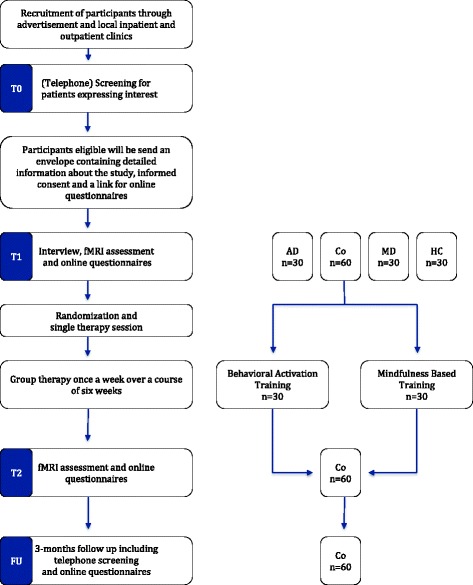
By means of functional magnetic resonance imaging (fMRI), 60 comorbid alcohol dependent and depressed patients are compared to 30 patients with depression only, 30 patients with alcohol use disorder only and 30 healthy control participants. Comorbid patients are randomized to either receive a behavioral activation or mindfulness based training and asked to participate in a second fMRI session and 3 month follow-up assessment. Thereby, we plan to explore whether these brief group psychotherapeutic intervention programs are able to positively influence the identified neurobiological pathomechanisms. The primary outcomes are reward and default mode network activity and connectivity evoked by paradigms measuring different facets of reward and emotion processing. Secondary outcome measures include craving and depression scores, as well as relapse rates. Predictors include participants' characteristics, personality traits and indicators of mental health.
The objective of the project is to identify common and/or distinct neural signatures underlying the comorbidity of alcohol dependence and depression. If the neurobiological understanding of alcohol addiction and depression is improved, this could potentially serve as a key predictor of treatment response to specific types of behavioral or mindfulness therapies hypothesized to alter reward and resting state systems.
German Clinical Trial Register DRKS00010249 . The trial was registered January 23th 2017.
酒精使用障碍和抑郁症在社区中普遍存在。尽管这种高患病率的共病与较差的治疗后结果以及对昂贵治疗服务的更多利用相关,但现有的治疗试验通常会排除患有抑郁和酒精使用障碍共病的患者。过去的研究表明,诸如渴望和快感缺失等症状可能与奖赏回路内的改变有关,而情绪调节缺陷则与默认模式网络内的破坏有关。这项临床神经影像学研究的目的是将先前关于酒精使用障碍和抑郁症背后的奖赏回路和默认模式网络的研究成果进行转化,以更好地理解表征其共病的神经特征。此外,神经生物学结果将用于测试两种心理治疗干预方案,即正念训练和行为激活训练,是否能够对已确定的发病机制产生积极影响。
通过功能磁共振成像(fMRI),将60名酒精依赖和抑郁共病患者与30名仅患有抑郁症的患者、30名仅患有酒精使用障碍的患者以及30名健康对照参与者进行比较。共病患者被随机分配接受行为激活或正念训练,并被要求参加第二次fMRI检查和3个月的随访评估。借此,我们计划探索这些简短的团体心理治疗干预方案是否能够对已确定的神经生物学发病机制产生积极影响。主要结果是测量奖赏和情绪处理不同方面的范式所诱发的奖赏和默认模式网络活动及连通性。次要结果指标包括渴望和抑郁评分以及复发率。预测因素包括参与者的特征、人格特质和心理健康指标。
该项目的目标是识别酒精依赖和抑郁症共病背后的共同和/或不同的神经特征。如果对酒精成瘾和抑郁症的神经生物学理解得到改善,这可能潜在地作为对特定类型行为或正念疗法治疗反应的关键预测指标,这些疗法被假设可改变奖赏和静息状态系统。
德国临床试验注册中心DRKS00010249。该试验于2017年1月23日注册。