Wilson Graeme B, Wray Catherine, McGovern Ruth, Newbury-Birch Dorothy, McColl Elaine, Crosland Ann, Speed Chris, Cassidy Paul, Tomson Dave, Haining Shona, Howel Denise, Kaner Eileen F S
Institute of Health and Society, Newcastle University, Baddiley Clark Building, Richardson Road, Newcastle upon Tyne NE2 4AX, UK.
Trials. 2014 Jun 19;15:235. doi: 10.1186/1745-6215-15-235.
Many primary care patients with raised blood pressure or depression drink potentially hazardous levels of alcohol. Brief interventions (BI) to reduce alcohol consumption may improve comorbid conditions and reduce the risk of future alcohol problems. However, research has not established their effectiveness in this patient population. This study aimed to establish the feasibility of definitive trials of BI to reduce excessive drinking in primary care patients with hypertension or mild to moderate depression.
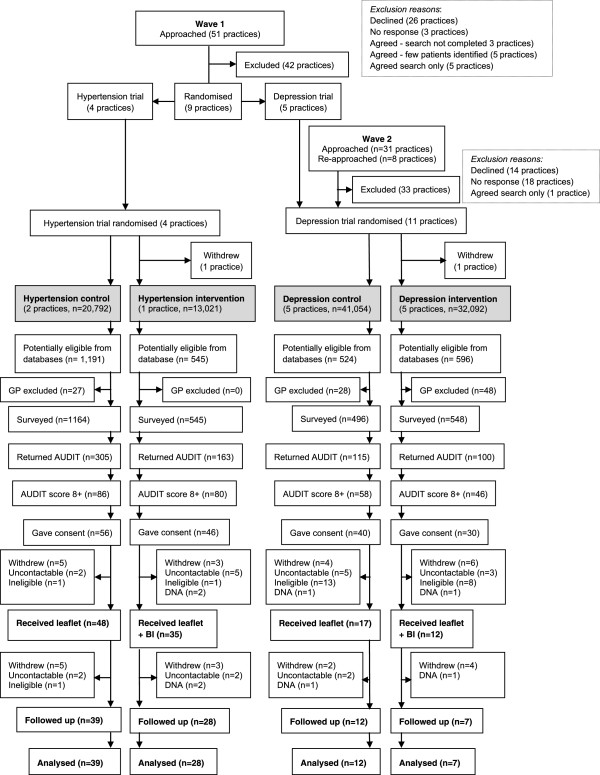
Thirteen general practices in North East England were randomized to the intervention or control arm of one of two parallel pilot trials. Adult patients drinking excessively and diagnosed with hypertension or mild-to-moderate depression received the Alcohol Use Disorders Identification Test (AUDIT) by postal survey. Consenting respondents scoring more than 7 on AUDIT (score range 0 to 40) received brief alcohol consumption advice plus an information leaflet (intervention) or an information leaflet alone (control) with follow-up at six months. Measurements included the numbers of patients eligible, recruited, and retained, and the AUDIT score and systolic/diastolic blood pressure of each patient or the nine-item Patient Health Questionnaire (PHQ-9) score. Acceptability was assessed via practitioner feedback and patient willingness to be screened, recruited, and retained at follow-up.
In the hypertension trial, 1709 of 33,813 adult patients (5.1%) were eligible and were surveyed. Among the eligible patients, 468 (27.4%) returned questionnaires; 166 (9.6% of those surveyed) screened positively on AUDIT and 83 (4.8% of those surveyed) were recruited (50.0% of positive screens). Sixty-seven cases (80.7% of recruited patients) completed follow-up at six months. In the depression trial, 1,044 of 73,146 adult patients (1.4%) were eligible and surveyed. Among these eligible patients, 215 (20.6%) responded; 104 (10.0% of those surveyed) screened positively on AUDIT and 29 (2.8% of those surveyed) were recruited (27.9% of positive screens). Nineteen cases (65.5% of recruited patients) completed follow-up at six months.
Recruitment and retention rates were higher in the hypertension trial than in the depression trial. A full brief intervention trial appears feasible for primary care patients with hypertension who drink excessively. High AUDIT scores in the depression trial suggest the importance of alcohol intervention in this group. However, future work may require alternative screening and measurement procedures.
Current Controlled Trials ISRCTN89156543; registered 21 October 2013.
许多血压升高或患有抑郁症的初级保健患者饮酒量可能达到有害水平。旨在减少酒精消费的简短干预措施(BI)可能会改善合并症并降低未来出现酒精问题的风险。然而,研究尚未证实其在该患者群体中的有效性。本研究旨在确定针对患有高血压或轻度至中度抑郁症的初级保健患者进行BI以减少过度饮酒的确定性试验的可行性。
英格兰东北部的13家全科诊所被随机分配到两项平行试点试验之一的干预组或对照组。通过邮政调查,对饮酒过量且被诊断患有高血压或轻度至中度抑郁症的成年患者进行酒精使用障碍识别测试(AUDIT)。同意参与的受访者在AUDIT上得分超过7分(分数范围为0至40)的,会收到简短的酒精消费建议以及一份信息传单(干预组),或仅收到一份信息传单(对照组),并在六个月后进行随访。测量指标包括符合条件、招募和保留的患者数量,以及每位患者的AUDIT得分和收缩压/舒张压,或九项患者健康问卷(PHQ-9)得分。通过从业者反馈以及患者在随访时接受筛查、被招募和被保留的意愿来评估可接受性。
在高血压试验中,33813名成年患者中有1709名(5.1%)符合条件并接受了调查。在符合条件的患者中,468名(27.4%)返回了问卷;166名(占被调查者的9.6%)在AUDIT上筛查呈阳性,83名(占被调查者的4.8%)被招募(占阳性筛查者中的50.0%)。67例(占招募患者的80.7%)在六个月时完成了随访。在抑郁症试验中,73146名成年患者中有1044名(1.4%)符合条件并接受了调查。在这些符合条件的患者中,215名(20.6%)做出了回应;104名(占被调查者的10.0%)在AUDIT上筛查呈阳性,29名(占被调查者的2.8%)被招募(占阳性筛查者中的27.9%)。19例(占招募患者的65.5%)在六个月时完成了随访。
高血压试验中的招募和保留率高于抑郁症试验。对于饮酒过量的初级保健高血压患者,进行全面的简短干预试验似乎是可行的。抑郁症试验中较高的AUDIT得分表明对该组进行酒精干预的重要性。然而,未来的工作可能需要采用替代的筛查和测量程序。
当前受控试验ISRCTN89156543;于2013年10月21日注册。