Zhang Xiaoran, Huang Weijun, Chen Xiaoyong, Lian Yufan, Wang Jiancheng, Cai Chuang, Huang Li, Wang Tao, Ren Jie, Xiang Andy Peng
Biotherapy Center, Third Affiliated Hospital, Sun Yat-Sen University, Guangzhou 510275, China; Center for Stem Cell Biology and Tissue Engineering, Key Laboratory for Stem Cells and Tissue Engineering, Ministry of Education, Sun Yat-Sen University, Guangzhou 510275, China.
Center for Stem Cell Biology and Tissue Engineering, Key Laboratory for Stem Cells and Tissue Engineering, Ministry of Education, Sun Yat-Sen University, Guangzhou 510275, China.
Mol Ther. 2017 Jun 7;25(6):1434-1447. doi: 10.1016/j.ymthe.2017.04.004. Epub 2017 Apr 26.
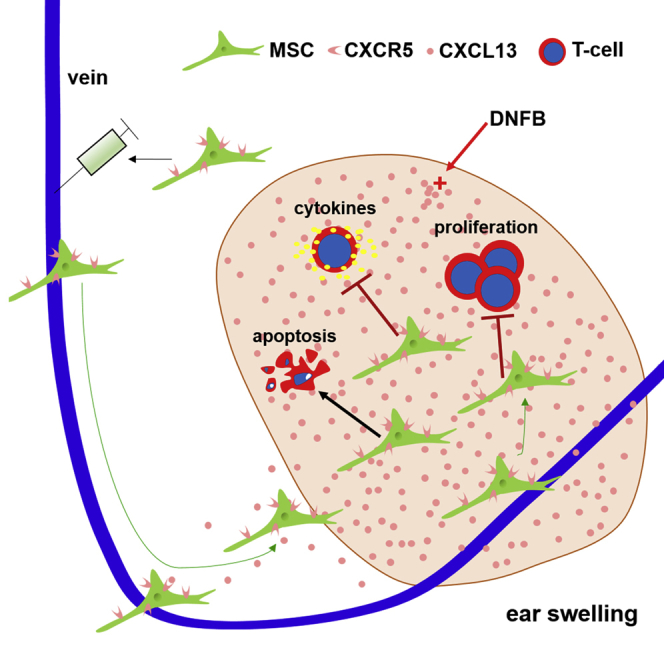
Mesenchymal stromal cells (MSCs) can modulate inflammation and contribute to tissue regeneration and, thus, have emerged as a promising option for cell-based therapy. However, the ability of MSCs to migrate to injured tissues still needs to be improved. In this study, we investigated whether genetically engineered MSCs could exhibit increased migratory properties and improved therapeutic efficacy. Using a mouse model of contact hypersensitivity (CHS), chemokine gene expression screening revealed that CXCL13 changed most significantly in injured tissue. Unfortunately, MSCs hardly express the corresponding receptor, CXCR5. Thus, CXCR5-overexpressing MSCs (MSC) were generated that retained their abilities of proliferation, differentiation, and immunomodulation. Furthermore, MSC showed significantly increased migrating ability toward CXCL13. Importantly, systemic infusion of MSC dramatically suppressed CHS in mice, as evidenced by decreased levels of inflammatory cell infiltration and pro-inflammatory cytokine production. Numerous MSC migrated into inflamed ears, localized with T cells, inhibited T cell proliferation, promoted T cell apoptosis, and suppressed the production of T cell-derived pro-inflammatory factors. Collectively, these findings demonstrate that CXCR5 overexpression increases the ability of MSCs to respond to migratory stimuli and highly intensifies their immunomodulatory effects in vivo. This strategy for enhancing targeted stem/progenitor cell homing may improve the efficacy of MSC-based therapies.
间充质基质细胞(MSCs)可调节炎症并促进组织再生,因此已成为基于细胞疗法的一个有前景的选择。然而,MSCs迁移至损伤组织的能力仍有待提高。在本研究中,我们调查了基因工程改造的MSCs是否能表现出增强的迁移特性和改善的治疗效果。使用接触性超敏反应(CHS)小鼠模型,趋化因子基因表达筛选显示CXCL13在损伤组织中变化最为显著。不幸的是,MSCs几乎不表达相应受体CXCR5。因此,生成了过表达CXCR5的MSCs(MSC),其保留了增殖、分化和免疫调节能力。此外,MSC对CXCL13显示出显著增强的迁移能力。重要的是,全身性输注MSC可显著抑制小鼠的CHS,炎症细胞浸润水平和促炎细胞因子产生减少证明了这一点。大量MSC迁移至发炎的耳朵,与T细胞定位在一起,抑制T细胞增殖,促进T细胞凋亡,并抑制T细胞衍生的促炎因子的产生。总体而言,这些发现表明CXCR5过表达增加了MSCs对迁移刺激的反应能力,并在体内高度增强了它们的免疫调节作用。这种增强靶向性干细胞/祖细胞归巢的策略可能会提高基于MSC的治疗效果。