Azzarelli Roberta, Hurley Christopher, Sznurkowska Magdalena K, Rulands Steffen, Hardwick Laura, Gamper Ivonne, Ali Fahad, McCracken Laura, Hindley Christopher, McDuff Fiona, Nestorowa Sonia, Kemp Richard, Jones Kenneth, Göttgens Berthold, Huch Meritxell, Evan Gerard, Simons Benjamin D, Winton Douglas, Philpott Anna
Department of Oncology, University of Cambridge, Hutchison/MRC Research Centre, Hills Road, Cambridge CB2 0XZ, UK; Wellcome Trust-Medical Research Council Cambridge Stem Cell Institute, University of Cambridge, Tennis Court Road, Cambridge CB2 1QR, UK.
Department of Oncology, University of Cambridge, Hutchison/MRC Research Centre, Hills Road, Cambridge CB2 0XZ, UK; Cancer Research UK Cambridge Research Institute, Li Ka Shing Centre, Robinson Way, Cambridge CB2 0RE, UK.
Dev Cell. 2017 May 8;41(3):274-286.e5. doi: 10.1016/j.devcel.2017.04.004. Epub 2017 Apr 27.
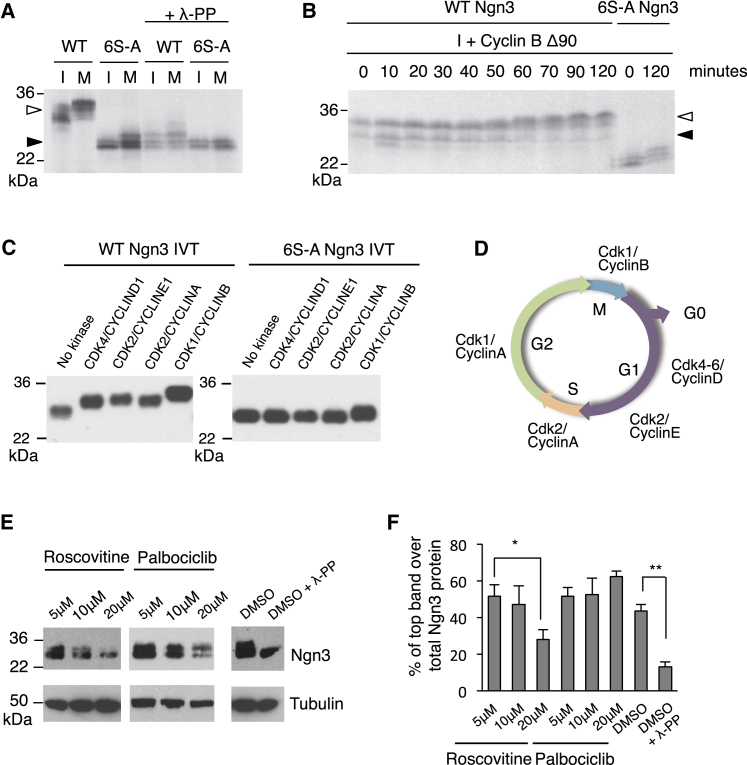
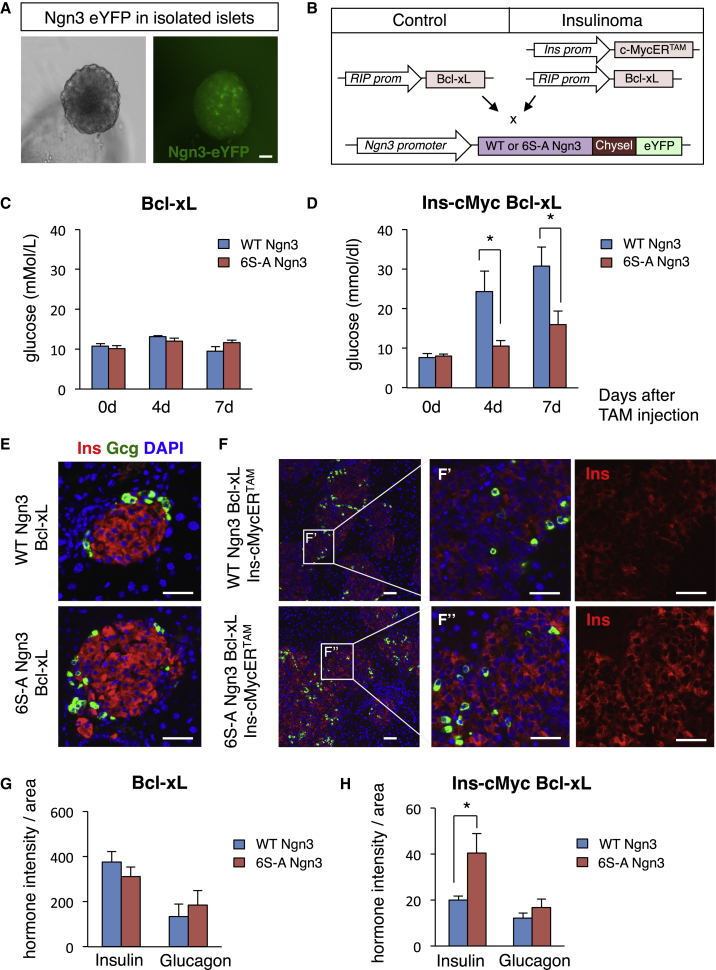
The proneural transcription factor Neurogenin3 (Ngn3) plays a critical role in pancreatic endocrine cell differentiation, although regulation of Ngn3 protein is largely unexplored. Here we demonstrate that Ngn3 protein undergoes cyclin-dependent kinase (Cdk)-mediated phosphorylation on multiple serine-proline sites. Replacing wild-type protein with a phosphomutant form of Ngn3 increases α cell generation, the earliest endocrine cell type to be formed in the developing pancreas. Moreover, un(der)phosphorylated Ngn3 maintains insulin expression in adult β cells in the presence of elevated c-Myc and enhances endocrine specification during ductal reprogramming. Mechanistically, preventing multi-site phosphorylation enhances both Ngn3 stability and DNA binding, promoting the increased expression of target genes that drive differentiation. Therefore, multi-site phosphorylation of Ngn3 controls its ability to promote pancreatic endocrine differentiation and to maintain β cell function in the presence of pro-proliferation cues and could be manipulated to promote and maintain endocrine differentiation in vitro and in vivo.
神经原性转录因子Neurogenin3(Ngn3)在胰腺内分泌细胞分化中起关键作用,尽管对Ngn3蛋白的调控在很大程度上尚未得到充分研究。在此,我们证明Ngn3蛋白在多个丝氨酸 - 脯氨酸位点经历细胞周期蛋白依赖性激酶(Cdk)介导的磷酸化。用Ngn3的磷酸化突变体形式取代野生型蛋白会增加α细胞的生成,α细胞是发育中的胰腺中最早形成的内分泌细胞类型。此外,未磷酸化的Ngn3在c-Myc升高的情况下维持成年β细胞中的胰岛素表达,并在导管重编程过程中增强内分泌细胞特化。从机制上讲,阻止多位点磷酸化可增强Ngn3的稳定性和DNA结合能力,促进驱动分化的靶基因表达增加。因此,Ngn3的多位点磷酸化控制其在存在促增殖信号时促进胰腺内分泌分化和维持β细胞功能的能力,并且可以通过操控来在体外和体内促进和维持内分泌分化。