Najar Mehdi, Krayem Mohammad, Meuleman Nathalie, Bron Dominique, Lagneaux Laurence
Laboratory of Clinical Cell Therapy, Institut Jules Bordet, Université Libre de Bruxelles (ULB), Campus Erasme, Belgium.
Laboratory of Oncology and Experimental Surgery, Institut Jules Bordet, Université Libre de Bruxelles, Brussels 1000, Belgium.
Immune Netw. 2017 Apr;17(2):89-102. doi: 10.4110/in.2017.17.2.89. Epub 2017 Apr 20.
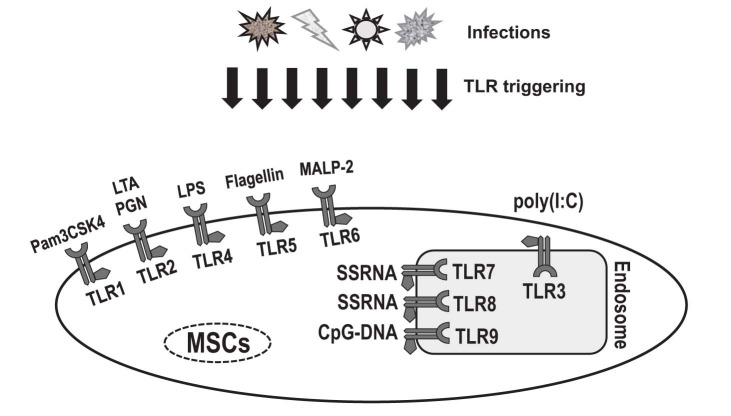
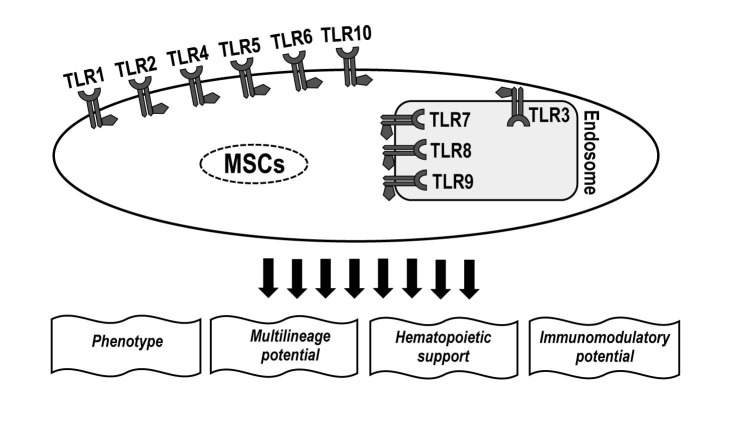
Mesenchymal Stromal Cells (MSCs) are potential cellular candidates for several immunotherapy purposes. Their multilineage potential and immunomodulatory properties make them interesting tools for the treatment of various immunological diseases. However, depending on the local microenvironment, diverse biological functions of MSCs can be modulated. Indeed, during infections such as obtained following TLR-agonist engagement (called as TLR priming), the phenotype, multilineage potential, hematopoietic support and immunomodulatory capacity of MSCs can present critical changes, which could further affect their therapeutic potential. Thus, for appropriate clinical application of MSCs, it is important to well know and understand these effects in particular during infectious episodes and to find the suitable experimental settings to study that. Pre-stimulation of MSCs with a specific TLR ligand may serve as an effective priming step to modulate one of its function to achieve a desired therapeutic issue.
间充质基质细胞(MSCs)是多种免疫治疗目的的潜在细胞候选者。它们的多向分化潜能和免疫调节特性使其成为治疗各种免疫性疾病的有趣工具。然而,根据局部微环境,MSCs的多种生物学功能可被调节。事实上,在诸如TLR激动剂激活后发生的感染(称为TLR预激活)期间,MSCs的表型、多向分化潜能、造血支持和免疫调节能力会出现关键变化,这可能进一步影响其治疗潜力。因此,为了MSCs的适当临床应用,尤其在感染发作期间充分了解和理解这些影响并找到合适的实验设置来进行研究非常重要。用特定的TLR配体对MSCs进行预刺激可能作为一种有效的预激活步骤,以调节其一种功能来实现期望的治疗效果。