
在经历一次引发情感的日常生活事件后,身体活动会增加。
Physical Activity Increases after an Affectively Arousing Daily Life Event.
作者信息
Pollak Michael H, Hart J Ryan
机构信息
Department of Psychiatry and Behavioral Sciences, Oklahoma State University Center for Health Sciences, TulsaOK, USA.
出版信息
Front Psychol. 2017 Apr 18;8:518. doi: 10.3389/fpsyg.2017.00518. eCollection 2017.
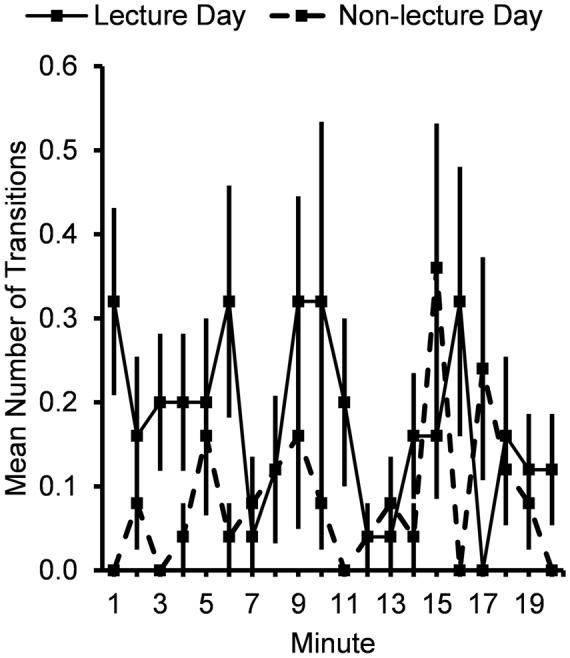
Evidence that structured physical activity can help to regulate affective state has spurred interest in identifying associations between unstructured physical activity and affective states during daily life. The present study examined whether stressful daily life situations that elicit affective arousal also elicit increased physical activity in the form of restless movement. The study compared the physical activity of professors ( = 25) after presenting a classroom lecture to their physical activity at the same time of day on a non-lecture workday. The expectation was that lecturing would increase affective arousal, leading to greater restless movement following the lecture compared to the non-lecture control day. The study assessed subjective arousal to confirm that arousal was higher during the lecture. The primary outcome measures were actigraphy-measured standing and stepping times and number of steps and posture transitions. Results indicate that energetic and tense arousal were higher during the lecture than during the control period. Mean (±SE) up time (standing and stepping) for the 1st minute of the 20 minute post-lecture period was double that of the last minute (32.8 ± 5.73 s to 16.5 ± 5.41 s), while it remained low throughout the comparison period on the control day ( = 0.01). Subjects also took more steps ( = 0.006) and engaged in more transitions between sitting and standing ( = 0.02) after the lecture than after the control period. These results support the conclusion that stressful daily life situations that elicit affective arousal also elicit increased physical activity in the form of restless movement and suggest that affective responses to stressful situations may be important determinants of physical activity during daily life.
有证据表明,有组织的体育活动有助于调节情绪状态,这激发了人们对确定日常生活中无组织体育活动与情绪状态之间关联的兴趣。本研究调查了引发情绪唤醒的紧张日常生活情境是否也会引发以不安运动形式增加的体育活动。该研究比较了25名教授在课堂授课后与在非授课工作日同一天同一时间的体育活动情况。预期是授课会增加情绪唤醒,导致授课后比非授课对照日有更多的不安运动。该研究评估了主观唤醒以确认授课期间唤醒水平更高。主要结果测量指标是通过活动记录仪测量的站立和行走时间、步数以及姿势转换次数。结果表明,授课期间的精力充沛和紧张唤醒水平高于对照期。授课后20分钟时段第1分钟的平均(±标准误)活动时间(站立和行走)是最后1分钟的两倍(32.8±5.73秒对16.5±5.41秒),而在对照日的整个比较时段内该时间一直较低(P = 0.01)。与对照期后相比,授课后受试者也走了更多步数(P = 0.006),并且在坐立之间转换更频繁(P = 0.02)。这些结果支持以下结论:引发情绪唤醒的紧张日常生活情境也会引发以不安运动形式增加的体育活动,并表明对压力情境的情绪反应可能是日常生活中体育活动的重要决定因素。


 Zotero 插件