Kimball S M, Mirhosseini N, Holick M F
Pure North S'Energy Foundation, Calgary, AB, Canada.
Boston University Medical Center, Boston, MA, USA.
Dermatoendocrinol. 2017 Apr 13;9(1):e1300213. doi: 10.1080/19381980.2017.1300213. eCollection 2017.
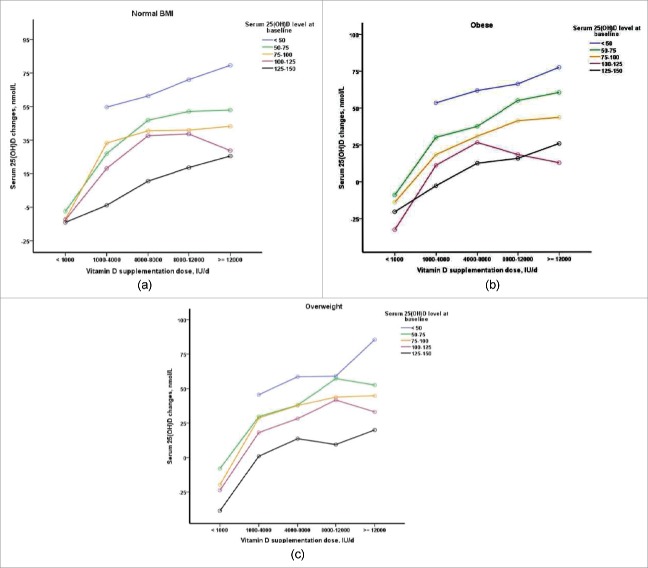
Supplementation by the general public with vitamin D at doses above the Tolerable Upper Level of Intake (UL) is becoming quite common. The objective of the current analysis was to characterize the effect of vitamin D supplementation at doses up to 15,000 IU/d in a community-based program on vitamin D status, calcium homeostasis as well as on kidney, liver and immune function. We evaluated data collected for 3,882 participants in a community program for whom there were blood measurements at program entry and at follow-up within 6-18 months between 2013 and 2015. Participants were supplemented with a wide range of vitamin D doses (1,000 - 15,000 IU/d) aimed at achieving serum 25-hydroxyvitamin D [25(OH)D] levels of at least 100 nmol/L. Serum 25(OH)D concentrations up to 300 nmol/L were achieved without perturbation of calcium homeostasis or incidence of toxicity. Hypercalcemia and hypercalciuria were not related to an increase in 25(OH)D concentrations nor vitamin D dose. To achieve serum 25(OH)D levels >100 nmol/L on average, required vitamin D intakes of 6,000 IU/d for normal Body Mass Index (BMI), 7,000 IU/d for overweight and 8,000 IU/d for obese. Doses of vitamin D in excess of 6,000 IU/d were required to achieve serum 25(OH)D concentrations above 100 nmol/L, especially in individuals who were overweight or obese without any evidence of toxicity. Serum 25(OH)D concentrations up to 300 nmol/L were found to be safe.
普通公众补充剂量超过可耐受最高摄入量(UL)的维生素D正变得相当普遍。当前分析的目的是在一项基于社区的项目中,描述每日补充剂量高达15,000国际单位的维生素D对维生素D状态、钙稳态以及肾脏、肝脏和免疫功能的影响。我们评估了在2013年至2015年期间,一个社区项目中3882名参与者的数据,这些参与者在项目开始时和6至18个月的随访期内进行了血液检测。参与者补充了广泛剂量的维生素D(1000 - 15,000国际单位/天),目标是使血清25-羟基维生素D[25(OH)D]水平至少达到100纳摩尔/升。在不干扰钙稳态或不发生毒性反应的情况下,血清25(OH)D浓度达到了300纳摩尔/升。高钙血症和高钙尿症与25(OH)D浓度的增加或维生素D剂量无关。对于正常体重指数(BMI)的人,平均要达到血清25(OH)D水平>100纳摩尔/升,需要每日摄入6000国际单位的维生素D;超重者需要7000国际单位/天;肥胖者需要8000国际单位/天。要使血清25(OH)D浓度高于100纳摩尔/升,需要超过6000国际单位/天的维生素D剂量,尤其是在超重或肥胖个体中,且没有任何毒性证据。发现血清25(OH)D浓度高达300纳摩尔/升是安全的。