Ramos Bernardes da Silva Filho Silvio, Oliveira Barbosa Jeam Haroldo, Rondinoni Carlo, Dos Santos Antonio Carlos, Garrido Salmon Carlos Ernesto, da Costa Lima Nereida Kilza, Ferriolli Eduardo, Moriguti Júlio César
Ribeirao Preto Medical School of University of Sao Paulo, Ribeirao Preto, SP, Brazil.
Faculty of Philosophy, Sciences and Letters at Ribeirao Preto, University of Sao Paulo (FFCLRP-USP), Ribeirao Preto, SP, Brazil.
Neuroimage Clin. 2017 Apr 3;15:15-24. doi: 10.1016/j.nicl.2017.04.001. eCollection 2017.
Alzheimer's disease (AD) is a primary and progressive neurodegenerative disorder, which is marked by cognitive deterioration and memory impairment. Atrophy of hippocampus and other basal brain regions is one of the most predominant structural imaging findings related to AD. Most studies have evaluated the pre-clinical and initial stages of AD through clinical trials using Magnetic Resonance Imaging. Structural biomarkers for advanced AD stages have not been evaluated yet, being considered only hypothetically.
To evaluate the brain morphometry of AD patients at all disease stages, identifying the structural neuro-degeneration profile associated with AD severity.
AD patients aged 60 years or over at different AD stages were recruited and grouped into three groups following the Clinical Dementia Rating (CDR) score: CDR1 (n = 16), CDR2 (n = 15), CDR3 (n = 13). Age paired healthy volunteers (n = 16) were also recruited (control group). Brain images were acquired on a 3T magnetic resonance scanner using a conventional Gradient eco 3D T1-w sequence without contrast injection. Volumetric quantitative data and cortical thickness were obtained by automatic segmentation using the Freesurfer software. Volume of each brain region was normalized by the whole brain volume in order to minimize age and body size effects. Volume and cortical thickness variations among groups were compared.
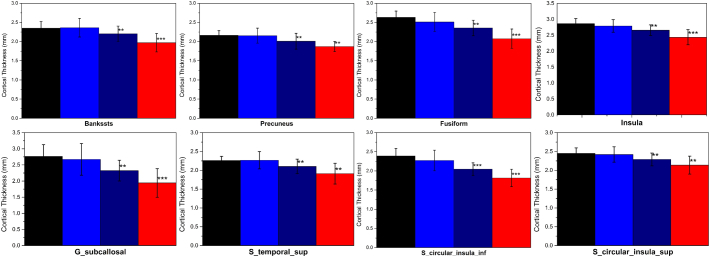
Atrophy was observed in the hippocampus, amygdala, entorhinal cortex, parahippocampal region, temporal pole and temporal lobe of patients suffering from AD at any stage. Cortical thickness was reduced only in the parahippocampal gyrus at all disease stages. Volume and cortical thickness were correlated with the Mini Mental State Examination (MMSE) score in all studied regions, as well as with CDR and disease duration.
As previously reported, brain regions affected by AD during its initial stages, such as hippocampus, amygdala, entorhinal cortex, and parahippocampal region, were found to be altered even in individuals with severe AD. In addition, individuals, specifically, with CDR 3, have multiple regions with lower volumes than individuals with a CDR 2. These results indicate that rates of atrophy have not plateaued out at CDR 2-3, and in severe patients there are yet neuronal loss and gliosis. These findings can add important information to the more accepted model in the literature that focuses mainly on early stages. Our findings allow a better understanding on the AD pathophysiologic process and follow-up process of drug treatment even at advanced disease stages.
阿尔茨海默病(AD)是一种原发性进行性神经退行性疾病,其特征为认知功能衰退和记忆障碍。海马体及其他脑基底区域萎缩是与AD相关的最主要结构影像学表现之一。大多数研究通过磁共振成像临床试验评估AD的临床前期和初始阶段。晚期AD阶段的结构生物标志物尚未得到评估,仅为假设性探讨。
评估各疾病阶段AD患者的脑形态测量学特征,确定与AD严重程度相关的结构神经退行性变特征。
招募60岁及以上处于不同AD阶段的患者,根据临床痴呆评定量表(CDR)评分分为三组:CDR1组(n = 16)、CDR2组(n = 15)、CDR3组(n = 13)。还招募了年龄匹配的健康志愿者(n = 16)作为对照组。使用常规梯度回波3D T1加权序列在3T磁共振扫描仪上采集脑图像,不注射造影剂。通过Freesurfer软件自动分割获取体积定量数据和皮质厚度。每个脑区的体积通过全脑体积进行归一化,以尽量减少年龄和体型的影响。比较各组间的体积和皮质厚度变化。
在任何阶段的AD患者中,均观察到海马体、杏仁核、内嗅皮质、海马旁区域、颞极和颞叶萎缩。在所有疾病阶段,仅海马旁回皮质厚度降低。在所有研究区域,体积和皮质厚度均与简易精神状态检查表(MMSE)评分相关,也与CDR和病程相关。
如先前报道,AD早期受影响的脑区,如海马体、杏仁核、内嗅皮质和海马旁区域,即使在重度AD个体中也有改变。此外,特别是CDR 3的个体,与CDR 2的个体相比,有多个脑区体积更小。这些结果表明,萎缩率在CDR 2 - 3阶段并未趋于平稳,在重度患者中仍存在神经元丢失和胶质增生。这些发现可为文献中主要关注早期阶段的更普遍接受的模型增添重要信息。我们的发现有助于更好地理解AD的病理生理过程以及即使在疾病晚期的药物治疗随访过程。