Verma Inderjeet, Syngle Ashit, Krishan Pawan
Department of Pharmaceutical Sciences and Drug Research, Punjabi University, Patiala, India.
Cardio Rheuma and Healing Touch City Clinic, Chandigarh and Rheumatologist Fortis Multi Specialty Hospital, Mohali, India.
Indian Heart J. 2017 Mar-Apr;69(2):200-206. doi: 10.1016/j.ihj.2016.10.013. Epub 2016 Nov 14.
Cardiovascular (CV) disease is leading cause of mortality in rheumatoid arthritis (RA). Dysfunction of the vascular endothelium is a hallmark of most conditions that are associated with atherosclerosis and is therefore an early feature in atherogenesis. Biomarkers for rapid evolution of CV complications would be highly desirable for risk stratification. Finally, predictive biomarkers for cardiovascular risk would allow tailoring therapy to the individual. We assessed endothelial function and atherosclerosis utilizing carotid intima-media thickness (CIMT) in RA in context of clinical and laboratory markers in Indian RA population.
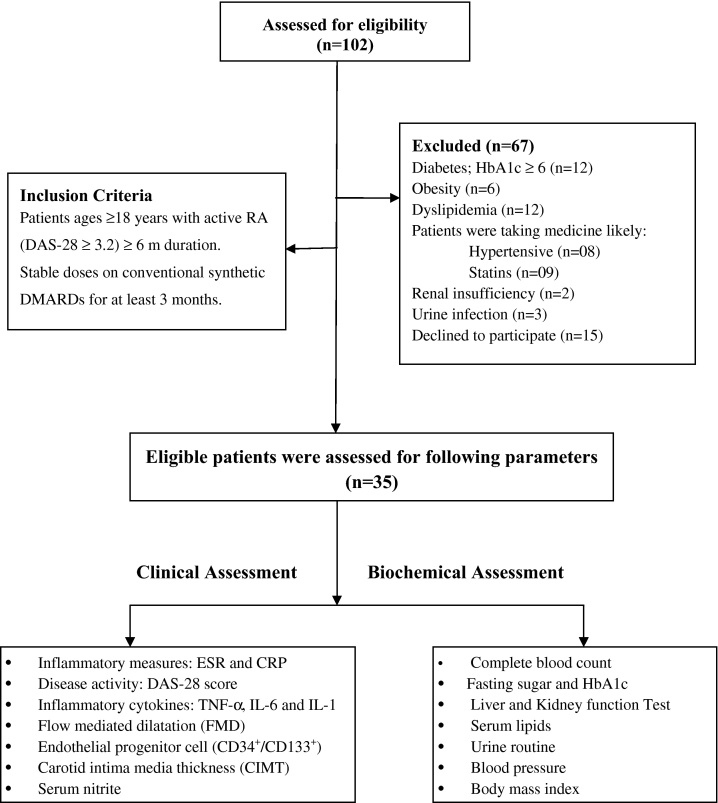
We performed a prospective study of 35 consecutive RA patients and 25 age- and sex matched healthy controls. Patients with traditional CV risk factors were excluded. Flow mediated dilatation (FMD) as measures of endothelial function and CIMT as measures of atherosclerosis were assessed. Disease-specific measures, inflammatory measures, serum cytokines, serum nitrite, lipids and endothelial progenitor cells (EPCs) were estimated.
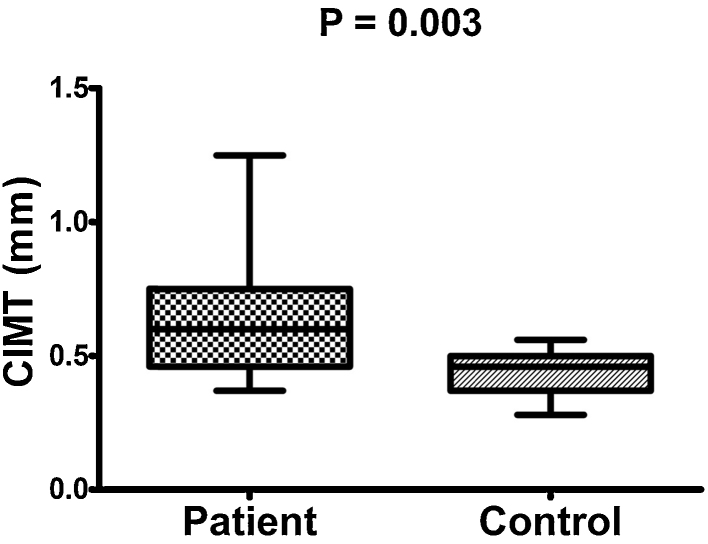
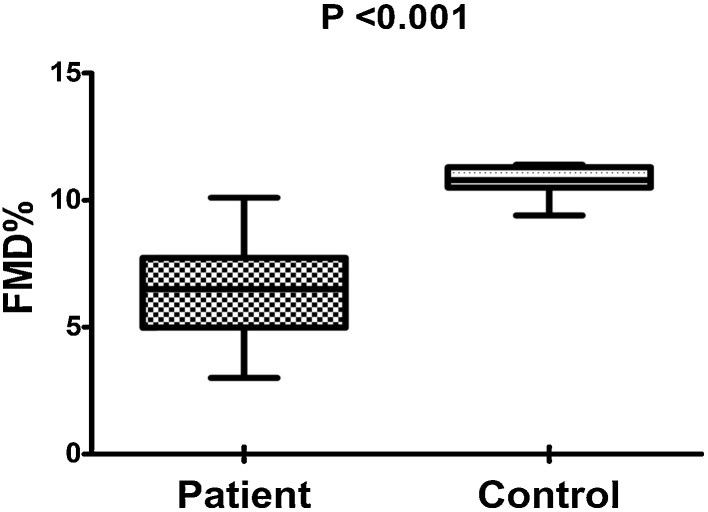
FMD was significantly lower in RA (6.53%±1.81%) compared to controls (10.77%±0.53%; p<0.001). CIMT (mm) was significantly increased in RA (0.62±0.17) vs. controls (0.043±0.07; p=0.003). In RA patients, FMD% inversely correlated with CIMT, CRP, DAS-28, TNF-α, serum nitrite and positively correlated with EPC. CIMT correlated with age, DAS-28, IL-6, HDL, LDL, and inversely correlated with EPC.
In the present study, FMD and CIMT were impaired in RA, indicating endothelial dysfunction and accelerated atherosclerosis respectively. CRP, TNF-α, serum nitrite, DAS-28 and depleted EPC population predicted endothelial dysfunction. Age, IL-6, HDL, LDL and depleted EPC population predicted accelerated atherosclerosis.
心血管(CV)疾病是类风湿关节炎(RA)患者死亡的主要原因。血管内皮功能障碍是大多数与动脉粥样硬化相关疾病的一个标志,因此是动脉粥样硬化形成的早期特征。对于风险分层而言,非常需要能够快速提示心血管并发症进展的生物标志物。最后,心血管风险的预测性生物标志物将有助于实现个体化治疗。我们结合印度类风湿关节炎患者的临床和实验室指标,利用颈动脉内膜中层厚度(CIMT)评估类风湿关节炎患者的内皮功能和动脉粥样硬化情况。
我们对35例连续的类风湿关节炎患者和25例年龄及性别匹配的健康对照者进行了一项前瞻性研究。排除具有传统心血管危险因素的患者。评估了作为内皮功能指标的血流介导的血管舒张(FMD)和作为动脉粥样硬化指标的CIMT。还评估了疾病特异性指标、炎症指标、血清细胞因子、血清亚硝酸盐、血脂和内皮祖细胞(EPCs)。
与对照组(10.77%±0.53%)相比,类风湿关节炎患者的FMD显著降低(6.53%±1.81%;p<0.001)。类风湿关节炎患者的CIMT(mm)显著增加(0.62±1.7),而对照组为(0.043±0.07;p=0.003)。在类风湿关节炎患者中,FMD%与CIMT、CRP、DAS-28、TNF-α、血清亚硝酸盐呈负相关,与EPC呈正相关。CIMT与年龄、DAS-28、IL-6、高密度脂蛋白(HDL)、低密度脂蛋白(LDL)相关,与EPC呈负相关。
在本研究中,类风湿关节炎患者的FMD和CIMT受损,分别表明内皮功能障碍和动脉粥样硬化加速。CRP、TNF-α、血清亚硝酸盐、DAS-28和EPC数量减少预示着内皮功能障碍。年龄、IL-6、HDL、LDL和EPC数量减少预示着动脉粥样硬化加速。