Mohan Alladi, Sada Sujay, Kumar B Siddhartha, Sarma K V S, Devi B Vijayalakshmi, Rao P V L N Srinivasa, Rajasekhar D, Katyarmal D T
Department of Medicine, Sri Venkateswara Institute of Medical Sciences, Tirupati, India.
Indian J Med Res. 2014 Sep;140(3):379-86.
BACKGROUND & OBJECTIVES: Patients with rheumatoid arthritis (RA) are more prone for accelerated atherosclerosis and Asian Indians as an ethnic group are predisposed to a high risk of premature atherosclerosis. However, sparse data are available regarding the burden of atherosclerosis among asymptomatic adult patients with RA in south India. We studied the burden of asymptomatic atherosclerosis in adult south Indian patients with RA at Tirupati, Andhra Pradesh, India, utilizing carotid intima-media thickness (CIMT) as a surrogate marker.
Ultrasound examination of the carotids and CIMT measurement (mm) were carried out in 32 patients with RA, 32 age- and gender-matched normal controls, and 32 patients with atherosclerosis and angiographically proven coronary artery disease. The CIMT values in patients with CAD and normal controls were used to derive the appropriate cut-off value of CIMT for defining atherosclerosis that would be applicable for the ethnic population studied.
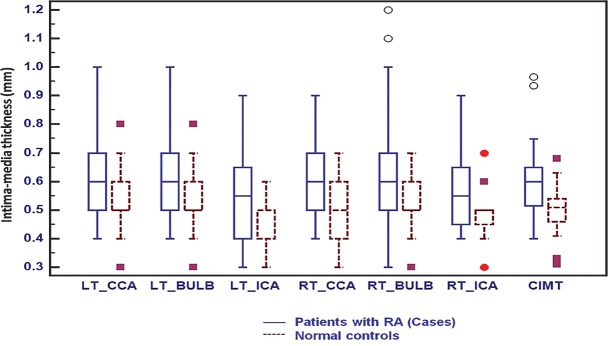
Patients with RA had a higher mean CIMT (mm) compared with normal control subjects (0.598 ± 0.131 vs 0.501 ± 0.081; p0 = 0.001). Carotid plaque was found more frequently among the cases compared with normal controls [5/32 (15.6%) vs 0/32 (0%), p0 =0.020]. Using this cut-off value derived by the receiver operator characteristic curve method (≥ 0.57 mm; sensitivity 84.4; specificity 90.6%) and the 75 th percentile value among normal controls (≥ 0.55 mm) as surrogate markers, the presence of subclinical atherosclerosis was significantly more among asymptomatic patients with RA compared with normal controls [(59.3 vs 12.5%; p0 <0.001) and (62.5 vs 25%; P<0.001) respectively].
INTERPRETATION & CONCLUSIONS: Based on the present findings CIMT appears to be a useful surrogate marker for detecting subclinical atherosclerosis in adult Indian patients with RA.
类风湿关节炎(RA)患者更容易出现动脉粥样硬化加速,而亚洲印度人作为一个族群易患早发性动脉粥样硬化的高风险疾病。然而,关于印度南部无症状成年RA患者的动脉粥样硬化负担的数据却很稀少。我们在印度安得拉邦蒂鲁伯蒂对成年南部印度RA患者无症状动脉粥样硬化负担进行了研究,采用颈动脉内膜中层厚度(CIMT)作为替代标志物。
对32例RA患者、32例年龄和性别匹配的正常对照者以及32例经血管造影证实患有动脉粥样硬化和冠状动脉疾病的患者进行了颈动脉超声检查并测量CIMT(毫米)。使用CAD患者和正常对照者的CIMT值得出适用于所研究族群人群的定义动脉粥样硬化的CIMT合适截断值。
与正常对照者相比,RA患者的平均CIMT(毫米)更高(0.598±0.131对0.501±0.081;p0 = 0.001)。与正常对照者相比,病例中颈动脉斑块的发现频率更高[5/32(15.6%)对0/32(0%),p0 = 0.020]。使用通过受试者工作特征曲线法得出的该截断值(≥0.57毫米;敏感性84.4;特异性90.6%)以及正常对照者中的第75百分位数(≥0.55毫米)作为替代标志物,无症状RA患者中亚临床动脉粥样硬化的存在明显多于正常对照者[分别为(59.3对12.5%;p0<0.001)和(62.5对25%;P<0.001)]。
基于目前的研究结果,CIMT似乎是检测成年印度RA患者亚临床动脉粥样硬化的有用替代标志物。