Zangrando Federico, Piccinini Giulia, Tagliolini Clara, Marsilli Gabriella, Iosa Marco, Vulpiani Maria Chiara, Paolucci Teresa
Complex Unit of Physical Medicine and Rehabilitation, Policlinico Umberto I Hospital, "Sapienza" University of Rome, Rome, Italy.
Unit of Physical Medicine and Rehabilitation, Sant'Andrea Hospital, "Sapienza" University of Rome, Rome, Italy.
J Pain Res. 2017 Apr 20;10:941-949. doi: 10.2147/JPR.S129313. eCollection 2017.
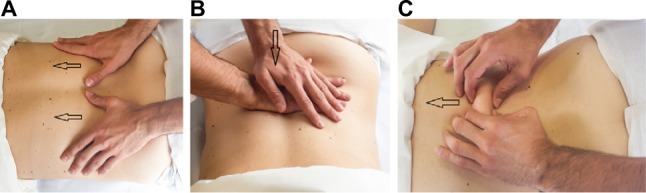
Massage therapy is an important element of rehabilitation in the treatment of chronic low back pain (CLBP). The objective of this study was to determine the relative efficacy of massage therapy between traditional massage and a new massage approach for CLBP. We also examined whether any reduction in pain was linked to interoceptive awareness and parasympathetic activation.
A single-blind, randomized, controlled trial of 51 patients who were allocated into a traditional massage therapy group (TMG; N=24, mean age: 50.54±9.13 years) or experimental massage therapy group (SMG; N=27, mean age: 50.77±6.80 years). The primary outcome was the reduction in pain per the visual analog scale (VAS); the secondary outcome measures were multidimensional pain intensity on the McGill Pain Questionnaire, pain-related disability per the Waddel Disability Index, interoceptive awareness per the Multidimensional Assessment of Interoceptive Awareness Questionnaire, quality of life per the Short Form - 12 Health Survey, and heart rate variability, expressed as the coherence ratio (CR) by photoplethysmography. The following outcome measures were assessed at baseline, at the end of the treatment program, and at the 3-month follow-up. The mean and standard deviation were calculated for continuous data. Mann-Whitney test was used to perform between-group comparisons, Friedman's analysis was used for data on the 3 assessment times in each group, and Spearman's coefficient was used to analyze correlations.
Both approaches had a positive result on pain, an effect that was more acute in the SMG versus TMG for all pain scales, with better maintenance at the 3-month follow-up (VAS =0.005 and =0.098; Waddell Index =0.034 and 0.044; McGill total =0.000 and 0.003). In the SMG, CR scores were significant at baseline and at the end of the treatment program (=0.000 and 0.002).
The new massage approach with a preparatory phase that is pleasant to the touch was more effective than the traditional approach for CLBP.
按摩疗法是慢性下腰痛(CLBP)康复治疗的重要组成部分。本研究的目的是确定传统按摩与一种新的按摩方法对CLBP的相对疗效。我们还研究了疼痛的减轻是否与内感受性觉知和副交感神经激活有关。
对51例患者进行单盲、随机对照试验,将其分为传统按摩治疗组(TMG;N = 24,平均年龄:50.54±9.13岁)或实验性按摩治疗组(SMG;N = 27,平均年龄:50.77±6.80岁)。主要结局是根据视觉模拟量表(VAS)评估的疼痛减轻情况;次要结局指标包括麦吉尔疼痛问卷上的多维疼痛强度、根据瓦德尔残疾指数评估的疼痛相关残疾、根据内感受性觉知多维评估问卷评估的内感受性觉知、根据简短健康调查问卷-12评估的生活质量,以及通过光电容积描记法表示为相干比(CR)的心率变异性。在基线、治疗方案结束时和3个月随访时评估以下结局指标。对连续数据计算均值和标准差。采用曼-惠特尼检验进行组间比较,采用弗里德曼分析处理每组3次评估的数据,采用斯皮尔曼系数分析相关性。
两种方法对疼痛均有积极效果,在所有疼痛量表上,SMG组的效果比TMG组更显著,且在3个月随访时维持得更好(VAS = 0.005和 = 0.098;瓦德尔指数 = 0.034和0.044;麦吉尔总分 = 0.000和0.003)。在SMG组中,CR分数在基线和治疗方案结束时具有显著性(= 0.000和0.002)。
这种带有触感宜人的准备阶段的新按摩方法对CLBP的治疗比传统方法更有效。