Astroza Gastón, Catalán Manuel, Consigliere Lucas, Selman Tomás, Salvadó José, Rubilar Francisco
Pontificia Universidad Católica de Chile, Santiago, Chile.
Cent European J Urol. 2017;70(1):88-92. doi: 10.5173/ceju.2016.919. Epub 2016 Dec 28.
Use of a ureteral access sheath (UAS) within flexible ureteroscopy (fURS) for the management of kidney and ureteral stones has shown improvements in its effectiveness, but it is also associated with increased risk of ureteral injury. Use of ureteral stent (US) after fURS is recommended by some authors, because of its role in reducing postoperative pain and preventing complications. Our objective is to determine if postoperative stenting is necessary in pre-stented patients that underwent fURS using UAS.
A retrospective history review of patients who underwent fURS using UAS at our hospital between July 1 2013 and May 31 2016 was performed. Only pre-stented patients were included. All procedures were performed using the same UAS (Boston Navigator TM., 11-13 Fr.). Patients were separated according to the use or not of postoperative US. The same US (26 cm 6 Fr percuflex, Boston Scienfic) was used for all stented patients. Clinical parameters, stone demographics, operative time and postoperative events were analyzed.
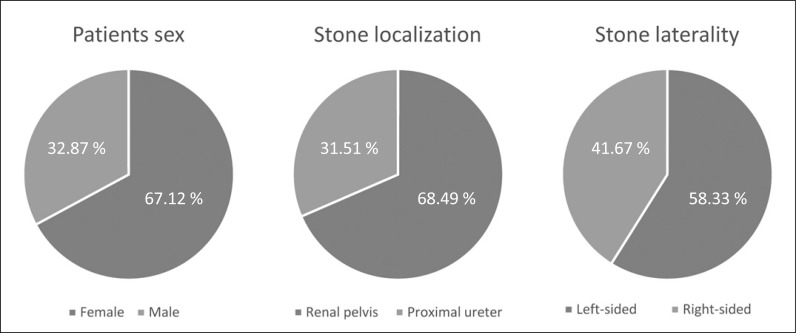
Seventy patients met the inclusion criteria. Mean stone size was 8.5 mm (SD 7.06), 68.49% were located in the renal pelvis and 31.51% were in the proximal ureter. Reasons of preoperative stenting were: 14 (19.18%) ureteral stricture, 17 (23.29%) urosepsis, 29 (39.73%) residual stones after a first intervention (stage procedure) and 13 (17.8%) unsuccessful extracorporeal shockwave lithotripsy. Mean operative time was 88 minutes (SD 37.20); 32 patients (45.71%) were stented and 38 (54.28%) were not. There were no significant differences in operative time (p = 0.85) or postoperative outcomes (p = 1).
A postoperative ureteral stent is not necessary after fURS using UAS in pre-stented patients.
在软性输尿管镜检查(fURS)中使用输尿管通路鞘(UAS)来处理肾和输尿管结石已显示出其有效性有所提高,但它也与输尿管损伤风险增加相关。一些作者推荐在fURS后使用输尿管支架(US),因为其在减轻术后疼痛和预防并发症方面的作用。我们的目的是确定在使用UAS进行fURS的预先置入支架的患者中术后是否有必要置入支架。
对2013年7月1日至2016年5月31日期间在我院接受使用UAS的fURS的患者进行回顾性病史审查。仅纳入预先置入支架的患者。所有手术均使用相同的UAS(波士顿导航器TM,11 - 13 Fr.)。根据是否使用术后US对患者进行分组。所有置入支架的患者均使用相同的US(26 cm 6 Fr Percuflex,波士顿科学公司)。分析临床参数、结石特征、手术时间和术后事件。
70例患者符合纳入标准。平均结石大小为8.5 mm(标准差7.06),68.49%位于肾盂,31.51%位于输尿管近端。术前置入支架的原因有:14例(19.18%)输尿管狭窄,17例(23.29%)尿脓毒症,29例(39.73%)首次干预(分期手术)后残留结石,13例(17.8%)体外冲击波碎石术失败。平均手术时间为88分钟(标准差37.20);32例患者(45.71%)置入支架,38例(54.28%)未置入支架。手术时间(p = 0.85)或术后结果(p = 1)无显著差异。
在预先置入支架的患者中,使用UAS进行fURS后无需放置术后输尿管支架。