Ugo Okoli, Ezinne Eze-Ajoku, Modupe Oludipe, Nicole Spieker, Winifred Ekezie, Kelechi Ohiri
SURE P MCH Project, National Primary Health Care Development Agency, Abuja, Nigeria.
Save One Million Lives Initiative, Abuja, Nigeria.
Health Serv Res Manag Epidemiol. 2016 Aug 31;3:2333392816662581. doi: 10.1177/2333392816662581. eCollection 2016 Jan-Dec.
Nigeria has a high population density but a weak health-care system. To improve the quality of care, 3 organizations carried out a quality improvement pilot intervention at the primary health-care level in selected rural areas.
To assess the change in quality of care in primary health-care facilities in rural Nigeria following the provision of technical governance support and to document the successes and challenges encountered.
A total of 6 states were selected across the 6 geopolitical zones of the country. However, assessments were carried out in 40 facilities in only 5 states. Selection was based on location, coverage, and minimum services offered. The facilities were divided randomly into 2 groups. The treatment group received quality-of-care assessment, continuous feedback, and improvement support, whereas the control group received quality assessment and no other support. Data were collected using the SafeCare Healthcare Standards and managed on the SafeCare Data Management System-AfriDB. Eight core areas were assessed at baseline and end line, and compliance to quality health-care standards was compared.
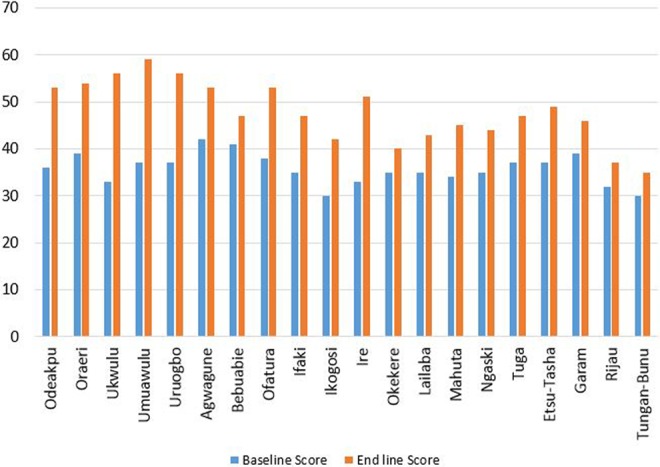
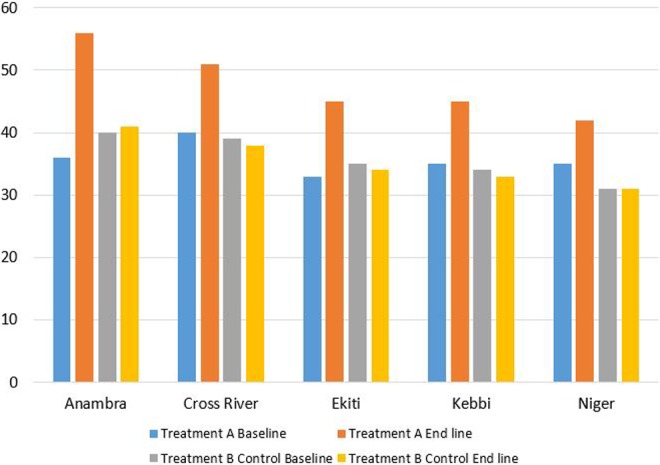
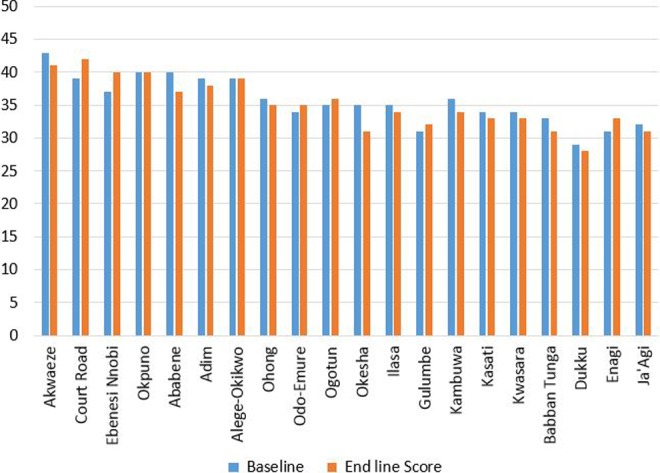
Outcomes from 40 facilities were accepted and analyzed. Overall scores increased in the treatment facilities compared to the control facilities, with strong evidence of improvement ( = 5.28, = .0004) and 11% average improvement, but no clear pattern of improvement emerged in the control group.
The study demonstrated governance support and active community involvement offered potential for quality improvement in primary health-care facilities.
尼日利亚人口密度高,但医疗体系薄弱。为提高医疗质量,3个组织在选定农村地区的初级卫生保健层面开展了质量改进试点干预。
评估在提供技术治理支持后,尼日利亚农村地区初级卫生保健机构的医疗质量变化,并记录所取得的成功和遇到的挑战。
在该国6个地缘政治区共选择了6个州。然而,仅在5个州的40家机构进行了评估。选择基于地点、覆盖范围和提供的最低服务。这些机构被随机分为2组。治疗组接受医疗质量评估、持续反馈和改进支持,而对照组接受质量评估且无其他支持。使用SafeCare医疗保健标准收集数据,并在SafeCare数据管理系统 - AfriDB上进行管理。在基线和终线评估8个核心领域,并比较对质量医疗保健标准的遵守情况。
40家机构的结果被接受并进行分析。与对照机构相比,治疗机构的总体得分有所提高,有明显的改善证据( = 5.28, = .0004),平均提高了11%,但对照组未出现明显的改善模式。
该研究表明,治理支持和社区积极参与为初级卫生保健机构的质量改进提供了潜力。