Yun Young Ho, Kim Young Ae, Lee Myung Kyung, Sim Jin Ah, Nam Byung-Ho, Kim Sohee, Lee Eun Sook, Noh Dong-Young, Lim Jae-Young, Kim Sung, Kim Si-Young, Cho Chi-Heum, Jung Kyung Hae, Chun Mison, Lee Soon Nam, Park Kyong Hwa, Park Sohee
Department of Biomedical Sciences, Seoul National University College of Medicine, Seoul, South Korea.
Cancer Research Institute, Seoul National University Hospital and College of Medicine, Seoul, South Korea.
BMC Cancer. 2017 May 2;17(1):298. doi: 10.1186/s12885-017-3290-9.
We aimed to evaluate the potential benefits of the Leadership and Coaching for Health (LEACH) program on physical activity (PA), dietary habits, and distress management in cancer survivors.
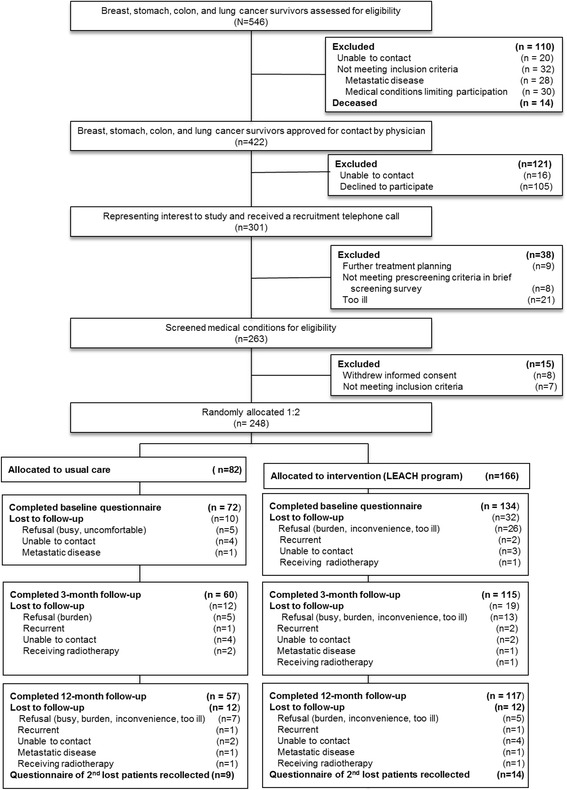
We randomly assigned 248 cancer survivors with an allocation ratio of two-to-one to the LEACH program (LP) group, coached by long-term survivors, or the usual care (UC) group. At baseline, 3, 6, and 12 months, we used PA scores, the intake of vegetables and fruits (VF), and the Post Traumatic Growth Inventory (PTGI) as primary outcomes and, for secondary outcomes, the Ten Rules for Highly Effective Health Behavior adhered to and quality of life (QOL), the Hospital Anxiety and Depression Scale (HADS), and the European Organization for Research and Treatment of Cancer Quality of Life Questionnaire (EORTC QLQ-C30).
For primary outcomes, the two groups did not significantly differ in PA scores or VF intake but differed marginally in PTGI. For secondary outcomes, the LP group showed a significantly greater improvement in the HADS anxiety score, the social functioning score, and the appetite loss and financial difficulties scores of the EORTC QLQ-C30 scales from baseline to 3 months. From baseline to 12 months, the LP group showed a significantly greater decrease in the EORTC QLQ-C30 fatigue score and a significantly greater increase in the number of the Ten Rules for Highly Effective Health Behavior.
Our findings indicate that the LEACH program, coached by long-term survivors, can provide effective management of the QOL of cancer survivors but not of their PA or dietary habits.
Clinical trial information can be found for the following: NCT01527409 (the date when the trial was registered: February 2012).
我们旨在评估健康领域领导力与辅导(LEACH)项目对癌症幸存者身体活动(PA)、饮食习惯和压力管理的潜在益处。
我们将248名癌症幸存者按二比一的分配比例随机分为由长期幸存者指导的LEACH项目(LP)组或常规护理(UC)组。在基线、3个月、6个月和12个月时,我们将PA得分、蔬菜和水果摄入量(VF)以及创伤后成长量表(PTGI)作为主要结局指标,将遵循的高效健康行为十条准则和生活质量(QOL)、医院焦虑抑郁量表(HADS)以及欧洲癌症研究与治疗组织生活质量问卷(EORTC QLQ - C30)作为次要结局指标。
对于主要结局指标,两组在PA得分或VF摄入量方面无显著差异,但在PTGI方面略有差异。对于次要结局指标,从基线到3个月,LP组在HADS焦虑得分、社会功能得分以及EORTC QLQ - C30量表的食欲减退和经济困难得分方面有显著更大的改善。从基线到12个月,LP组在EORTC QLQ - C30疲劳得分方面有显著更大的下降,在高效健康行为十条准则的遵循数量方面有显著更大的增加。
我们的研究结果表明,由长期幸存者指导的LEACH项目可有效管理癌症幸存者的生活质量,但对其身体活动或饮食习惯无效果。
可在以下网址查询临床试验信息:NCT01527409(试验注册日期:2012年2月)。