Ritchey Matthew D, Loustalot Fleetwood, Wall Hilary K, Steiner Claudia A, Gillespie Cathleen, George Mary G, Wright Janet S
Division for Heart Disease and Stroke Prevention, Centers for Disease Control and Prevention, Atlanta, GA
Division for Heart Disease and Stroke Prevention, Centers for Disease Control and Prevention, Atlanta, GA.
J Am Heart Assoc. 2017 May 2;6(5):e006021. doi: 10.1161/JAHA.117.006021.
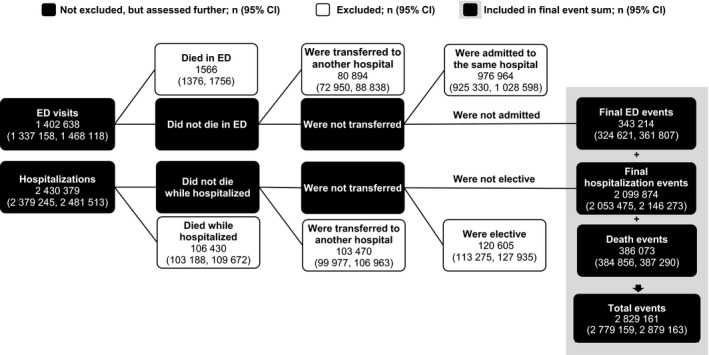
This study describes the national surveillance and modeling methodology developed to monitor achievement of the Million Hearts initiative's aim of preventing 1 million acute myocardial infarctions, strokes, and other related cardiovascular events during 2012-2016.
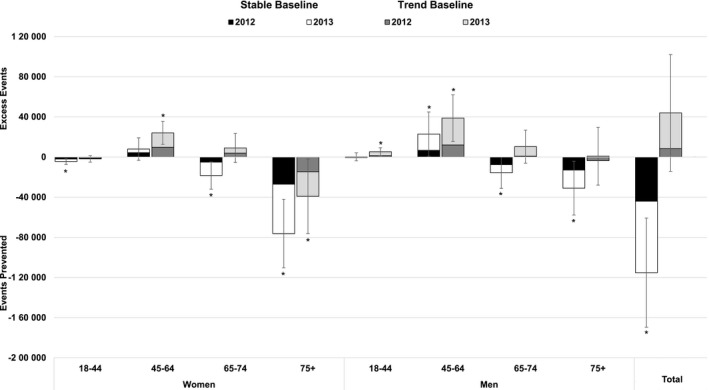
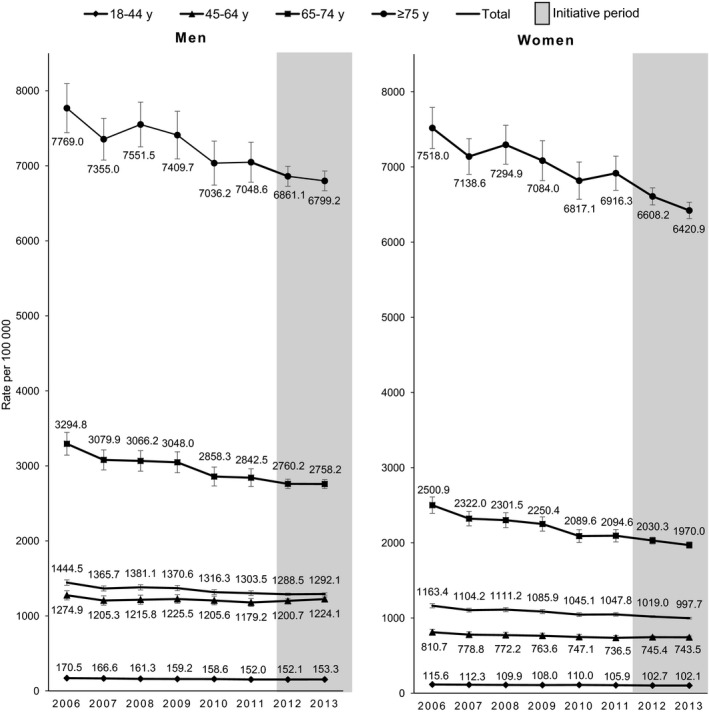
We calculate sex- and age-specific cardiovascular event rates (combination of emergency department, hospitalization, and death events) among US adults aged ≥18 from 2006 to 2011 and, based on log-linear models fitted to the rates, calculate their annual percent change. We describe 2 baseline strategies to be used to compare observed versus expected event totals during 2012-2016: (1) assume no rate changes, with modeled 2011 rates held constant through 2016; and (2) assume 2006-2011 rate trends will continue, with the annual percent changes applied to the modeled 2011 rates to calculate expected 2012-2016 rates. Events prevented estimates during 2012-2013 were calculated using available data: 115 210 (95% CI, 60 858, 169 562) events were prevented using stable baselines and an excess of 43 934 (95% CI, -14 264, 102 132) events occurred using trend baselines. Women aged ≥75 had the most events prevented (stable, 76 242 [42 067, 110 417]; trend, 39 049 [1901, 76 197]). Men aged 45 to 64 had the greatest number of excess events (stable, 22 912 [95% CI, 855, 44 969]; trend, 38 810 [95% CI, 15 567, 62 053]).
Around 115 000 events were prevented during the initiative's first 2 years compared with what would have occurred had 2011 rates remained stable. Recent flattening or reversals in some event rate trends were observed supporting intensifying national action to prevent cardiovascular events.
本研究描述了为监测“百万心脏”倡议在2012 - 2016年期间预防100万例急性心肌梗死、中风及其他相关心血管事件这一目标的实现情况而制定的全国监测和建模方法。
我们计算了2006年至2011年美国18岁及以上成年人按性别和年龄划分的心血管事件发生率(急诊科、住院和死亡事件的综合),并基于拟合这些发生率的对数线性模型计算其年度百分比变化。我们描述了2种用于比较2012 - 2016年期间观察到的与预期的事件总数的基线策略:(1)假设发生率无变化,2011年的建模发生率在2016年保持不变;(2)假设2006 - 2011年的发生率趋势将继续,将年度百分比变化应用于2011年的建模发生率以计算2012 - 2016年的预期发生率。使用现有数据计算了2012 - 2013年期间预防的事件估计数:使用稳定基线预防了115210例(95%CI,60858,169562)事件,使用趋势基线发生了43934例(95%CI,-14264,102132)额外事件。75岁及以上女性预防的事件最多(稳定情况,76242例[42067,110417];趋势情况,39049例[1901,76197])。45至64岁男性的额外事件数量最多(稳定情况,22912例[95%CI,855,44969];趋势情况,38810例[95%CI,15567,62053])。
与2011年发生率保持稳定时本应发生的情况相比,在该倡议的前两年约预防了115000例事件。观察到近期一些事件发生率趋势趋于平稳或出现逆转,这支持加强全国预防心血管事件的行动。