Kigen Gabriel, Edwards Geoffrey
Department of Pharmacology and Toxicology, Moi University School of Medicine, P.O. Box 4606, 30100, Eldoret, Kenya.
Department of Molecular and Clinical Pharmacology, University of Liverpool, Liverpool, L69 3GE, UK.
BMC Pharmacol Toxicol. 2017 May 4;18(1):20. doi: 10.1186/s40360-017-0129-6.
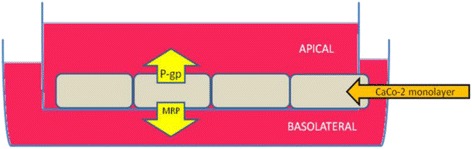
Drug interactions between antiretroviral drugs (ARVs) and anthelminthic drugs, ivermectin (IVM) and praziquantel (PZQ) were assessed by investigating their permeation through the Caco-2 cell monolayers in a transwell. The impact of anthelminthics on the transport of ARVs was determined by assessing the apical to basolateral (AP → BL) [passive] and basolateral to apical (BL → AP) [efflux] directions alone, and in presence of an anthelminthic. The reverse was conducted for the assessment of the influence of ARVs on anthelminthics.
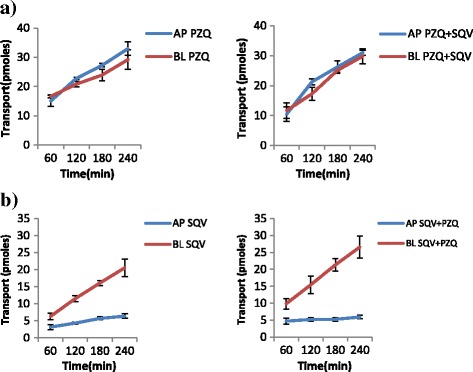
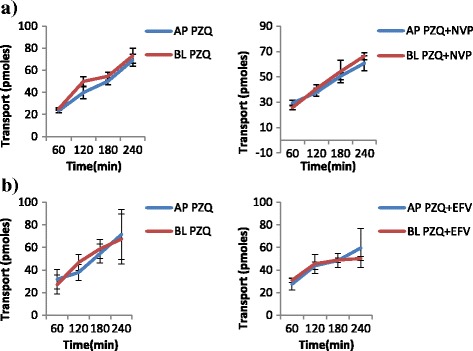
Samples from the AP and BL compartments were taken at 60, 120, 180 and 240 min and quantified either by HPLC or radiolabeled assay using a liquid scintillating counter for the respective drugs. Transepithelial resistance (TEER) was used to assess the integrity of the monolayers. The amount of compound transported per second (apparent permeability, Papp) was calculated for both AP to BL (Papp), and BL to AP (Papp) movements. Samples collected after 60 min were used to determine the efflux ratio (ER), quotient of secretory permeability and absorptive permeability (PappBL-AP/PappAP-BL). The reverse, (PappAP-BL/PappBL-AP) constituted the uptake ratio. The impact of SQV, EFV and NVP on the transport of both IVM and PZQ were investigated. The effect of LPV on the transport of IVM was also determined. The influence of IVM on the transport of SQV, NVP, LPV and EFV; as well as the effect PZQ on the transport of SQV of was also investigated, and a two-tailed p value of <0.05 was considered significant.
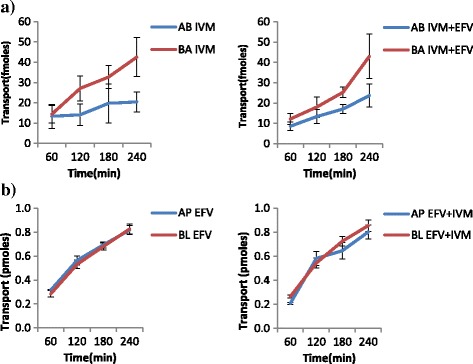
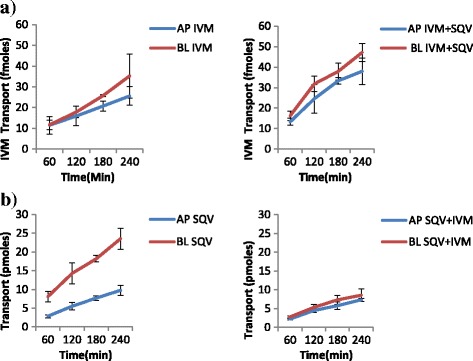
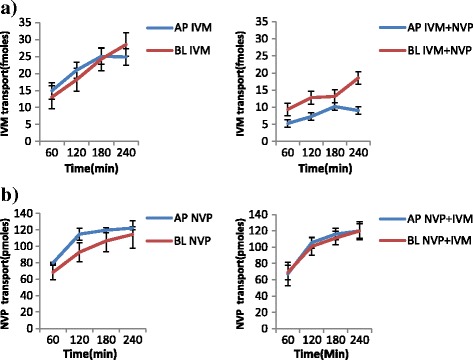
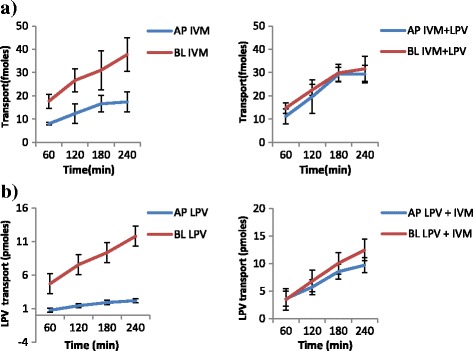
IVM significantly inhibited the efflux transport (BL → AP movement) of LPV (ER; 6.7 vs. 0.8, p = 0.0038) and SQV (ER; 3.1 vs. 1.2 p = 0.00328); and increased the efflux transport of EFV (ER; 0.7 vs. 0.9, p = 0.031) suggesting the possibility of drug transporter mediated interactions between the two drugs. NVP increased the efflux transport of IVM (ER; 0.8 vs. 1.8, p = 0.0094).
The study provides in vitro evidence of potential interactions between IVM, an anthelminthic drug with antiretroviral drugs; LPV, SQV, NVP and EFV. Further investigations should be conducted to investigate the possibility of in vivo interactions.
通过研究抗逆转录病毒药物(ARVs)与驱虫药伊维菌素(IVM)和吡喹酮(PZQ)在Transwell中透过Caco-2细胞单层的渗透情况,评估它们之间的药物相互作用。通过单独评估顶端到基底外侧(AP→BL)[被动]和基底外侧到顶端(BL→AP)[外排]方向,以及在存在驱虫药的情况下,确定驱虫药对ARVs转运的影响。反之,评估ARVs对驱虫药的影响时也采用同样的方法。
在60、120、180和240分钟时从AP和BL隔室采集样品,并分别通过高效液相色谱法(HPLC)或使用液体闪烁计数器的放射性标记测定法对相应药物进行定量。使用跨上皮电阻(TEER)评估单层的完整性。计算AP到BL(Papp)和BL到AP(Papp)运动每秒转运的化合物量(表观渗透率,Papp)。60分钟后收集的样品用于确定外排率(ER),即分泌渗透率与吸收渗透率的商(PappBL-AP/PappAP-BL)。反之,(PappAP-BL/PappBL-AP)构成摄取率。研究了沙奎那韦(SQV)、依非韦伦(EFV)和奈韦拉平(NVP)对IVM和PZQ转运的影响。还确定了洛匹那韦(LPV)对IVM转运的影响。研究了IVM对SQV、NVP、LPV和EFV转运的影响;以及PZQ对SQV转运的影响,双尾p值<0.05被认为具有统计学意义。
IVM显著抑制LPV的外排转运(BL→AP运动)(ER;6.7对0.8,p = 0.0038)和SQV的外排转运(ER;3.1对1.2,p = 0.00328);并增加了EFV的外排转运(ER;从0.7到0.9,p = 0.031),这表明两种药物之间可能存在药物转运体介导的相互作用。NVP增加了IVM的外排转运(ER;0.8对1.8,p = 0.0094)。
该研究提供了体外证据,证明驱虫药IVM与抗逆转录病毒药物LPV、SQV、NVP和EFV之间存在潜在相互作用。应进行进一步研究以探讨体内相互作用的可能性。