Klusek Jessica, LaFauci Giuseppe, Adayev Tatyana, Brown W Ted, Tassone Flora, Roberts Jane E
Department of Communication Sciences and Disorders, University of South Carolina, Keenan Building, Suite 300, Columbia, SC 29208 USA.
Department of Developmental Biochemistry, New York State Institute for Basic Research in Developmental Disabilities, 1050 Forest Hill Road, Staten Island, NY 10314 USA.
J Neurodev Disord. 2017 May 2;9:16. doi: 10.1186/s11689-017-9197-6. eCollection 2017.
Autonomic dysfunction is implicated in a range of psychological conditions, including depression and anxiety. The () premutation is a common genetic mutation that affects ~1:150 women and is associated with psychological vulnerability. This study examined cardiac indicators of autonomic function among women with the premutation and control women as potential biomarkers for psychological risk that may be linked to .
Baseline inter-beat interval and respiratory sinus arrhythmia (a measure of parasympathetic vagal tone) were measured in 35 women with the premutation and 28 controls. The women completed anxiety and depression questionnaires. genetic indices (i.e., CGG repeat, quantitative FMRP, mRNA, activation ratio) were obtained for the premutation group.
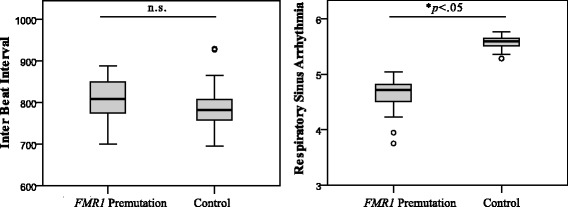
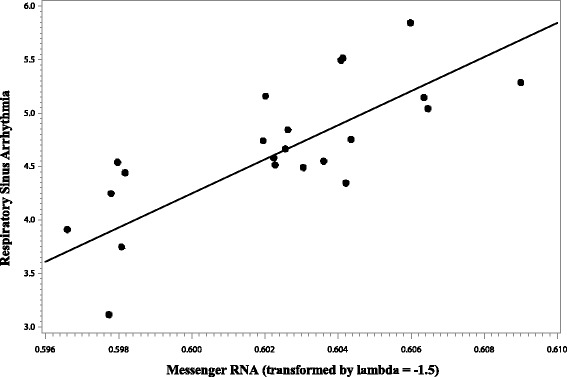
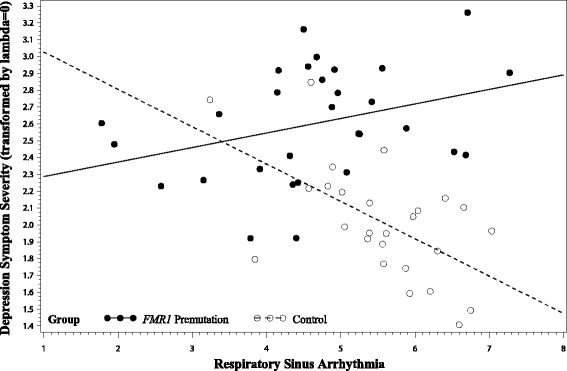
Respiratory sinus arrhythmia was reduced in the premutation group relative to controls. While depression symptoms were associated with reduced respiratory sinus arrhythmia among control women, these variables were unrelated in the premutation. Elevated mRNA was associated with higher respiratory sinus arrhythmia.
Women with the premutation demonstrated autonomic dysregulation characterized by reduced vagal tone. Unlike patterns observed in the general population and in study controls, vagal activity and depression symptoms were decoupled in women with the premutation, suggesting independence between autonomic regulation and psychopathological symptoms that is atypical and potentially specific to the premutation. The association between vagal tone and mRNA suggests that molecular variation associated with plays a role in autonomic regulation.
自主神经功能障碍与一系列心理状况有关,包括抑郁和焦虑。()前突变是一种常见的基因突变,影响约1:150的女性,并与心理易感性相关。本研究检查了前突变女性和对照女性自主神经功能的心脏指标,作为可能与(相关)心理风险的潜在生物标志物。
测量了35名前突变女性和28名对照女性的基线心跳间期和呼吸性窦性心律失常(副交感迷走神经张力的一种测量方法)。这些女性完成了焦虑和抑郁问卷。为前突变组获取了(相关)基因指标(即CGG重复、定量FMRP、(相关)mRNA、激活率)。
相对于对照组,前突变组的呼吸性窦性心律失常降低。虽然抑郁症状与对照女性呼吸性窦性心律失常的降低有关,但在有前突变的女性中,这些变量并无关联。(相关)mRNA升高与较高的呼吸性窦性心律失常有关。
有前突变的女性表现出以迷走神经张力降低为特征的自主神经调节异常。与在一般人群和研究对照中观察到的模式不同,有前突变的女性迷走神经活动和抑郁症状不相关,这表明自主神经调节和精神病理症状之间的独立性是非典型的,并且可能是前突变所特有的。迷走神经张力与(相关)mRNA之间的关联表明,与(相关)相关的分子变异在自主神经调节中起作用。