Greenwalt Mary, Griffen David, Wilkerson Jim
Midwest Healthcare Quality Alliance.
BMJ Qual Improv Rep. 2017 Mar 27;6(1). doi: 10.1136/bmjquality.u214416.w5476. eCollection 2017.
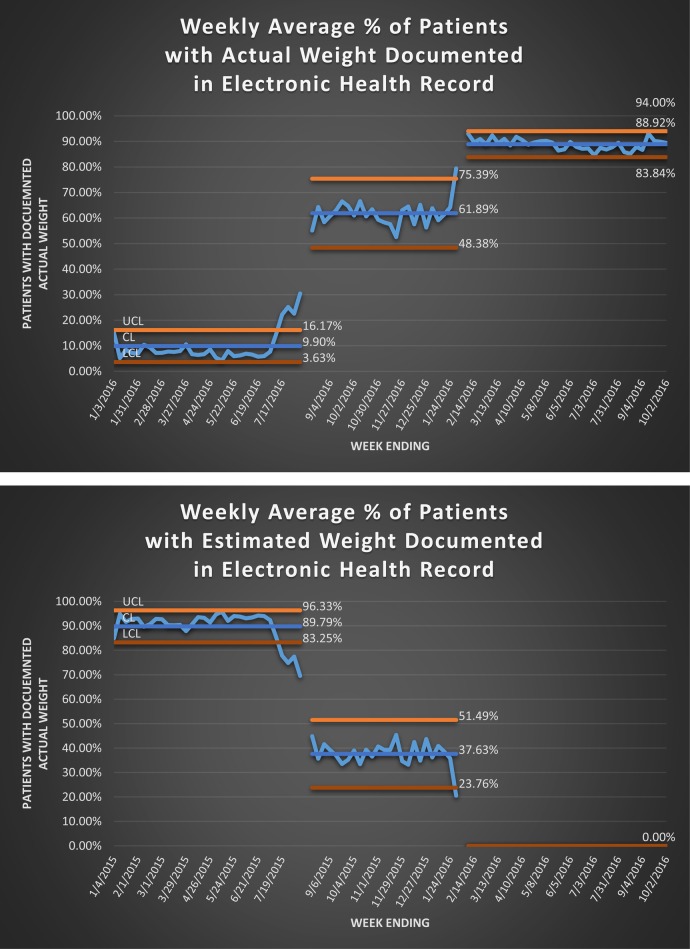
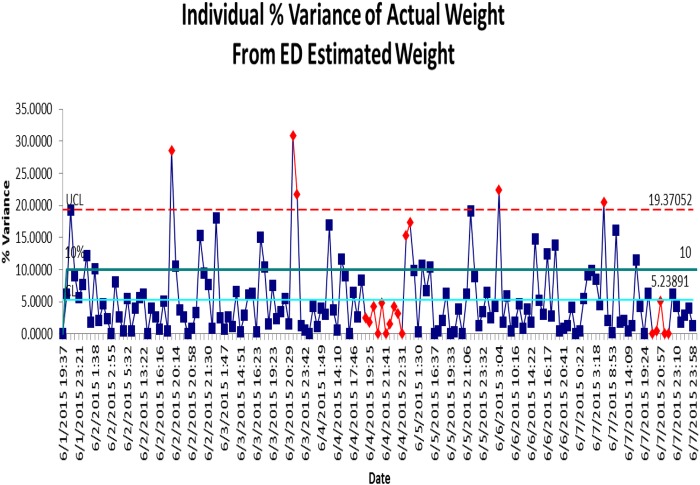
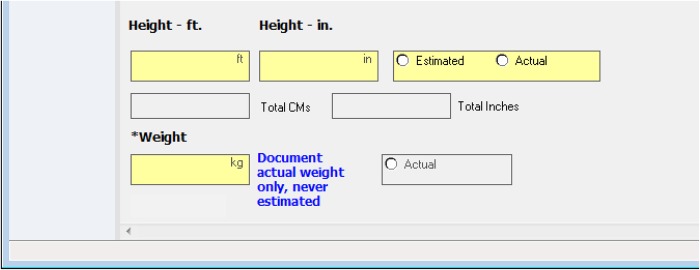
From 7/2014 through 6/2015, 10 emergency department (ED) medication dosing errors were reported through the electronic incident reporting system of an urban academic medical center. Analysis of these medication errors identified inaccurate estimated weight on patients as the root cause. The goal of this project was to reduce weight-based dosing medication errors due to inaccurate estimated weights on patients presenting to the ED. Chart review revealed that 13.8% of estimated weights documented on admitted ED patients varied more than 10% from subsequent actual admission weights recorded. A random sample of 100 charts containing estimated weights revealed 2 previously unreported significant medication dosage errors (.02 significant error rate). Key improvements included removing barriers to weighing ED patients, storytelling to engage staff and change culture, and removal of the estimated weight documentation field from the ED electronic health record (EHR) forms. With these improvements estimated weights on ED patients, and the resulting medication errors, were eliminated.
从2014年7月到2015年6月,一家城市学术医疗中心通过电子事件报告系统报告了10起急诊科(ED)用药剂量错误。对这些用药错误的分析确定患者估计体重不准确是根本原因。该项目的目标是减少因急诊科患者估计体重不准确而导致的基于体重给药的用药错误。病历审查显示,急诊科收治患者记录的估计体重中有13.8%与随后记录的实际入院体重相差超过10%。对100份包含估计体重的病历进行随机抽样,发现了2起之前未报告的重大用药剂量错误(重大错误率为0.02)。主要改进措施包括消除给急诊科患者称重的障碍、通过讲故事来促使工作人员参与并改变文化,以及从急诊科电子健康记录(EHR)表格中删除估计体重记录字段。通过这些改进,消除了急诊科患者的估计体重以及由此产生的用药错误。