St. James's Hospital, Dublin 8, Ireland.
Centre for Colorectal Disease, St. Vincent's University Hospital, Dublin 4, Ireland.
Cancer Med. 2017 Jun;6(6):1465-1472. doi: 10.1002/cam4.1025. Epub 2017 May 3.
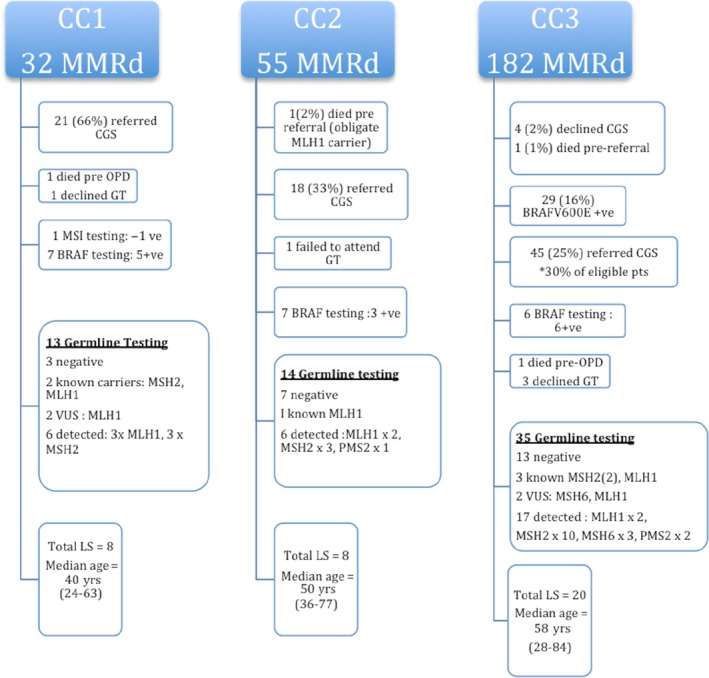
Reflex immunohistochemistry (rIHC) for mismatch repair (MMR) protein expression can be used as a screening tool to detect Lynch Syndrome (LS). Increasingly the mismatch repair-deficient (dMMR) phenotype has therapeutic implications. We investigated the pattern and consequence of testing for dMMR in three Irish Cancer Centres (CCs). CRC databases were analyzed from January 2005-December 2013. CC1 performs IHC upon physician request, CC2 implemented rIHC in November 2008, and CC3 has been performing rIHC since 2004. The number of eligible patients referred to clinical genetic services (CGS), and the number of LS patients per center was determined. 3906 patients were included over a 9-year period. dMMR CRCs were found in 32/153 (21%) of patients at CC1 and 55/536 (10%) at CC2, accounting for 3% and 5% of the CRC population, respectively. At CC3, 182/1737 patients (10%) had dMMR CRCs (P < 0.001). Additional testing for the BRAF V600E mutation, was performed in 49 patients at CC3 prior to CGS referral, of which 29 were positive and considered sporadic CRC. Referrals to CGS were made in 66%, 33%, and 30% of eligible patients at CC1, CC2, and CC3, respectively. LS accounted for CRC in eight patients (0.8%) at CC1, eight patients (0.7%) at CC2, and 20 patients (1.2%) at CC3. Cascade testing of patients with dMMR CRC was not completed in 56%. Universal screening increases the detection of dMMR tumors and LS kindreds. Successful implementation of this approach requires adequate resources for appropriate downstream management of these patients.
免疫组织化学(rIHC)检测错配修复(MMR)蛋白表达可作为一种筛查工具,用于检测林奇综合征(LS)。越来越多的证据表明,错配修复缺陷(dMMR)表型具有治疗意义。我们调查了在爱尔兰 3 家癌症中心(CC)中检测 dMMR 的模式和结果。从 2005 年 1 月至 2013 年 12 月对 CRC 数据库进行了分析。CC1 根据医生的要求进行 IHC 检测,CC2 于 2008 年 11 月开始实施 rIHC,CC3 自 2004 年以来一直进行 rIHC。确定了向临床遗传服务(CGS)转诊的合格患者数量以及每个中心的 LS 患者数量。在 9 年的时间里共纳入了 3906 名患者。在 CC1 中,32/153(21%)的患者存在 dMMR CRC,在 CC2 中,55/536(10%)的患者存在 dMMR CRC,分别占 CRC 人群的 3%和 5%。在 CC3 中,182/1737 名患者(10%)存在 dMMR CRC(P<0.001)。在转诊到 CGS 之前,在 CC3 对 49 名患者进行了 BRAF V600E 突变的额外检测,其中 29 名呈阳性,被认为是散发性 CRC。在 CC1、CC2 和 CC3 中,分别有 66%、33%和 30%的合格患者被转诊到 CGS。LS 占 CC1 中 8 名患者(0.8%)、CC2 中 8 名患者(0.7%)和 CC3 中 20 名患者(1.2%)的 CRC 比例。有 56%的 dMMR CRC 患者的级联检测未完成。普遍筛查可提高 dMMR 肿瘤和 LS 家族的检出率。成功实施这一方法需要有足够的资源来对这些患者进行适当的下游管理。