Hu Qiaofei, Hong Liming, Nie Mingyue, Wang Qin, Fang Ying, Dai Yinmei, Zhai Yanhong, Wang Shuyu, Yin Chenghong, Yang Xiaokui
Department of Human Reproductive Medicine, Beijing Obstetrics and Gynecology Hospital, Capital Medical University, 251 Yaojiayuan Road, Chaoyang District, Beijing, 100026, China.
Department of Reproduction Regulation, Beijing Obstetrics and Gynecology Hospital, Capital Medical University, Beijing, 100006, China.
J Ovarian Res. 2017 May 4;10(1):32. doi: 10.1186/s13048-017-0326-3.
Diminished ovarian reserve(DOR) is associated with female infertility and poor response to ovarian stimulation. Our objective was to assess the effect of dehydroepiandrosterone(DHEA) on DOR women and to explore whether the improvement of ovarian response after DHEA supplementation was dependent on the expression levels of androgen receptor(AR).
A prospective cohort study was performed in the Department of Human Reproductive Medicine, Beijing Obstetrics and Gynecology Hospital during August 2014 to August 2016. 103 DOR women who completed the study were divided into the DHEA group (n = 53), which received DHEA supplementation (25 mg three times a day) for 8 weeks, and the control group (n = 50), which did not receive DHEA, before the IVF cycles. Serum hormone levels(FSH, LH, E, T, DHEAs, AMH, INHB), antral follicle count(AFC) and the expression of AR and FSH receptor(FSHR) in granulosa cells(GCs) were measured, meanwhile ovarian response parameters and IVF outcomes were compared. The GCs from another 36 DOR women were cultured with different concentrations of DHEA in vitro. Then, we compared the expression of AR and FSHR in GCs according to the different numbers of oocytes retrieved both in DHEA and control group.
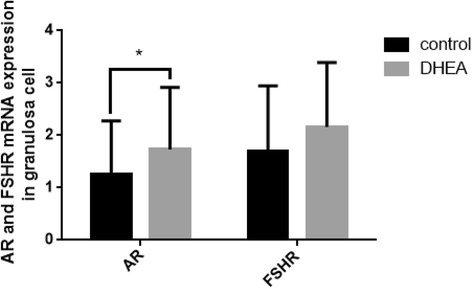
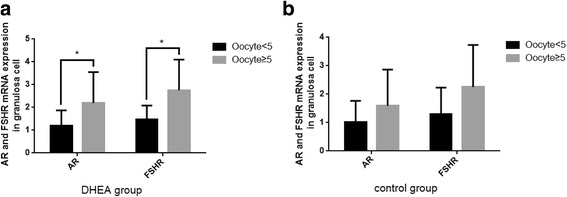
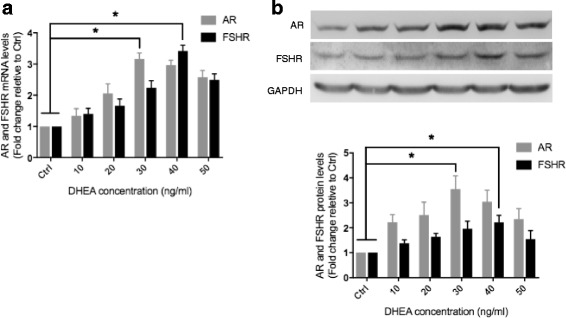
In the present study, DHEA supplementation resulted in significantly higher levels of serum T(P = 0.047), DHEAs(P = 0.019) and AR mRNA expression in GCs(P = 0.049). In vitro experiment, the protein and mRNA expression of AR and FSHR in the preovulatory GCs were significantly increased in response to DHEA supplementation(P <0.05). No significant differences were found in ovarian reserve, ovarian response, or IVF outcomes between the two groups. Subgroup analyses showed the levels of AR and FSHR mRNA in GCs were significantly increased in DHEA group with ≥5 oocytes retrieved(P <0.05).
DHEA supplementation can increase the expression of AR in preovulatory GCs both in vivo and in vitro. The selective beneficial effects of DHEA supplementation on ovarian response in DOR women may depend on the increasing expression of AR and FSHR in GCs.
The Chinese Clinical Trial Registry ( ChiCTR-IPR-15006126 ). Retrospectively Registered 19 March 2015.
卵巢储备功能减退(DOR)与女性不孕及卵巢刺激反应不良有关。我们的目的是评估脱氢表雄酮(DHEA)对DOR女性的影响,并探讨补充DHEA后卵巢反应的改善是否依赖于雄激素受体(AR)的表达水平。
2014年8月至2016年8月在北京妇产医院人类生殖医学科进行了一项前瞻性队列研究。103例完成研究的DOR女性在体外受精周期前被分为DHEA组(n = 53),接受DHEA补充治疗(25mg,每日3次),共8周;对照组(n = 50),未接受DHEA治疗。测量血清激素水平(FSH、LH、E、T、DHEAs、AMH、INHB)、窦卵泡计数(AFC)以及颗粒细胞(GCs)中AR和FSH受体(FSHR)的表达,同时比较卵巢反应参数和体外受精结局。另外36例DOR女性的GCs在体外与不同浓度的DHEA进行培养。然后,我们根据DHEA组和对照组中回收的卵母细胞数量不同,比较GCs中AR和FSHR的表达。
在本研究中,补充DHEA导致血清T水平(P = 0.047)、DHEAs水平(P = 0.019)以及GCs中AR mRNA表达显著升高(P = 0.049)。体外实验中,补充DHEA后,排卵前GCs中AR和FSHR的蛋白和mRNA表达显著增加(P <0.05)。两组在卵巢储备、卵巢反应或体外受精结局方面未发现显著差异。亚组分析显示,回收≥5个卵母细胞的DHEA组中,GCs中AR和FSHR mRNA水平显著升高(P <0.05)。
补充DHEA可在体内和体外增加排卵前GCs中AR的表达。补充DHEA对DOR女性卵巢反应的选择性有益作用可能取决于GCs中AR和FSHR表达的增加。
中国临床试验注册中心(ChiCTR-IPR-15006126)。2015年3月19日回顾性注册。