Gosiewski J D, Holsgrove T P, Gill H S
Department of Mechanical Engineering, University of Bath, Claverton Down Rd, Bath, Somerset BA2 7AY, UK
Department of Engineering, College of Engineering, Mathematics & Physical Sciences, University of Exeter, and Department of Mechanical Engineering, University of Bath (visiting academic), University of Exeter, College of Engineering, Mathematics & Physical Sciences, Harrison Building, Streatham Campus, University of Exeter, EX4 4QF, UK.
Bone Joint Res. 2017 May;6(5):270-276. doi: 10.1302/2046-3758.65.BJR-2017-0287.R1.
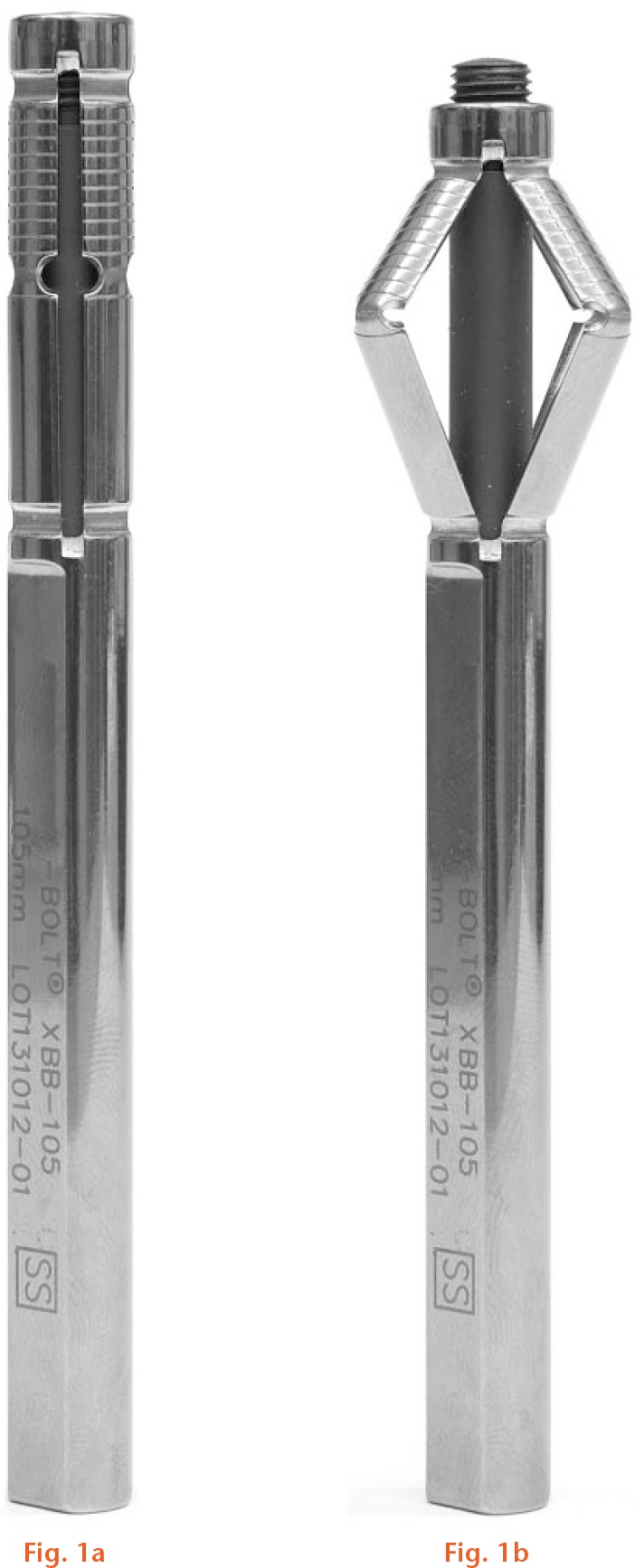
Fractures of the proximal femur are a common clinical problem, and a number of orthopaedic devices are available for the treatment of such fractures. The objective of this study was to assess the rotational stability, a common failure predictor, of three different rotational control design philosophies: a screw, a helical blade and a deployable crucifix.
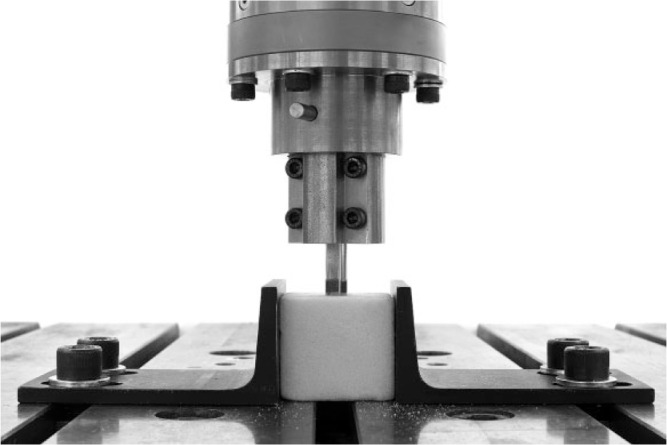
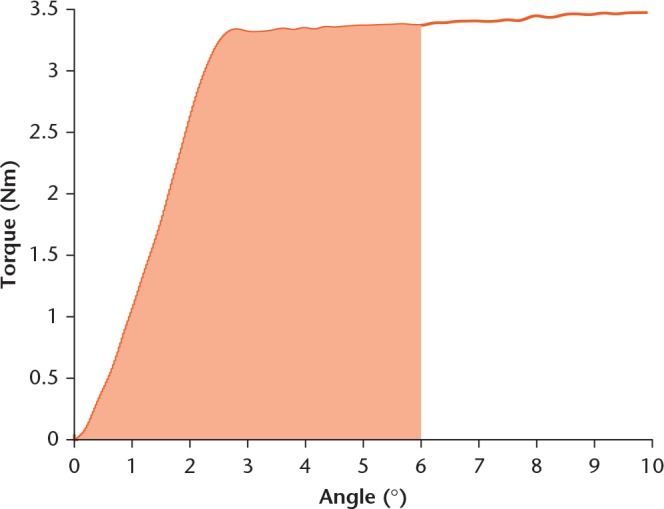
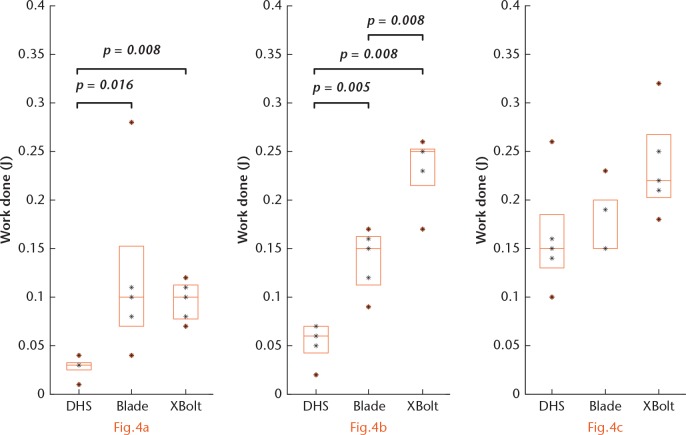
Devices were compared in terms of the mechanical work (W) required to rotate the implant by 6° in a bone substitute material. The substitute material used was Sawbones polyurethane foam of three different densities (0.08 g/cm, 0.16 g/cm and 0.24 g/cm). Each torsion test comprised a steady ramp of 1°/minute up to an angular displacement of 10°.
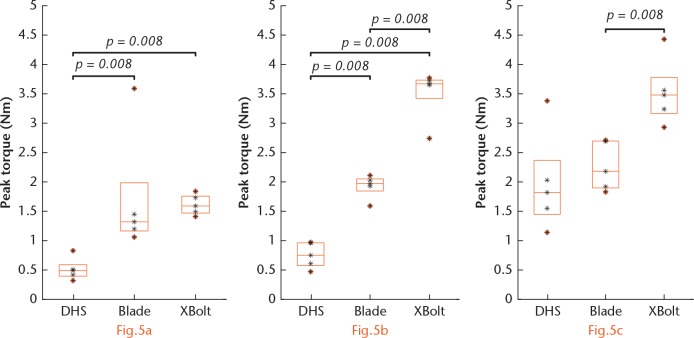
The deployable crucifix design (X-Bolt), was more torsionally stable, compared to both the dynamic hip screw (DHS, p = 0.008) and helical blade (DHS Blade, p= 0.008) designs in bone substitute material representative of osteoporotic bone (0.16 g/cm polyurethane foam). In 0.08 g/cm density substrate, the crucifix design (X-Bolt) had a higher resistance to torsion than the screw (DHS, p = 0.008). There were no significant differences (p = 0.101) between the implants in 0.24 g/cm density bone substitute.
Our findings indicate that the clinical standard proximal fracture fixator design, the screw (DHS), was the least effective at resisting torsional load, and a novel crucifix design (X-Bolt), was the most effective design in resisting torsional load in bone substitute material with density representative of osteoporotic bone. At other densities the torsional stability was also higher for the X-Bolt, although not consistently significant by statistical analysis.: J. D. Gosiewski, T. P. Holsgrove, H. S. Gill. The efficacy of rotational control designs in promoting torsional stability of hip fracture fixation. 2017;6:270-276. DOI: 10.1302/2046-3758.65.BJR-2017-0287.R1.
股骨近端骨折是常见的临床问题,有多种骨科器械可用于治疗此类骨折。本研究的目的是评估三种不同旋转控制设计理念(螺钉、螺旋刀片和可展开十字形)的旋转稳定性,旋转稳定性是一种常见的失效预测指标。
通过比较在骨替代材料中使植入物旋转6°所需的机械功(W)来对比不同器械。所用的替代材料是三种不同密度(0.08 g/cm³、0.16 g/cm³和0.24 g/cm³)的Sawbones聚氨酯泡沫。每次扭转试验包括以1°/分钟的稳定斜率递增,直至角位移达到10°。
在代表骨质疏松骨的骨替代材料(0.16 g/cm³聚氨酯泡沫)中,与动力髋螺钉(DHS,p = 0.008)和螺旋刀片(DHS Blade,p = 0.008)设计相比,可展开十字形设计(X - Bolt)的抗扭稳定性更高。在0.08 g/cm³密度的基质中,十字形设计(X - Bolt)比螺钉(DHS,p = 0.008)具有更高的抗扭性。在0.24 g/cm³密度的骨替代物中,不同植入物之间无显著差异(p = 0.101)。
我们的研究结果表明,临床标准的近端骨折固定器设计——螺钉(DHS)在抵抗扭转载荷方面效果最差,而一种新型十字形设计(X - Bolt)在代表骨质疏松骨密度的骨替代材料中抵抗扭转载荷的效果最佳。在其他密度下,X - Bolt的扭转稳定性也更高,尽管经统计分析并非始终具有显著差异。:J. D. Gosiewski、T. P. Holsgrove、H. S. Gill。旋转控制设计对促进髋部骨折固定扭转稳定性的疗效。2017年;6:270 - 276。DOI:10.1302/2046 - 3758.65.BJR - 2017 - 0287.R1。