Nie Shaobo, Li Ming, Ji Hui, Li Zhirui, Li Wenwen, Zhang Hao, Licheng Zhang, Tang Peifu
Department of Orthopaedics, First Medical Center, Chinese PLA General Hospital, Beijing, China.
National Clinical Research Center for Orthopedics, Sports Medicine & Rehabilitation, Beijing, China.
Bone Joint Res. 2020 Dec;9(12):840-847. doi: 10.1302/2046-3758.912.BJR-2020-0284.R1.
Restoration of proximal medial femoral support is the keystone in the treatment of intertrochanteric fractures. None of the available implants are effective in constructing the medial femoral support. Medial sustainable nail (MSN-II) is a novel cephalomedullary nail designed for this. In this study, biomechanical difference between MSN-II and proximal femoral nail anti-rotation (PFNA-II) was compared to determine whether or not MSN-II can effectively reconstruct the medial femoral support.
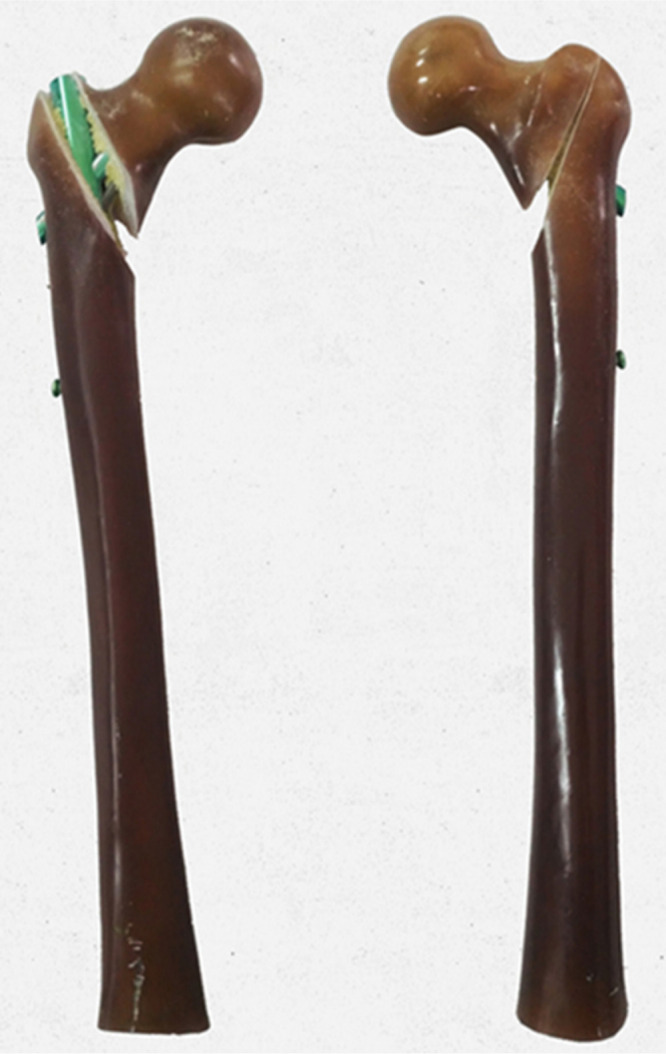
A total of 36 synthetic femur models with simulated intertrochanteric fractures without medial support (AO/OTA 31-A2.3) were assigned to two groups with 18 specimens each for stabilization with MSN-II or PFNA-II. Each group was further divided into three subgroups of six specimens according to different experimental conditions respectively as follows: axial loading test; static torsional test; and cyclic loading test.
The mean axial stiffness, vertical displacement, and maximum failure load of MSN-II were 258.47 N/mm (SD 42.27), 2.99 mm (SD 0.56), and 4,886 N (SD 525.31), respectively, while those of PFNA-II were 170.28 N/mm (SD 64.63), 4.86 mm (SD 1.66), and 3,870.87 N (SD 552.21), respectively. The mean torsional stiffness and failure torque of MSN-II were 1.72 N m/° (SD 0.61) and 16.54 N m (SD 7.06), respectively, while those of PFNA-II were 0.61 N m/° (SD 0.39) and 6.6 N m (SD 6.65), respectively. The displacement of MSN-II in each cycle point was less than that of PFNA-II in cyclic loading test. Significantly higher stiffness and less displacement were detected in the MSN-II group (p < 0.05).
The biomechanical performance of MSN-II was better than that of PFNA-II, suggesting that MSN-II may provide more effective mechanical support in the treatment of unstable intertrochanteric fractures. Cite this article: 2020;9(12):840-847.
恢复股骨近端内侧支撑是治疗转子间骨折的关键。现有的植入物均无法有效构建股骨内侧支撑。内侧可持续髓内钉(MSN-II)是为此设计的一种新型头髓内钉。在本研究中,比较了MSN-II与股骨近端抗旋髓内钉(PFNA-II)之间的生物力学差异,以确定MSN-II是否能有效重建股骨内侧支撑。
将36个模拟无内侧支撑的转子间骨折(AO/OTA 31-A2.3)的合成股骨模型分为两组,每组18个标本,分别用MSN-II或PFNA-II进行固定。根据不同实验条件,每组进一步分为三个亚组,每组6个标本,具体如下:轴向加载试验;静态扭转试验;循环加载试验。
MSN-II的平均轴向刚度、垂直位移和最大破坏载荷分别为258.47 N/mm(标准差42.27)、2.99 mm(标准差0.56)和4886 N(标准差525.31),而PFNA-II的分别为170.28 N/mm(标准差64.63)、4.86 mm(标准差1.66)和3870.87 N(标准差552.21)。MSN-II的平均扭转刚度和破坏扭矩分别为1.72 N·m/°(标准差0.61)和16.54 N·m(标准差7.06),而PFNA-II的分别为0.61 N·m/°(标准差0.39)和6.6 N·m(标准差6.65)。在循环加载试验中,MSN-II在每个循环点的位移均小于PFNA-II。MSN-II组检测到明显更高的刚度和更小的位移(p < 0.05)。
MSN-II的生物力学性能优于PFNA-II,表明MSN-II在治疗不稳定转子间骨折时可能提供更有效的力学支撑。引用本文:2020;9(12):840-847。