Gozal David, Khalyfa Abdelnaby, Qiao Zhuanghong, Smith Dale L, Philby Mona F, Koren Dorit, Kheirandish-Gozal Leila
Section of Sleep Medicine, Department of Pediatrics, Pritzker School of Medicine, Biological Sciences Division, The University of Chicago, Chicago, Illinois, USA.
Department of Public Health Sciences, The University of Chicago, Chicago, Illinois, USA.
Obesity (Silver Spring). 2017 Jun;25(6):1083-1090. doi: 10.1002/oby.21859. Epub 2017 May 5.
Obstructive sleep apnea (OSA) is a prevalent condition, especially in children with obesity, and is associated with increased risk for metabolic syndrome (MetS). Angiopoietins have been identified as potential biomarkers of endothelial dysfunction and MetS. In adults, angiopoietin-2 (Ang-2) and its soluble receptor (sTie-2) are associated with diabetes, hypertension, and obesity and could be increased in children with OSA and obesity, particularly those with evidence of cardiometabolic alterations.
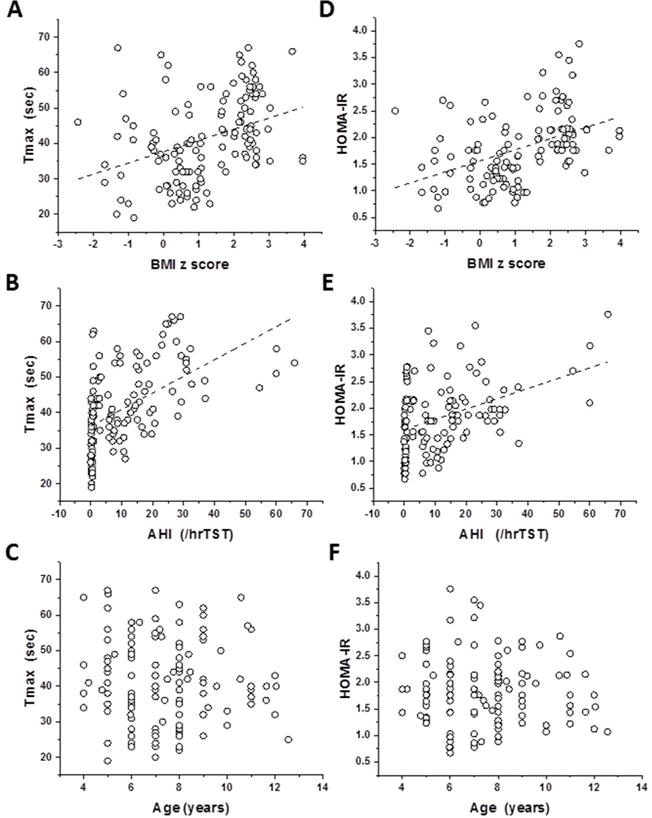
One hundred twenty-six children (7.4 ± 2.0 years) were consecutively recruited and underwent overnight polysomnography, as well as endothelial function and BMI z score assessments and a fasting blood draw the morning after the sleep study. In addition to lipid profile, glucose and insulin levels, and homeostatic model assessment of insulin resistance (HOMA-IR), Ang-2 and sTie-2 concentrations were determined.
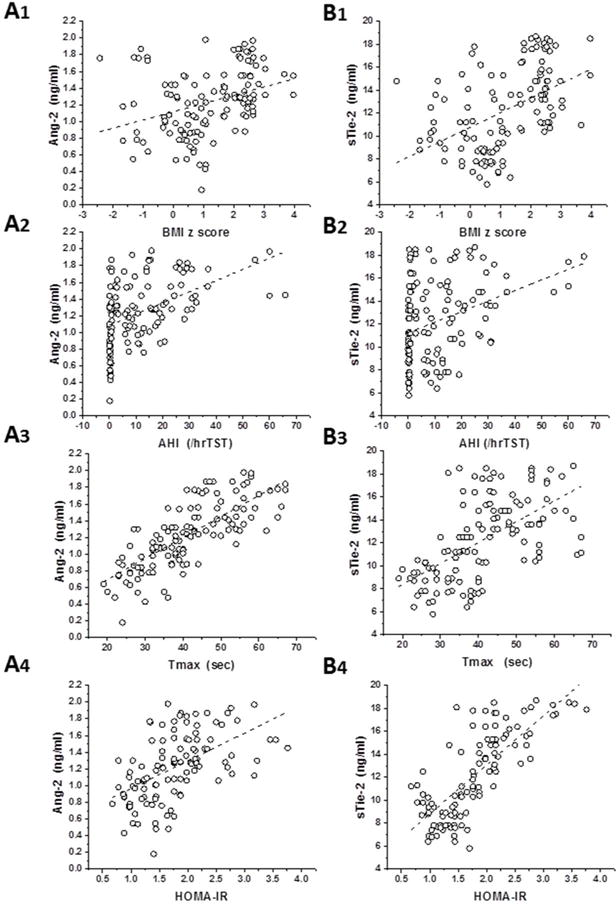
Children with obesity and OSA had significantly elevated plasma Ang-2 and sTie-2 levels compared to corresponding controls with and without obesity. Furthermore, endothelial function (Tmax) and HOMA-IR were linearly and independently associated with Ang-2 and sTie-2 levels. In a small subset of children (n = 14), treatment of OSA by adenotonsillectomy resulted in reductions of Ang-2 and sTie-2 (P < 0.01).
Ang-2 and sTie-2 plasma levels are increased in pediatric OSA and obesity, particularly when endothelial dysfunction or insulin resistance is detectable, and appear to decrease upon OSA treatment.
阻塞性睡眠呼吸暂停(OSA)是一种常见病症,在肥胖儿童中尤为普遍,且与代谢综合征(MetS)风险增加相关。血管生成素已被确定为内皮功能障碍和MetS的潜在生物标志物。在成年人中,血管生成素-2(Ang-2)及其可溶性受体(sTie-2)与糖尿病、高血压和肥胖相关,在患有OSA和肥胖的儿童中可能会升高,尤其是那些有心脏代谢改变证据的儿童。
连续招募了126名儿童(7.4±2.0岁),他们接受了夜间多导睡眠图检查,以及内皮功能和BMI z评分评估,并在睡眠研究后的早晨进行了空腹采血。除了血脂谱、血糖和胰岛素水平以及胰岛素抵抗的稳态模型评估(HOMA-IR)外,还测定了Ang-2和sTie-2的浓度。
与有或没有肥胖的相应对照组相比,患有肥胖和OSA的儿童血浆Ang-2和sTie-2水平显著升高。此外,内皮功能(Tmax)和HOMA-IR与Ang-2和sTie-2水平呈线性且独立相关。在一小部分儿童(n = 14)中,腺样体扁桃体切除术治疗OSA导致Ang-2和sTie-2降低(P < 0.01)。
小儿OSA和肥胖患者血浆Ang-2和sTie-2水平升高,尤其是在内皮功能障碍或胰岛素抵抗可检测到时,并且在OSA治疗后似乎会降低。