Variabilite de Reponse Aux Psychotropes, INSERM, U1144, 75006 Paris, France.
Universite Paris Descartes, UMR-S 1144, Paris, F-75006, France.
Curr Neuropharmacol. 2017 Nov 14;15(8):1156-1173. doi: 10.2174/1570159X15666170504095823.
Opioids are widely used in pain management, acting via opioid receptors and/or Toll-like receptors (TLR) present at the central nervous system (CNS). At the blood-brain barrier (BBB), several influx and efflux transporters, such as the ATP-binding cassette (ABC) P-glycoprotein (P-gp, ABCB1), Breast Cancer Resistance Protein (BCRP, ABCG2) and multidrug resistance-associated proteins (MRP, ABCC) transporters, and solute carrier transporters (SLC), are responsible for the transport of xenobiotics from the brain into the bloodstream or vice versa.
ABC transporters export several clinically employed opioids, altering their neuropharmacokinetics and CNS effects. In this review, we explore the interactions between opioids and ABC transporters, and decipher the molecular mechanisms by which opioids can modify their expression at the BBB.
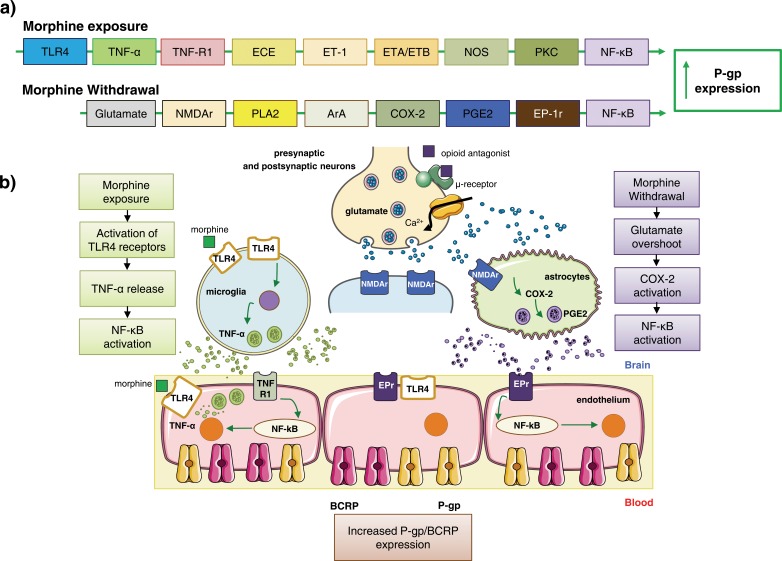
P-gp is largely implicated in the brain-to-blood efflux of opioids, namely morphine and oxycodone. Long-term exposure to morphine and oxycodone has proven to up-regulate the expression of ABC transporters, such as P-gp, BCRP and MRPs, at the BBB, which may lead to increased tolerance to the antinociceptive effects of such drugs. Recent studies uncover two mechanisms by which morphine may up-regulate P-gp and BCRP at the BBB: 1) via a glutamate, NMDA-receptor and COX-2 signaling cascade, and 2) via TLR4 activation, subsequent development of neuroinflammation, and activation of NF-kB, presumably via glial cells.
The BBB-opioid interaction can culminate in bilateral consequences, since ABC transporters condition the brain disposition of opioids, while opioids also affect the expression of ABC transporters at the BBB, which may result in increased CNS drug pharmacoresistance.
阿片类药物广泛用于疼痛管理,通过中枢神经系统 (CNS) 中的阿片受体和/或 Toll 样受体 (TLR) 发挥作用。在血脑屏障 (BBB) 中,几种摄取和外排转运体,如三磷酸腺苷结合盒 (ABC) 糖蛋白 (P-gp,ABCB1)、乳腺癌耐药蛋白 (BCRP,ABCG2) 和多药耐药相关蛋白 (MRP,ABCC) 转运体和溶质载体转运体 (SLC),负责将外源性物质从大脑转运到血液中或反之亦然。
ABC 转运体可将几种临床上使用的阿片类药物排出体外,改变其神经药代动力学和 CNS 效应。在这篇综述中,我们探讨了阿片类药物与 ABC 转运体之间的相互作用,并阐明了阿片类药物可以修饰其在 BBB 表达的分子机制。
P-gp 在阿片类药物(如吗啡和羟考酮)从大脑到血液的外排中起主要作用。长期暴露于吗啡和羟考酮已被证明可上调 BBB 上 ABC 转运体的表达,如 P-gp、BCRP 和 MRPs,这可能导致对这些药物的镇痛作用产生更高的耐受性。最近的研究揭示了吗啡上调 BBB 上 P-gp 和 BCRP 的两种机制:1)通过谷氨酸、NMDA 受体和 COX-2 信号级联,2)通过 TLR4 激活,随后发生神经炎症,以及 NF-kB 的激活,可能通过神经胶质细胞。
BBB-阿片类药物相互作用可能导致双侧后果,因为 ABC 转运体影响阿片类药物在大脑中的分布,而阿片类药物也会影响 BBB 上 ABC 转运体的表达,这可能导致 CNS 药物耐药性增加。