Grybauskas Algis, Koga Tomoyo, Kuprys Paulius V, Nolan Michael, McCarty Ryan, Walker Loyal, Green Kelsey A, Norkett William M, Yue Beatrice Y J T, Knepper Paul A
Department of Ophthalmology and Visual Sciences, University of Illinois at Chicago, College of Medicine, Chicago, IL.
Department of Ophthalmology and Visual Sciences, University of Illinois at Chicago, College of Medicine, Chicago, IL ; Department of Ophthalmology, Northwestern University Medical School, Chicago, IL.
Mol Vis. 2015 Mar 5;21:201-12. eCollection 2015.
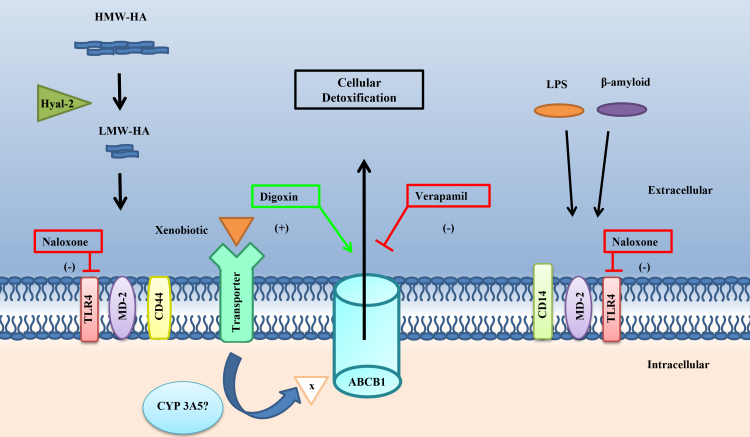
The aqueous humor nourishes the avascular tissues of the anterior segment, and the trabecular meshwork (TM) plays a role in the efflux of endogenous substances and xenobiotics from the aqueous humor. ATP (ATP)-binding cassette (ABC) transporter superfamily members respond to stressors such as hypoxia, cytokine signaling, and aging. The innate immune system within the TM, particularly Toll-like receptor 4 (TLR4) and its ligands, e.g., low-molecular-weight hyaluronic acid (LMW-HA) and lipopolysaccharide (LPS), plays a significant role in maintaining a normal environment in the anterior chamber. We hypothesize that the innate immune system may interact with ATP-binding cassette sub-family members ABCB1 (p-glycoprotein and multidrug resistance protein 1) to detoxify xenobiotics from the aqueous humor and in the TM.
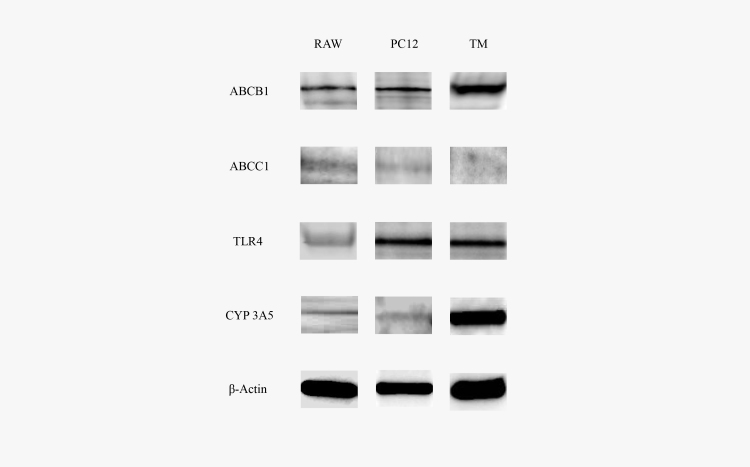
Cell lysates of human TM cells, RAW 264.7 macrophages, and PC12 cells were subjected to western blot analysis. The TM cells were positive for TLR4, ABCB1, and CYP3A5 and were negative for the ABCC1 transporter. Human TM cells and RAW 264.7 macrophages were plated on eight-well chamber slides at 5,000 cells/well overnight in 10% fetal bovine serum (FBS) cell growth medium. The medium was changed to 0.1% FBS 2 h before treatment. Cells were challenged with 1 and 10 mM lactate, 100 ng LMW-HA (20 kDa), 100 ng high-molecular-weight HA (HMW-HA, 1,000 kDa), 100 ng LPS, and/or 100 μM naloxone for 0.5, 1, 2, and 4 h. Calcein acetyoxymethyl ester (calcein AM; 0.25 μM) was added for 30 min as the reporting molecule. After calcein AM was administered, it was cleaved by an esterase into a fluorescent product that is normally transported out of the cell by ABCB1. Positive controls were 100 μM verapamil and 50 μM digoxin. After the challenge, the TM cells were fixed at 4 °C in 3% paraformaldehyde for 15 min, mounted with Vectashield and 4',6-diamidino-2-phenylindole (DAPI) mounting medium, and analyzed by a masked observer using a Leica confocal microscope and software.
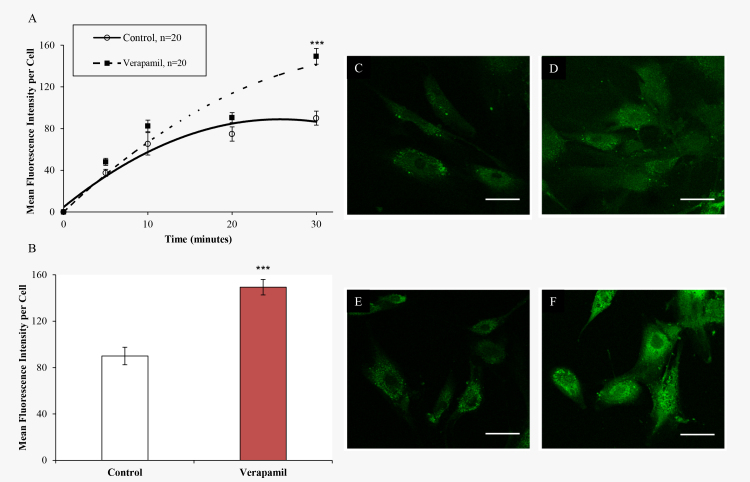
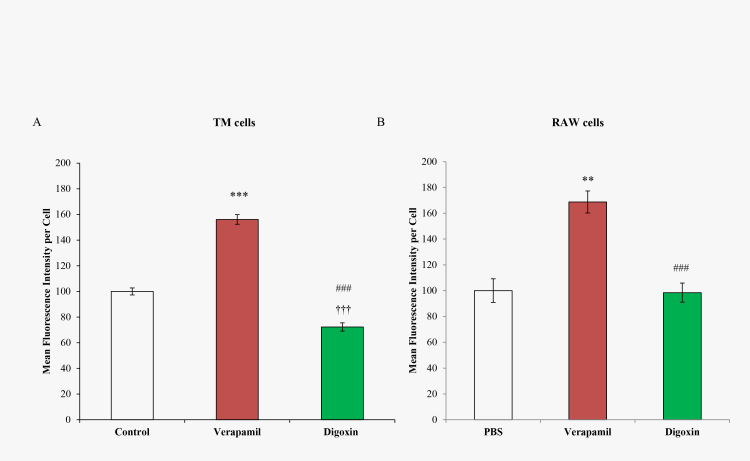
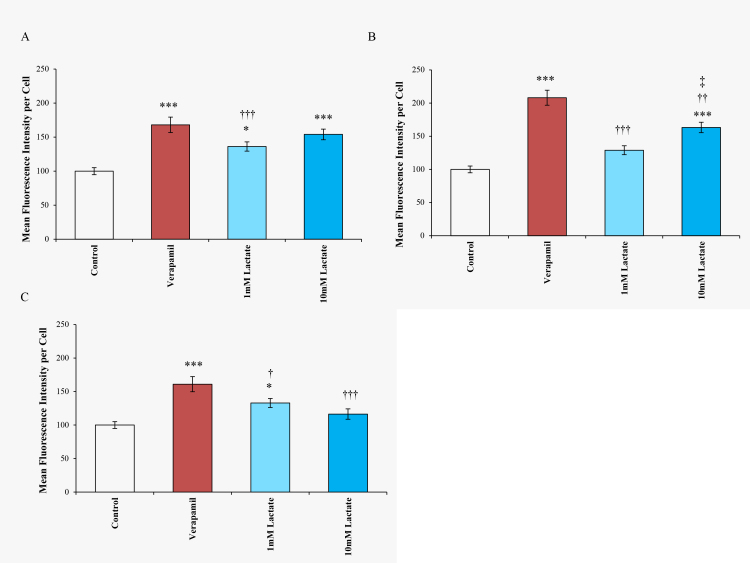
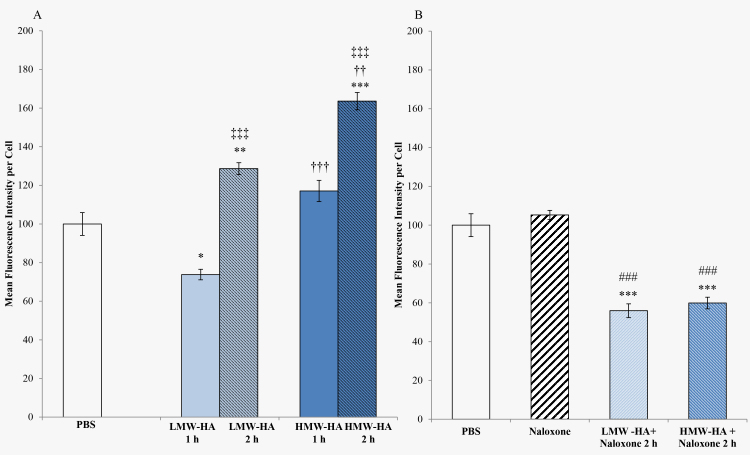
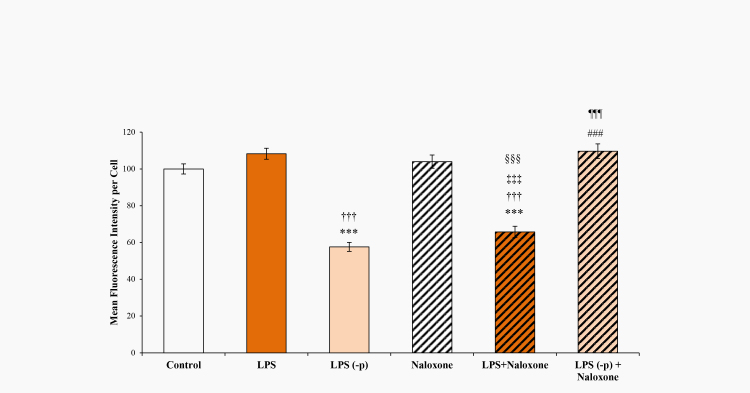
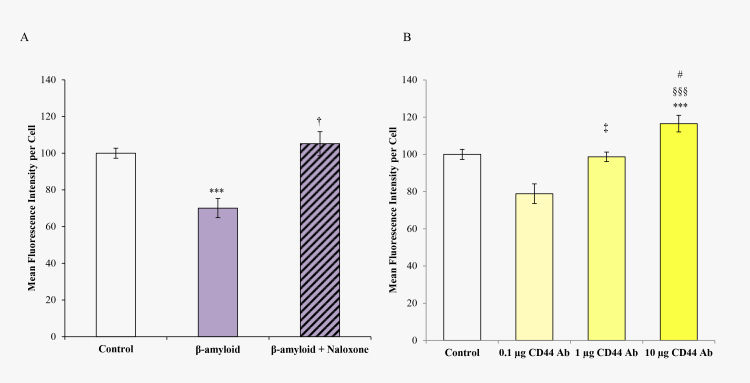
Verapamil, an ABCB1 inhibitor, significantly (p<0.001) increased fluorescent calcein retention in the cytoplasm of the TM and RAW 264.7 cells compared to the PBS control. Digoxin, an ABCB1 activator, increased calcein efflux (p<0.001). Lactate reduced ABCB1 activity. HMW-HA significantly (p<0.001) reduced ABCB1 activity, whereas LMW-HA decreased ABCB1 activity, and the HA effects were blocked by naloxone (p<0.001), a TLR4 inhibitor. LPS alone did not change ABCB1 activity whereas dephosphorylated LPS significantly (p<0.001) enhanced ABCB1 activity in the TM cells. β-amyloid significantly reduced ABCB1 activity, and the β-amyloid effects were blocked by naloxone.
TM cells are responsive to ABCB1 inhibitors and activators. ABCB1 functional activity is affected by TLR4 agonists suggesting that modulation of TLR4 is important in ABCB1 function. The innate immune inflammatory response in the TM may play a role in the ABCB1 detoxification of potentially harmful constituents in the aqueous humor.
房水滋养眼前节的无血管组织,小梁网(TM)在房水中内源性物质和外源性物质的流出中起作用。ATP(三磷酸腺苷)结合盒(ABC)转运蛋白超家族成员对缺氧、细胞因子信号传导和衰老等应激源有反应。TM内的固有免疫系统,特别是Toll样受体4(TLR4)及其配体,如低分子量透明质酸(LMW-HA)和脂多糖(LPS),在维持前房正常环境中起重要作用。我们假设固有免疫系统可能与ATP结合盒亚家族成员ABCB1(P-糖蛋白和多药耐药蛋白1)相互作用,以从房水和TM中清除外源性物质。
对人TM细胞、RAW 264.7巨噬细胞和PC12细胞的细胞裂解物进行蛋白质印迹分析。TM细胞TLR4、ABCB1和CYP3A5呈阳性,ABCC1转运蛋白呈阴性。将人TM细胞和RAW 264.7巨噬细胞以5000个细胞/孔接种在八孔培养载玻片上,在含10%胎牛血清(FBS)的细胞生长培养基中培养过夜。处理前2小时将培养基换成含0.1%FBS的培养基。用1和10 mM乳酸、100 ng LMW-HA(20 kDa)、100 ng高分子量HA(HMW-HA,1000 kDa)、100 ng LPS和/或100 μM纳洛酮刺激细胞0.5、1、2和4小时。加入乙酰氧基甲基钙黄绿素(钙黄绿素AM;0.25 μM)30分钟作为报告分子。加入钙黄绿素AM后,它被酯酶切割成一种荧光产物,通常由ABCB1转运出细胞。阳性对照为100 μM维拉帕米和50 μM地高辛。刺激后,将TM细胞在4℃用3%多聚甲醛固定15分钟,用Vectashield和4',6-二脒基-2-苯基吲哚(DAPI)封片剂封片,由一位不知情的观察者使用徕卡共聚焦显微镜和软件进行分析。
与PBS对照相比,ABCB1抑制剂维拉帕米显著(p<0.001)增加了TM和RAW 264.7细胞胞质中荧光钙黄绿素的保留。ABCB1激活剂地高辛增加了钙黄绿素的流出(p<0.001)。乳酸降低了ABCB1的活性。HMW-HA显著(p<0.001)降低了ABCB1的活性,而LMW-HA降低了ABCB1的活性,HA的作用被TLR4抑制剂纳洛酮阻断(p<0.001)。单独的LPS没有改变ABCB1的活性,而去磷酸化的LPS显著(p<0.001)增强了TM细胞中ABCB1的活性。β-淀粉样蛋白显著降低了ABCB1的活性,β-淀粉样蛋白的作用被纳洛酮阻断。
TM细胞对ABCB1抑制剂和激活剂有反应。ABCB1的功能活性受TLR4激动剂影响表明TLR4的调节对ABCB1功能很重要。TM中的固有免疫炎症反应可能在房水中潜在有害成分的ABCB1解毒中起作用。