Shi Yi-Wu, Min Fu-Li, Zhou Dong, Qin Bin, Wang Juan, Hu Fa-Yun, Cheung Ying-Kit, Zhou Jin-Hua, Hu Xiang-Shu, Zhou Jue-Qian, Zhou Lie-Min, Zheng Zhong-Zheng, Pan Jie, He Na, Liu Zhi-Sheng, Hou Yun-Qi, Lim Kheng-Seang, Ou Yang-Mei, Hui-Ping Khor Amy, Ng Ching-Ching, Mao Bi-Jun, Liu Xiao-Rong, Li Bing-Mei, Kuan Yao-Yun, Yi Yong-Hong, He Xue-Lian, Deng Xiao-Yan, Su Tao, Kwan Patrick, Liao Wei-Ping
Author affiliations are provided at the end of the article.
Neurology. 2017 Jun 6;88(23):2183-2191. doi: 10.1212/WNL.0000000000004008. Epub 2017 May 5.
To investigate the involvement of human leukocyte antigen (HLA) loci in aromatic antiepileptic drug-induced cutaneous adverse reactions.
A case-control study was performed to detect HLA loci involved in aromatic antiepileptic drug-induced Stevens-Johnson syndrome in a southern Han Chinese population. Between January 1, 2006, and December 31, 2015, 91 cases of Stevens-Johnson syndrome induced by aromatic antiepileptic drugs and 322 matched drug-tolerant controls were enrolled from 8 centers. Important genotypes were replicated in cases with maculopapular eruption and in the meta-analyses of data from other populations. Sequence-based typing determined the HLA-A, HLA-B, HLA-C, and HLA-DRB1 genotypes.
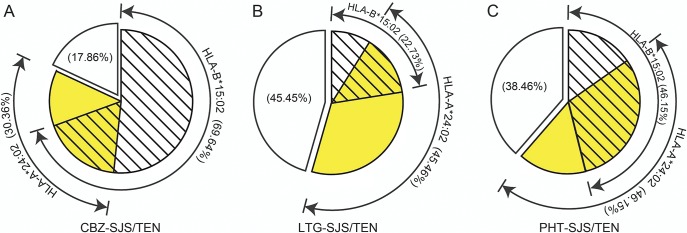
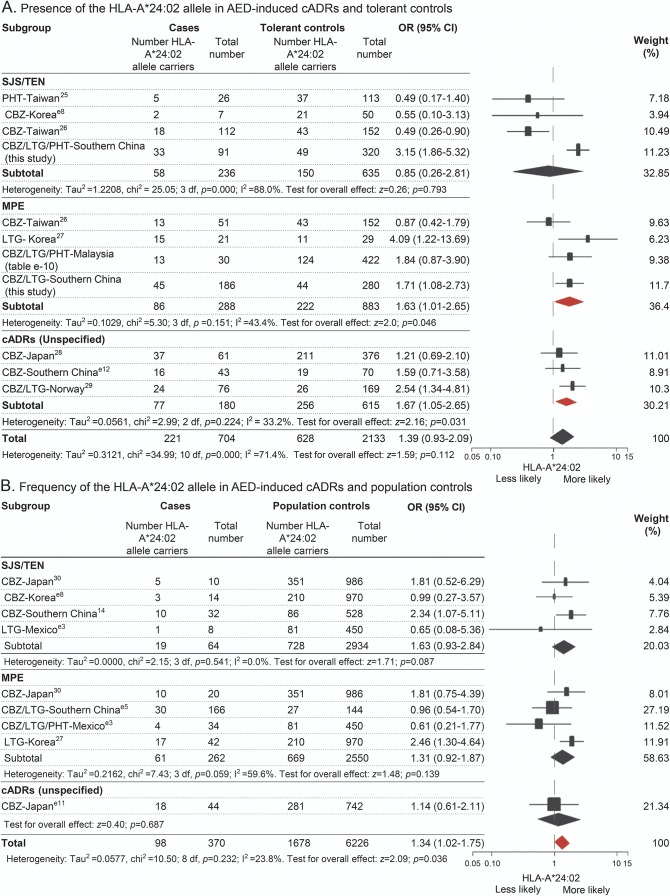
HLA-B15:02 was confirmed as strongly associated with carbamazepine-induced Stevens-Johnson syndrome ( = 5.63 × 10). In addition, HLA-A24:02 was associated significantly with Stevens-Johnson syndrome induced by the aromatic antiepileptic drugs as a group ( = 1.02 × 10) and by individual drugs (carbamazepine = 0.015, lamotrigine = 0.005, phenytoin = 0.027). Logistic regression analysis revealed a multiplicative interaction between HLA-B15:02 and HLA-A24:02. Positivity for HLA-A24:02 and/or HLA-B15:02 showed a sensitivity of 72.5% and a specificity of 69.0%. The presence of HLA-A*24:02 in cases with maculopapular exanthema was also significantly higher than in controls ( = 0.023). Meta-analysis of data from Japan, Korea, Malaysia, Mexico, Norway, and China revealed a similar association.
HLA-A*24:02 is a common genetic risk factor for cutaneous adverse reactions induced by aromatic antiepileptic drugs in the southern Han Chinese and possibly other ethnic populations. Pretreatment screening is recommended for people in southern China.
研究人类白细胞抗原(HLA)基因座与芳香族抗癫痫药物所致皮肤不良反应的关系。
进行一项病例对照研究,以检测汉族南方人群中与芳香族抗癫痫药物所致史蒂文斯-约翰逊综合征相关的HLA基因座。在2006年1月1日至2015年12月31日期间,从8个中心纳入了91例由芳香族抗癫痫药物引起的史蒂文斯-约翰逊综合征患者和322例匹配的药物耐受对照。在斑丘疹病例和来自其他人群的数据的荟萃分析中重复重要基因型。基于序列的分型确定了HLA-A、HLA-B、HLA-C和HLA-DRB1基因型。
HLA-B15:02被确认为与卡马西平所致史蒂文斯-约翰逊综合征密切相关(=5.63×10)。此外,HLA-A24:02与芳香族抗癫痫药物作为一个整体所致的史蒂文斯-约翰逊综合征(=1.02×10)以及与个别药物(卡马西平=0.015,拉莫三嗪=0.005,苯妥英=0.027)所致的史蒂文斯-约翰逊综合征显著相关。逻辑回归分析显示HLA-B15:02与HLA-A24:02之间存在相乘相互作用。HLA-A24:02和/或HLA-B15:02阳性显示敏感性为72.5%,特异性为69.0%。斑丘疹病例中HLA-A*24:02的存在也显著高于对照组(=0.023)。来自日本、韩国、马来西亚、墨西哥、挪威和中国的数据的荟萃分析显示了类似的关联。
HLA-A*24:02是汉族南方人群以及可能其他种族人群中芳香族抗癫痫药物所致皮肤不良反应的常见遗传危险因素。建议对中国南方人群进行治疗前筛查。