Wingfield Tom, Tovar Marco A, Huff Doug, Boccia Delia, Montoya Rosario, Ramos Eric, Datta Sumona, Saunders Matthew J, Lewis James J, Gilman Robert H, Evans Carlton A
Department of Clinical Infection, Microbiology and Immunology, Institute of Infection and Global Health, Ronald Ross Building, 8 West Derby Street, Liverpool, L69 7BE, England.
Innovation For Health And Development (IFHAD), Universidad Peruana Cayetano Heredia, Lima, Peru.
Bull World Health Organ. 2017 Apr 1;95(4):270-280. doi: 10.2471/BLT.16.170167. Epub 2017 Feb 9.
To evaluate the impact of socioeconomic support on tuberculosis preventive therapy initiation in household contacts of tuberculosis patients and on treatment success in patients.
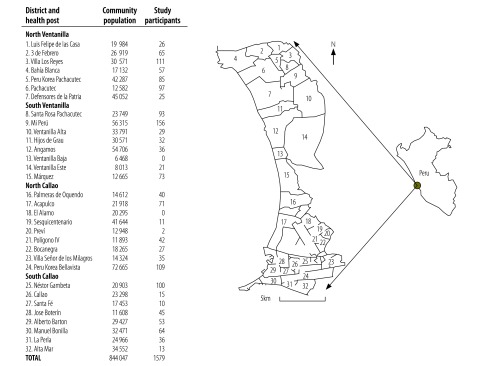
A non-blinded, household-randomized, controlled study was performed between February 2014 and June 2015 in 32 shanty towns in Peru. It included patients being treated for tuberculosis and their household contacts. Households were randomly assigned to either the standard of care provided by Peru's national tuberculosis programme (control arm) or the same standard of care plus socioeconomic support (intervention arm). Socioeconomic support comprised conditional cash transfers up to 230 United States dollars per household, community meetings and household visits. Rates of tuberculosis preventive therapy initiation and treatment success (i.e. cure or treatment completion) were compared in intervention and control arms.
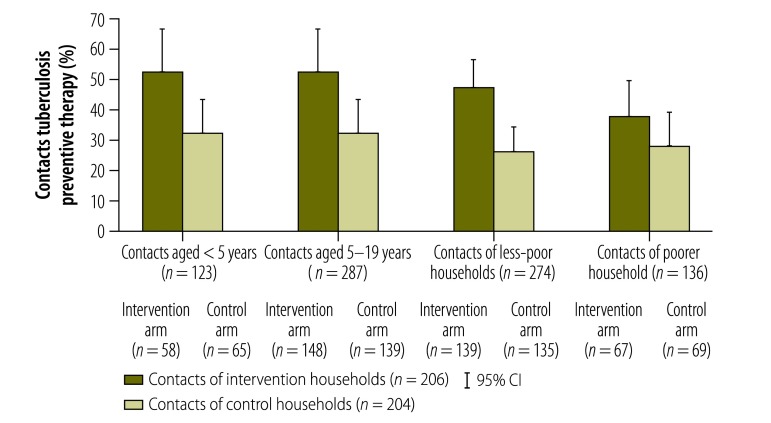
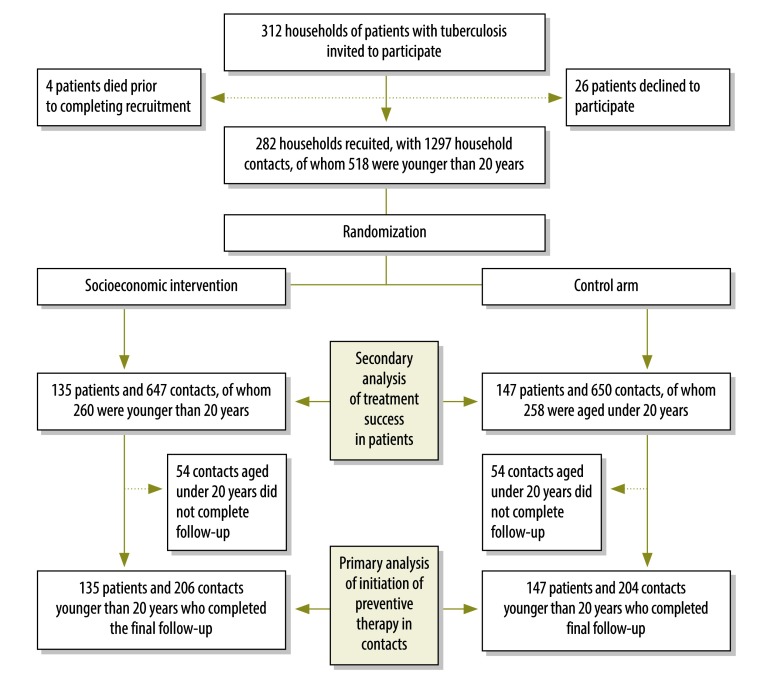
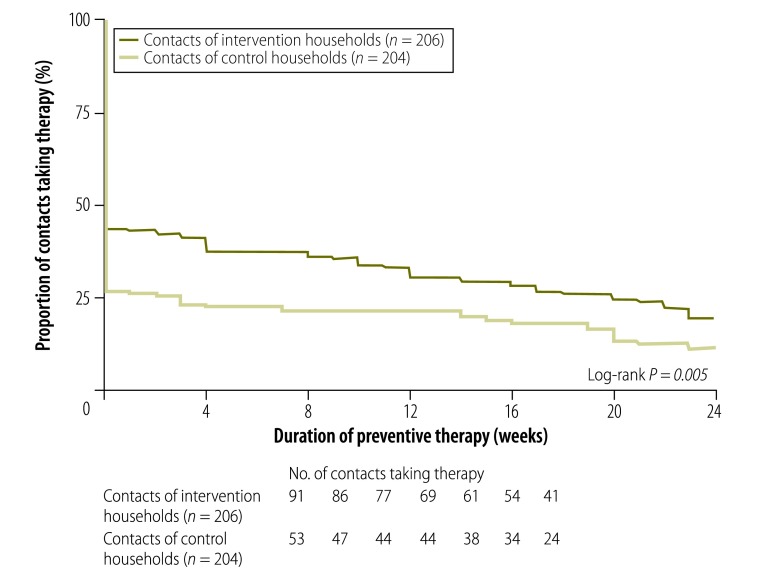
Overall, 282 of 312 (90%) households agreed to participate: 135 in the intervention arm and 147 in the control arm. There were 410 contacts younger than 20 years: 43% in the intervention arm initiated tuberculosis preventive therapy versus 25% in the control arm (adjusted odds ratio, aOR: 2.2; 95% confidence interval, CI: 1.1-4.1). An intention-to-treat analysis showed that treatment was successful in 64% (87/135) of patients in the intervention arm versus 53% (78/147) in the control arm (unadjusted OR: 1.6; 95% CI: 1.0-2.6). These improvements were equitable, being independent of household poverty.
A tuberculosis-specific, socioeconomic support intervention increased uptake of tuberculosis preventive therapy and tuberculosis treatment success and is being evaluated in the Community Randomized Evaluation of a Socioeconomic Intervention to Prevent TB (CRESIPT) project.
评估社会经济支持对结核病患者家庭接触者开始结核病预防性治疗以及对患者治疗成功的影响。
2014年2月至2015年6月期间,在秘鲁的32个棚户区开展了一项非盲法、家庭随机对照研究。研究对象包括正在接受结核病治疗的患者及其家庭接触者。家庭被随机分配至秘鲁国家结核病项目提供的标准治疗组(对照组)或相同标准治疗加社会经济支持组(干预组)。社会经济支持包括每户最高230美元的有条件现金转移、社区会议和家庭访视。比较干预组和对照组中结核病预防性治疗开始率和治疗成功率(即治愈或完成治疗)。
总体而言,312户家庭中有282户(90%)同意参与:干预组135户,对照组147户。有410名20岁以下的接触者:干预组43%的接触者开始了结核病预防性治疗,而对照组为25%(调整优势比,aOR:2.2;95%置信区间,CI:1.