Smith Kyle B, Kang Paul, Sabbagh Marwan N
Department of Neurology, Barrow Neurological Institute, Phoenix AZ.
University of Arizona Mel and Enid Zuckerman College of Public Health, Phoenix AZ.
Alzheimers Dement (N Y). 2017 Jun;3(2):149-156. doi: 10.1016/j.trci.2017.01.001.
This study's aims are to identify whether or not a relationship between statin use and rate of cognitive decline exists.
The relationship between statins and MCI has been investigated in the past with the evidence showing mixed results.
768 subjects were identified with MCI. Subjects were stratified into 6 possible groups according to ApoE4 status and statin use and assessed for decline in cognitive function.
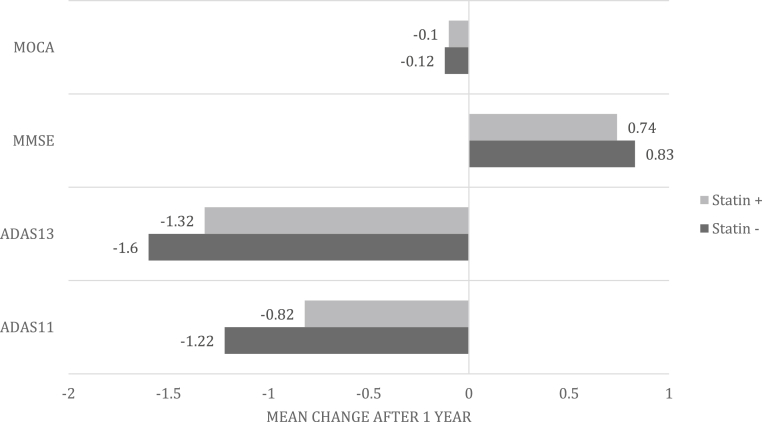
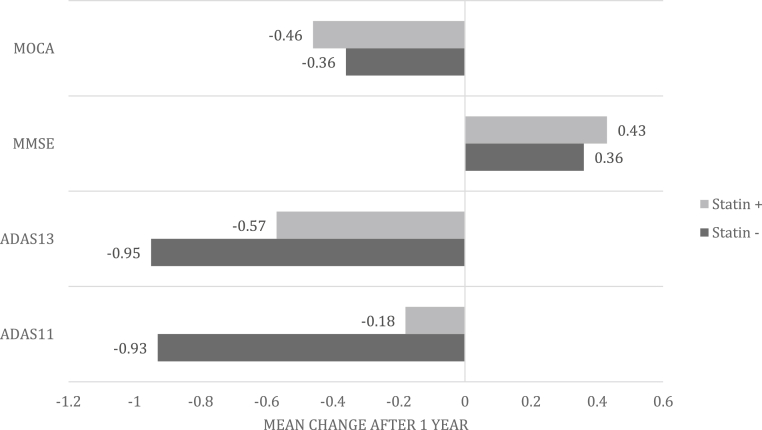
All cognitive assessments trended towards less decline with statin use. ADAS11 showed the biggest difference in mean change between statin users and nonusers (-0.82 vs. -1.22 respectively). Change reached marginal significance on the ADAS11 when stratified by ApoE4 negative subjects.
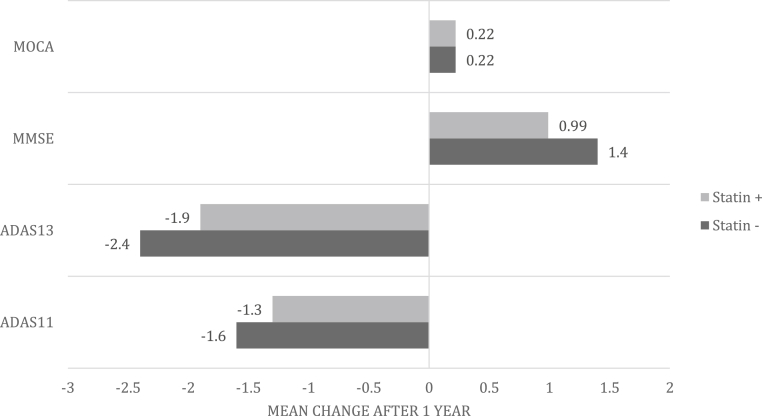
All cognitive assessments trended towards less decline when subjects were concurrently treated with a statin, supporting the position that statins do not have a net negative effect on cognitive assessment and suggests a potential treatment benefit.
本研究旨在确定他汀类药物的使用与认知功能衰退率之间是否存在关联。
过去已对他汀类药物与轻度认知障碍(MCI)之间的关系进行了研究,证据显示结果不一。
确定768名患有MCI的受试者。根据载脂蛋白E4(ApoE4)状态和他汀类药物的使用情况,将受试者分为6个可能的组,并对其认知功能衰退情况进行评估。
所有认知评估结果显示,使用他汀类药物的受试者认知衰退趋势较小。在阿尔茨海默病评定量表认知部分11项(ADAS11)中,使用他汀类药物者与未使用者的平均变化差异最大(分别为-0.82和-1.22)。按ApoE4阴性受试者分层时,ADAS11的变化达到边缘显著性。
当受试者同时接受他汀类药物治疗时,所有认知评估结果显示认知衰退趋势较小,这支持了他汀类药物对认知评估没有净负面影响的观点,并提示其可能具有治疗益处。