Department of Neuropsychiatry, Keio University School of Medicine, Tokyo, Japan; Research Fellow of Japan Society for the Promotion of Science, Tokyo, Japan.
Int J Neuropsychopharmacol. 2017 Jul 1;20(7):593-601. doi: 10.1093/ijnp/pyx031.
Organisms have evolved to approach pleasurable opportunities and to avoid or escape from aversive experiences. These 2 distinct motivations are referred to as approach and avoidance/escape motivations and are both considered vital for survival. Despite several recent advances in understanding the neurobiology of motivation, most studies addressed approach but not avoidance/escape motivation. Here we develop a new experimental paradigm to quantify avoidance/escape motivation and examine the pharmacological validity.
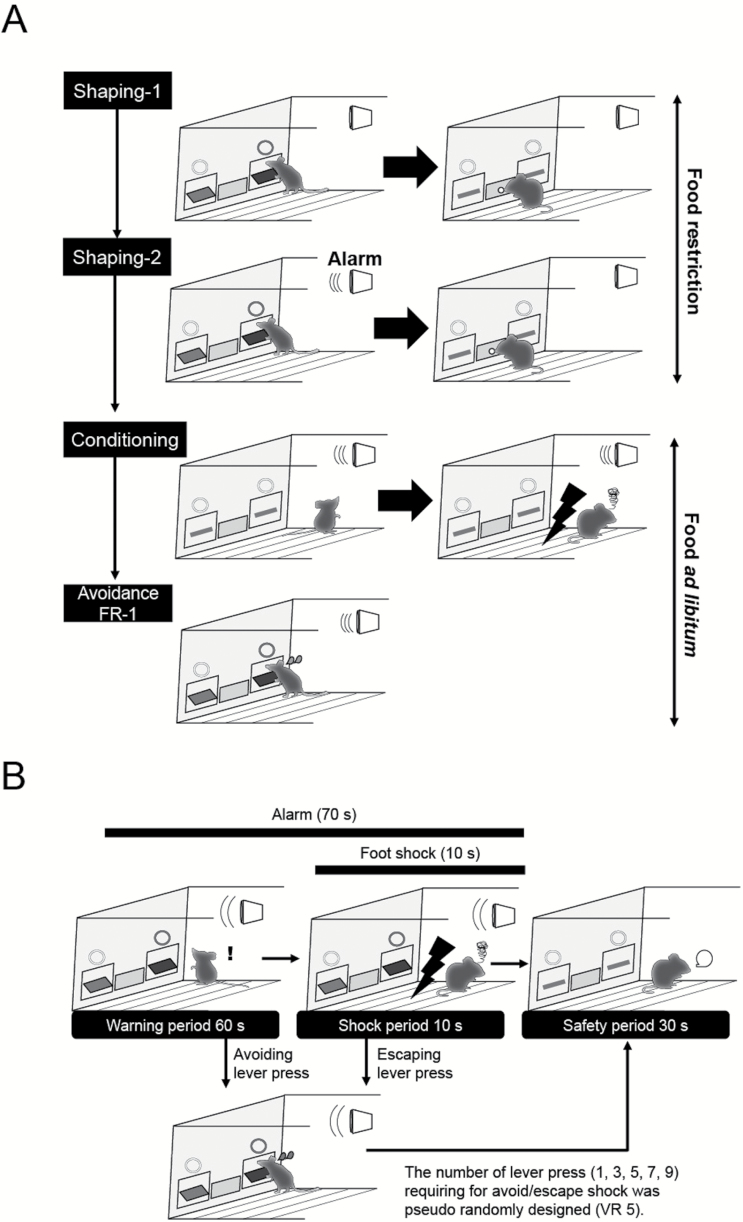
We set up an avoidance variable ratio 5 task in which mice were required to press a lever for variable times to avoid an upcoming aversive stimulus (foot shock) or to escape the ongoing aversive event if they failed to avoid it. We i.p. injected ketamine (0, 1, or 5 mg/kg) or buspirone (0, 5, or 10 mg/kg) 20 or 30 minutes before the behavioral task to see if ketamine enhanced avoidance/escape behavior and buspirone diminished it as previously reported.
We found that the performance on the avoidance variable ratio 5 task was sensitive to the intensity of the aversive stimulus. Treatment with ketamine increased while that with buspirone decreased the probability of avoidance from an aversive stimulus in the variable ratio 5 task, being consistent with previous reports.
Our new paradigm will prove useful for quantifying avoidance/escape motivation and will contribute to a more comprehensive understanding of motivation.
生物进化到接近愉快的机会,并避免或逃避不愉快的经历。这两种截然不同的动机被称为趋近动机和回避/逃避动机,它们都被认为对生存至关重要。尽管最近在理解动机的神经生物学方面取得了一些进展,但大多数研究都涉及趋近动机,而不是回避/逃避动机。在这里,我们开发了一种新的实验范式来量化回避/逃避动机,并检验其药理学有效性。
我们设置了一个回避可变比率 5 任务,要求小鼠按压杠杆以可变的时间来避免即将到来的不愉快刺激(足部电击),或者如果它们未能避免,逃避正在进行的不愉快事件。我们在行为任务前 20 或 30 分钟腹腔注射氯胺酮(0、1 或 5mg/kg)或丁螺环酮(0、5 或 10mg/kg),以观察氯胺酮是否增强回避/逃避行为,以及丁螺环酮是否如先前报道的那样减弱其行为。
我们发现,回避可变比率 5 任务的表现对不愉快刺激的强度敏感。氯胺酮治疗增加了回避可变比率 5 任务中对不愉快刺激的回避概率,而丁螺环酮治疗则降低了该概率,这与先前的报告一致。
我们的新范式将有助于量化回避/逃避动机,并有助于更全面地理解动机。