Shimoda Takahiro, Matsuzawa Ryota, Yoneki Kei, Harada Manae, Watanabe Takaaki, Matsumoto Mika, Yoshida Atsushi, Takeuchi Yasuo, Matsunaga Atsuhiko
Department of Rehabilitation Sciences, Kitasato University Graduate School of Medical Sciences, Sagamihara, Japan.
Department of Rehabilitation, Kitasato University Hospital, 1-15-1 Kitasato, Sagamihara, Kanagawa, 252-0375, Japan.
BMC Nephrol. 2017 May 8;18(1):154. doi: 10.1186/s12882-017-0569-7.
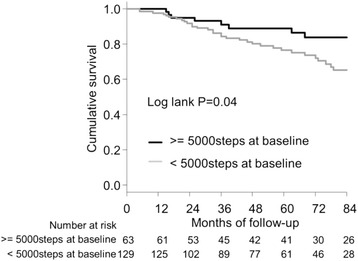
A previous cohort study indicated a significant association of lower baseline level of physical activity in hemodialysis patients with elevated risks of mortality. However, there have been no reports regarding the association between changes in physical activity over time and mortality in hemodialysis patients. This study was performed to examine the prognostic significance of physical activity changes in hemodialysis patients.
This retrospective cohort study was performed in 192 hemodialysis patients with a 7-year follow-up. The average number of steps taken per non-dialysis day was used as a measure of physical activity. Forty (20.8%) patients had died during the follow-up period. The percentage change in physical activity between baseline and 12 months was determined, and patients were divided into three categories according to changes in physical activity. A decrease or increase in physical activity > 30% was defined as becoming less or more active, respectively, while decrease or increase in physical activity < 30% were classified as stable.
Forty seven (24.5%), 51 (26.6%), and 94 (49.0%) patients were classified as becoming less active, becoming more active, and stable, respectively. The hazard ratio on multivariate analysis in patients with decreased physical activity was 3.68 (95% confidence interval, 1.55-8.78; P < 0.01) compared to those with increased physical activity.
Reductions in physical activity were significantly associated with poor prognosis independent of not only patient characteristics but also baseline physical activity. Therefore, improved prognosis in hemodialysis patients requires means of preventing a decline in physical activity over time.
先前的一项队列研究表明,血液透析患者较低的基线身体活动水平与死亡风险升高显著相关。然而,关于血液透析患者身体活动随时间的变化与死亡率之间的关联尚无报道。本研究旨在探讨血液透析患者身体活动变化的预后意义。
本回顾性队列研究纳入了192例血液透析患者,进行了7年的随访。将每个非透析日的平均步数用作身体活动的衡量指标。40例(20.8%)患者在随访期间死亡。确定了基线和12个月时身体活动的百分比变化,并根据身体活动的变化将患者分为三类。身体活动减少或增加>30%分别定义为变得不那么活跃或更活跃,而身体活动减少或增加<30%则归类为稳定。
分别有47例(24.5%)、51例(26.6%)和94例(49.0%)患者被归类为变得不那么活跃、变得更活跃和稳定。与身体活动增加的患者相比,身体活动减少的患者在多变量分析中的风险比为3.68(95%置信区间,1.55 - 8.78;P < 0.01)。
身体活动的减少与不良预后显著相关,这不仅独立于患者特征,还独立于基线身体活动。因此,改善血液透析患者的预后需要采取措施防止身体活动随时间下降。