Nakano Yusuke, Aso Hirofumi, Soper Andrew, Yamada Eri, Moriwaki Miyu, Juarez-Fernandez Guillermo, Koyanagi Yoshio, Sato Kei
Laboratory of Systems Virology, Department of Biosystems Science, Institute for Frontier Life and Medical Sciences, Kyoto University, 53 Shogoinkawara-cho, Sakyo-ku, Kyoto, 6068507, Japan.
Faculty of Pharmaceutical Sciences, Kyoto University, Kyoto, Japan.
Retrovirology. 2017 May 8;14(1):31. doi: 10.1186/s12977-017-0355-4.
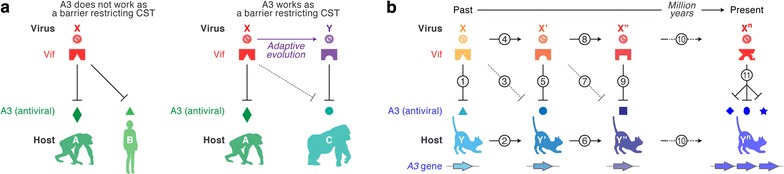
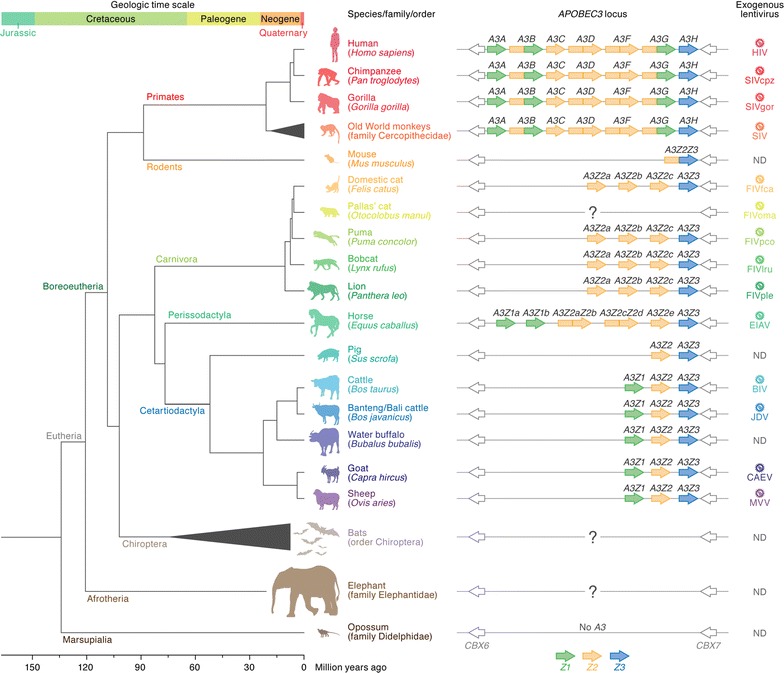
Apolipoprotein B mRNA editing enzyme catalytic polypeptide-like 3 (APOBEC3) proteins are mammalian-specific cellular deaminases and have a robust ability to restrain lentivirus replication. To antagonize APOBEC3-mediated antiviral action, lentiviruses have acquired viral infectivity factor (Vif) as an accessory gene. Mammalian APOBEC3 proteins inhibit lentiviral replication by enzymatically inserting G-to-A hypermutations in the viral genome, whereas lentiviral Vif proteins degrade host APOBEC3 via the ubiquitin/proteasome-dependent pathway. Recent investigations provide evidence that lentiviral vif genes evolved to combat mammalian APOBEC3 proteins. In corollary, mammalian APOBEC3 genes are under Darwinian selective pressure to escape from antagonism by Vif. Based on these observations, it is widely accepted that lentiviral Vif and mammalian APOBEC3 have co-evolved and this concept is called an "evolutionary arms race." This review provides a comprehensive summary of current knowledge with respect to the evolutionary dynamics occurring at this pivotal host-virus interface.
载脂蛋白B信使核糖核酸编辑酶催化多肽样3(APOBEC3)蛋白是哺乳动物特有的细胞脱氨酶,具有强大的抑制慢病毒复制的能力。为了对抗APOBEC3介导的抗病毒作用,慢病毒获得了病毒感染因子(Vif)作为辅助基因。哺乳动物的APOBEC3蛋白通过在病毒基因组中酶促插入G到A的超突变来抑制慢病毒复制,而慢病毒的Vif蛋白则通过泛素/蛋白酶体依赖性途径降解宿主APOBEC3。最近的研究提供了证据表明慢病毒vif基因的进化是为了对抗哺乳动物的APOBEC3蛋白。相应地,哺乳动物的APOBEC3基因处于达尔文选择压力之下,以逃避Vif的拮抗作用。基于这些观察结果,人们普遍认为慢病毒Vif和哺乳动物APOBEC3是共同进化的,这一概念被称为“进化军备竞赛”。本综述全面总结了关于在这个关键的宿主-病毒界面发生的进化动态的当前知识。